







Renovation Report: Archaeological Finds from HNOC’s 714 Toulouse Street Courtyard
Curator Lydia Blackmore shares details about about artifacts found during the renovation of our 533 Royal Street campus.

By Lydia Blackmore, curator
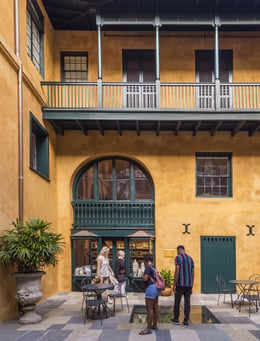
As HNOC works to restore and reopen its original 533 Royal Street campus, clues to the site’s history abound—some in plain sight, others tucked away in hidden layers. Staff had long wondered why a small courtyard behind the Townhouse at 714 Toulouse Street was nearly 40 inches higher than the other courtyards on the site. Exhibition plans for 533 Royal will lead visitors through this courtyard, which is being lowered to improve flow. Before construction began, HNOC contracted Chronicle Heritage to conduct an archaeological investigation of the courtyard, which is enclosed by the Townhouse, Service Wing, Williams Residence, and an alley wall.

As it turned out, the explanation for the courtyard’s unusual elevation was rather boring—a 1960s drainage solution—but once digging started, the archaeologists found more evidence of a rich and complex human history, excavating 1.4 meters of earth before hitting the water table. They uncovered and processed 902 artifacts, each enhancing our understanding of the people who lived and worked on this site from the 18th to the mid-20th centuries.
The artifacts fall into three periods of heavy use on the site. From about 1730 to 1750 a French colonial barracks extended along Toulouse Street between Royal and Bourbon Streets. In this layer, archaeologists uncovered a brick and cobblestone gutter, which supported drainage around the barracks; a gunflint from early weaponry; and French ceramics used for everyday cooking and eating.


Between 1794 and 1818, the courtyard facilitated the work of laborers enslaved by the Merieult family. Here Julie, Henriette, and others cooked, washed dishes, and butchered animals out of sight of the formal living and business areas. In this layer, archaeologists uncovered animal bones, shells, and broken dishes, glassware, and wine bottles. They also found evidence of the Merieult family’s wealth and global connections: A glass perfume bottle from Paris and a silver spoon made in London and marked with Jean-François Merieult’s initials indicate access to luxury goods from around the world.
The current building at 714 Toulouse Street was constructed by 1829. Archaeologists found very few objects from its first 60 years, when the structure was home to the Consolidated Association of the Planters of Louisiana. But the layer connected with the period from the 1880s through 1920s, when the property was a boardinghouse, yielded plentiful evidence of the men and women who lived here. A plastic comb, shell buttons, and a Lea and Perrins Worcestershire sauce bottle are evidence of less affluent residents of the early 20th century.
Some of the artifacts from the excavation will be on display in the Townhouse when it opens to the public after the renovation, restoration, and reimagination of the 533 Royal Street campus.
Learn More
Restore, Renew, Reimagine Campaign
Follow and support the campaign to transform HNOC’s campus at 533 Royal Street.


Explore the Restoration
Learn more about the exciting transformations coming to HNOC’s campus at 533 Royal Street.

Support the Campaign
Explore ways you can get involved through tax-deductible donations, naming opportunities, and more.

Follow Our Progress
Read the latest about the restoration, from archaeological finds to project milestones.
Subscribe to Campaign Updates
