






Cosimo at 100
The Sound That Shaped New Orleans
Panel: 1–2:30 p.m. (Williams Research Center, 410 Chartres Street)
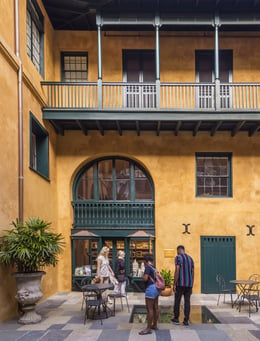
Party: 2:30–4 p.m. (Tricentennial Wing, 520 Royal Street)
Free and open to the public
Join us in celebrating the 100th birthday of Cosimo Matassa (1926–2014), architect of the New Orleans sound! American Routes host Nick Spitzer will lead a slate of special guests—including music scholar Matt Sakakeeny and legendary New Orleans musician Deacon John Moore—in conversation about Matassa’s life and legacy.
After the discussion, join us at 520 Royal Street for a birthday celebration featuring the Mahogany Blue Baby Dolls and DJ Buy It Now, who will spin hits from Matassa’s J&M Recording Studio. While the music plays, attendees are invited to grab a slice of cake and design their own custom album covers.
Don’t miss this special opportunity to cool off during French Quarter Fest while honoring a local legend. Admission is free and open to the public; no registration is required.
About Cosimo Matassa
Born in New Orleans 1926, Cosimo Matassa was an Italian American recording engineer and studio owner who played a seminal role in shaping the New Orleans sound of R&B and early rock ’n’ roll. In 1945, at age 18, he co-founded J&M Music Shop and Amusement Service with partner Joseph Mancuso. Matassa converted the back room at 838 North Rampart Street into J&M Recording Studio in 1946, and over the next decade, J&M became the epicenter of New Orleans music, producing national hits. In 1956, Matassa relocated to a larger space at 525 Governor Nicholls Street, renaming it Cosimo Recording Studio. Matassa recorded a diverse roster of artists, including Professor Longhair, Fats Domino, Little Richard, Roy Brown, Guitar Slim, Aaron Neville, Ray Charles, and more. His legacy was honored with inductions into the Louisiana Music Hall of Fame (2007) and Rock & Roll Hall of Fame (2012).
Cosimo Birthday Playlist
Speakers

“Deacon” John Moore
“Deacon” John Moore
“Deacon” John Moore is an iconic New Orleans figure: a powerhouse guitarist and smooth vocalist whose band, the Ivories, has been in demand at proms, weddings, Carnival balls, and festivals for decades. He’s an old school bluesman at heart, but can effortlessly slide from New Orleans R&B to gospel to disco to contemporary pop. He hasn’t had the recording career or touring life that would put him on the mainstream map, but he is a legend nonetheless.
Moore, one of 13 children, grew up in a musical household, and was influenced as much by the blues music he heard over late night radio—Bo Diddley and Howlin’ Wolf—as he was by the fertile New Orleans music scene around him, burgeoning with stars like Little Richard, Shirley and Lee, and Fats Domino.
In the late 1950s, he honed his guitar chops—and his reputation—playing in the house band at the legendary Dew Drop Inn, as a session man for Allen Toussaint at Cosimo Matassa’s J & M Studios, and backing then-rising stars like Aaron and Art Neville, Irma Thomas, Lee Dorsey, and Ernie K-Doe. He was given the nickname “Deacon” by a band member, and even though he didn’t like it at first, it stuck, and now the entire city is on first name terms with “Deke.”
He formed his own band in 1960, where both his showmanship and leadership flourished. Over the years, Deacon John and the Ivories became a staple at New Orleans’s many social events. The band is also known somewhat as a farm team; members have included James Booker, various Neville brothers, James Rivers, and Moore’s own family members, including guitarist son Charles and granddaughter Kathleen, who now sings with the WWII Museum’s Victory Belles.
Moore is a crowd favorite at the annual Jazz and Heritage Festival, has played at the White House and at gubernatorial inaugurations, and is an inductee in the Louisiana Music Hall of Fame. He’s the subject of the documentary film, Going Back to New Orleans: The Deacon John Film and a 2003 concert CD, Deacon John’s Jump Blues. He’s not famous on the world stage; as he told National Public Radio, “I never had a hit record and I never been on tour, and I never played in all these foreign countries. Many of my contemporaries have. I'm just one of the guys who stayed around here and made a living playing music.”
In addition to his leadership on the bandstand, Moore is also a behind-the-stage leader as the longtime president of the local branch of the American Federation of Musicians, the first African American to hold that role. He has also made acting appearances in the 1987 film Angel Heart, a cameo in the 2013 The Last Exorcism Part II, and as a guest star on several episodes of HBO’s Treme miniseries.

Matt Sakakeeny
Matt Sakakeeny
Matt Sakakeeny is an associate professor and chair of the Department of Music at Tulane University. He is an anthropologist studying music and sound in relation to structures of inequality in the United States. Sakakeeny is the author of Roll with It: Brass Bands in the Streets of New Orleans and co-author of the edited collections Keywords in Sound and Remaking New Orleans: Beyond Exceptionalism and Authenticity. He has received grants from the Spencer Foundation and the National Humanities Center for his next book about school marching bands in New Orleans. Sakakeeny has lived in New Orleans since 1997 and is a board member of two nonprofit organizations, the Roots of Music afterschool program and the Dinerral Shavers Educational Fund.

Nick Spitzer
Nick Spitzer
Nick Spitzer is a folklorist and a professor of anthropology and American studies at Tulane University. He specializes in American music and the cultures of the Gulf South, and received a PhD in anthropology from the University of Texas in 1986, with a dissertation on zydeco music and Afro-French Louisiana culture and identities. As Louisiana State Folklorist (1978–85), he created films, festivals, exhibits, and recordings of regional music, and he co-produced a 90-minute Folk Festival USA special on Louisiana music for NPR, helping to bring Cajun music and zydeco to national visibility. Spitzer directed the film Zydeco: Creole Music and Culture in Rural Louisiana (1986) and has produced or annotated two dozen documentary sound recordings. In 2002 he co-curated Raised to the Trade: Creole Building Arts of New Orleans at the New Orleans Museum of Art. His weekly radio show, American Routes, reaches nearly a million listeners each week on more than 268 stations and via its website.
More on Matassa
The French Quarter That Made Cosimo Matassa
Before his recording studio changed the course of American popular music, Cosimo Matassa grew up in a teeming French Quarter community that no longer exists.

Related Shortcut Talk
The New Orleans Sound: From R&B to Rock ’n’ Roll
In this talk, explore how New Orleans musicians evolved the rhythms and soul of jazz into new American genres that took the world by storm.

Related Stories

Following the Beat on the Street
HNOC charts the evolution of New Orleans brass bands from their Civil War–era origins up to today.

Keeping the Beat
Music educators are working to ensure that New Orleans’s marching band tradition continues for generations to come.
Related Collection Highlights

Vintage Tipitina’s Posters
HNOC cataloger Emily Perkins picks her favorites from the Tipitina’s posters in the Michael P. Smith Collection.

The Fat Man / Detroit City Blues
Fats Domino’s first single, produced in New Orleans, is considered one of the first rock ’n’ roll songs in history.

Leigh “Little Queenie” Harris Collection
A new collection documents the career of a “little” woman who made a big impact on New Orleans music.
Related Virtual Exhibitions

New Orleans Medley: Sounds of the City
The music of New Orleans is the living product of dynamic cultural interactions played out over centuries in this diverse southern port city.

Shout, Sister, Shout!: The Boswell Sisters of New Orleans
Explore the musical legacy of New Orleans’s own Boswell Sisters, who where among the first stars of radio’s golden age.
Related Books

Ernie K-Doe: The R&B Emperor of New Orleans
by Ben Sandmel
with a foreword by Peter Guralnick

French Baroque Music of New Orleans
edited by Alfred E. Lemmon
with essays in English by Jennifer Gipson, Andrew Justice, Alfred E. Lemmon, and Mark McKnight, and in French by Jean Duron
Subscribe to Our Newsletter
