







HNOC Hosts Her Majesty Queen Sofía of Spain for America&Spain250 Symposium
Presented September 24–26, the symposium offered an engaging exploration of Spanish Louisiana’s strategic, social, and cultural role during the American Revolution.

 Spain and the American Revolution along the Mississippi River
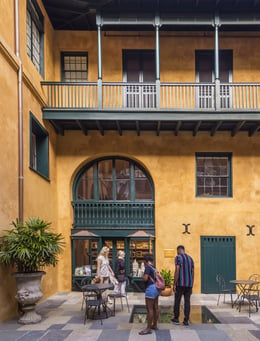
From September 24–26, the Historic New Orleans Collection (HNOC) was proud to welcome Her Majesty Queen Sofía of Spain for the America&Spain250 Symposium, “Spain and the American Revolution Along the Mississippi River.”
Featuring distinguished scholars from both sides of the Atlantic, the symposium offered a rigorous and engaging exploration of Spanish Louisiana’s strategic, social, and cultural role during the American Revolution. Sessions held at HNOC’s Williams Research Center on Saturday, September 26, explored Spain’s pivotal contributions to the American Revolution. The symposium also incorporated the opening of the exhibition Spain, Spanish America, and the Atlantic World in an Age of Revolution, hosted by Tulane University, and keynote remarks and presentations hosted by St. Louis Cathedral and the Cabildo.
The symposium was presented by the Queen Sofía Spanish Institute and HNOC in collaboration with Fundación Ramón Areces and Fundación Reina Sofía with support from the Cultural Office of the Embassy of Spain in the United States and the Consulate General of Spain in Houston.
Learn more in media coverage of the event below.
Related Stories

How the Enlightenment Shaped Spanish New Orleans
Inspired by the Enlightenment, King Carlos III enacted broad-ranging reforms across the Spanish empire, leading to major improvements in New Orleans.

How “Bloody” was O’Reilly?
Earlier historians called Alejandro O’Reilly an “executioner” because of his role in quelling the 1768 rebellion against Spanish rule. HNOC reevaluates the infamous governor’s legacy.
Related Collection Highlights

Bernardo de Gálvez Patent of Nobility
This beautiful document from a grateful king extols Gálvez’s virtues as a soldier and as a man.

Historic Maps from “Cartographic Legacies”
Maps are more than visual representations of landscapes and geographic features; they’re also storytellers.
Related Books


Subscribe to Our Newsletter
