









How the Fires of 1788 and 1794 Changed New Orleans
Exhibition Shortcuts Video
Two great fires destroyed large portions of New Orleans during the city’s Spanish colonial era, spurring changes that can still be seen today.
Story by Kurt Owens, Visitor Services interpreter; video by Xiomara Blanco, media producer
November 10, 2022
The Historic New Orleans Collection continues its Exhibition Shortcuts YouTube series with a video that examines the two great fires that struck New Orleans during its Spanish colonial era. The series, produced in conjunction with the exhibition Spanish New Orleans and the Caribbean, provides brief talks similar to what you would hear from our Visitor Services staff in the gallery. Live tours of the exhibition are offered in HNOC’s Tricentennial Wing at 520 Royal Street on Thursdays and Saturdays at 2:30 p.m. Admission is free and no registration is required.

Transcript
Throughout history, great cities have been destroyed by great fires. London. New York. Chicago. Great fires that brought about great changes.
Spanish colonial New Orleans also experienced great fires—two, in fact—in 1788 and 1794. Out of those disasters, the city was reborn—a New Orleans that was safer, more urban, and more prepared for the expansion and growth that followed.
The first fire began in the afternoon on March 21, 1788. Fed by strong winds, the flames eventually destroyed 856 of the over 1,100 buildings in the city.
In that fire, most of the buildings lost were made of wood, but those included some of the city’s most prominent structures: the church and presbytery, along with numerous church records; the municipal building; the barracks; the armory with all its arms; most of the businesses, including all of the bakeries; and many of the principal mansions of the city.
The Spanish administration sprang into action, arranging for temporary housing in tents and providing rations for those who had lost everything.
The city survived and began to rebuild, but just six years later, the second fire destroyed over 200 buildings. This second, smaller fire of December 8, 1794, began in nearly the same area and destroyed much of what had just been rebuilt.
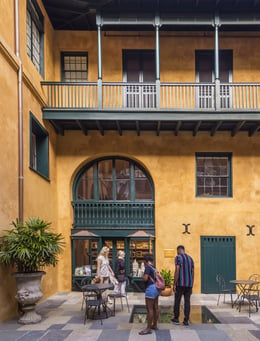
After the fires, the government sought to prevent a third great fire. They created fire patrols, employing both white and free Black militia members. They developed new building codes that required slate or tile roofs and walls of stronger bricks covered with stucco. And with the new buildings set flush to the sidewalks, there were no more gardens and yards surrounding them to catch fire. Interior courtyards were accessed through narrow alleyways or carriageways, and balconies held iron railings.
New Orleans not only proved safer thanks to these building codes, but it also took on a new look, as houses were rebuilt in different styles than before. What had been an almost pastoral, French-looking town began to resemble cities throughout the Spanish American empire, like Havana, San Juan, and Cartagena.
Although destructive, the fires paved the way for the city’s growth over the next decade. The economy and population of New Orleans increased, leading to a denser city center with more and taller buildings and expansion beyond the confines of the old Quarter.
If you’d like to learn more about this and other topics related to our exhibition Spanish New Orleans and the Caribbean, join us at the Historic New Orleans Collection at 520 Royal Street in the French Quarter. Visit our website for more details.
Don’t want to miss the next video? Subscribe to HNOC’s YouTube channel here.
Related Stories

How “Bloody” was O’Reilly?
Earlier historians called Alejandro O’Reilly an “executioner” because of his role in quelling the 1768 rebellion against Spanish rule. HNOC reevaluates the infamous governor’s legacy.

How Did Louisiana Become Spanish?
A new video untangles the web of war, family ties, and secret pacts that brought Louisiana under Spanish control.
Related Collection Highlights

Bernardo de Gálvez Patent of Nobility
This beautiful document from a grateful king extols Gálvez’s virtues as a soldier and as a man.

Historic Maps from “Cartographic Legacies”
Maps are more than visual representations of landscapes and geographic features; they’re also storytellers.
Related Books

New Orleans Stories,
Delivered to Your Inbox
