




“For instance, suppose a plaintiff known as Dubois
Somehow engages the services of an attorney
To prosecute a defendant known as Kowalski . . .”
From “Kicks”

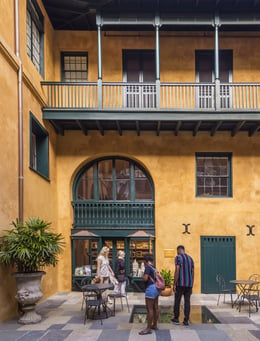
Enjoy free admission every day. Visit the museum, shop, and café, or resesarch our collections at the Williams Research Center.
Explore the world of the legendary New Orleans artist and his iconic characters, Vic and Nat’ly. On view until May 9, 2027.
On November 7, our 2026 Food Forum and Food Fête tasting event will explore the origins and deep community connections of Louisiana’s official state dish, led by renowned food historian Dr. Jessica B. Harris.
Dive into the Collection’s holdings with image-rich previews of treasures from New Orleans history.
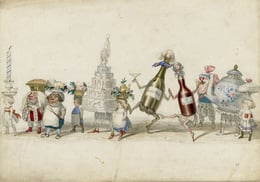
On October 31, chess lovers of all ages are invited to join us for our fifth-annual Chess Fest, offering a day of free activities, including a beginner-friendly chess tournament, a “human chess” game, Halloween costume contest, chessboard crafting, and much more!
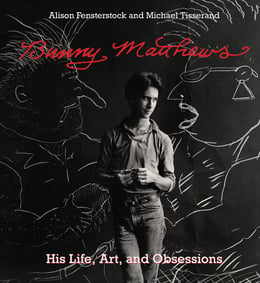
The bold personality of New Orleans’s legendary cartoonist and writer springs from the page in this first monograph of his work by Alison Fensterstock and Michael Tisserand.
On October 29, join us in celebrating six decades of preserving, collecting, and making history. Save the date for music, memories, and more at what is sure to be a fantastic night out in the French Quarter.

Founded in 1998, the Tennessee Williams Annual Review remains the only journal devoted to the works, worldwide influence, and cultural context of one of the most pivotal playwrights of the 20th century. Many issues showcase a previously unpublished work by Williams.
“For instance, suppose a plaintiff known as Dubois
Somehow engages the services of an attorney
To prosecute a defendant known as Kowalski . . .”
From “Kicks”
The iconic Streetcar Named Desire characters Blanche DuBois and Stanley Kowalski face off in court in Tennessee Williams’s poem “Kicks,” an archival gem that appears here in print for the first time. Biographical and textual introductions contextualize the poem, written during the challenging years of the playwright's late career. Inside, essays question Tom Wingfield’s memory in The Glass Menagerie, listen for Williams’s echoes of John Donne, explore archives in six states in order to track the playwright’s power struggle with Elia Kazan over Sweet Bird of Youth, and invite readers to experience a colorful and terrifying Viennese production of A Streetcar Named Desire.
HNOC 2021
softcover • 6" × 9" • 144 pp.
1 color image
ISSN 1097-6035
ISBN 978-0-917860-87-4
$15.00
The essay situates the poem “Kicks” in the context of Tennessee Williams’s frustration with his public image as a playwright whose best work was behind him and with critics’ and audiences’ poor reception of his avant-garde late-career plays and prose.
An introduction to the first-time publication of Tennessee William’s poem “Kicks,” written by the poem’s editor. The essay describes the editor’s process of finding and assembling the poem from archived pages and includes details about the manuscript. The essay also points out references in the poem to Williams’s plays and to elements in his biography, in particular a writeup of his play This Is (An Entertainment) in After Dark magazine.
First-time publication of Tennessee Williams’s poem “Kicks,” in which A Streetcar Named Desire characters Blanche DuBois and Stanley Kowalski meet in court. Includes fragments of draft versions. Available in print edition only.
While the early modern English poet John Donne is neither a source for nor influence on Tennessee Williams in the traditional sense, this essay argues that Williams’s work can be understood to be in conversation with Donne: in particular, in both authors’ themes and imagery of the conflicting but interdependent roles played by spirituality and physical sexuality in human happiness and of the (im)possibility of achieving that happiness in a society focused exclusively on money and power. The essay tracks references to and the implicit presence of Donne’s work during formative years in Williams’s life and then puts works alongside each other to demonstrate resonances. Among other plays, Williams’s Battle of Angels and Summer and Smoke are examined alongside Donne’s “Aire and Angels,” “The Canonization,” “The Sunne Rising,” and other poems.
“Unconscious Acts of Aggression”: Tennessee Williams, Elia Kazan, and Key Rewritings of Sweet Bird of Youth
Critics rarely explore in depth Tennessee Williams’s somewhat radical 1961 reworking of his play Sweet Bird of Youth, eventually published as the Dramatists Play Service acting edition. The 1961 revision adds value not only in and of itself but also from its evident attempt to salvage parts of what this essay calls “the Ghost Esquire Draft”: a more full-bodied manuscript of late 1958, created for Esquire magazine but never published. Instead, the magazine published a significantly different version of Sweet Bird in 1959. Putting the 1961 revision alongside its antecedent version of 1958 and other archival texts offers important insight into the author’s process and into Elia Kazan’s role in the Broadway script in particular, fleshing out scholars’ understanding of Williams’s working relationship with Kazan.
Manufactured Memory and the Staging of Two Toms: The Absent Narrator in The Glass Menagerie
The essay looks closely at Tennessee Williams’s “memory play,” The Glass Menagerie, focusing in particular on scenes whose dialogue has not been remembered but instead wholly invented by the character of the narrator, Tom Wingfield, who subtly fills in words and action he was not present to witness. The essay proposes that the scenes and their possible exaggerations and omissions be read as intentional and thus as revealing of the character himself—in particular, of Tom’s fixation on and inability to free himself from his feelings of guilt regarding his family.
Endstation Sehnsucht (A Streetcar Named Desire), directed by Pınar Karabulut
Review of Endstation Sehnsucht (A Streetcar Named Desire), written by Tennessee Williams, translated by Helmar Harald Fischer, directed by Pınar Karabulut, 16 September 2019, Volkstheater, Vienna, Austria. Production featured cisgender drag, an onstage waterfall, and other elements of gender fluidity and whimsical artifice that destabilized the familiar and highlighted the play’s gender politics.
Subscribe to Our Newsletter
Although submissions are welcomed at any point, August 15 serves as the deadline for those wishing to have work published in March of the following year.
The Tennessee Williams Annual Review invites academic writing on all aspects of the Williams oeuvre, including his plays, poetry, prose, and correspondence. Studies of the productions of his plays and technical analyses of stagecraft and institutional issues are also welcome. Founded in 1998, the journal routinely publishes brief texts that emerge from the ongoing examination of Williams’s literary records (usually draft versions of plays). Of particular interest is the history of the reception of Williams’s work—and the public persona cultivated by the author—in the postwar Broadway renaissance and in the period roughly from 1940 to 1980, in the US and abroad. Also of interest are the lasting effects of Williams’s work on the cinema of the 1950s and after. The editors are also eager to consider work devoted to present-day productions of recently discovered and newly edited texts.
In addition to work that focuses primarily on Williams, the journal is interested in studies of his contemporaries—of playwrights and other creative personnel as well—and of relevant issues (e.g., the queer history of the period). Especially welcome is scholarship that draws on archival sources and helps illuminate the material history of Williams’s literary output, as well as the culture his work and public persona both reflected and shaped.
Specifications
All submissions should be 4,500 to 9,000 words long, including notes but not including works cited, and should follow the most recent MLA guidelines.
Please prepare submissions in a recent version of Microsoft Word and send them as email attachments to Margit Longbrake, managing editor (Margit.Longbrake@hnoc.org).
Author anonymity: Authors should redact their names from their essays before submission, and notes or references to the author’s previous work should be in the third person. The journal will make every effort to respect the privacy of reviewers and readers of manuscripts submitted for review.
All quotations, sources, and images should be fully cited in such a way that the original source can be located. Authors must fully cite in the manuscript, at submission, their use of all content (whether text, images, data, or other) created by an AI tool. All submissions must carry assurance that they have been submitted exclusively to the Tennessee Williams Annual Review.
Permission to use any copyrighted, third-party material will need to be obtained before the contribution is published. Authors will be required to sign a license granting the Tennessee Williams Annual Review the right to publish. The license will ask authors to warrant that they are the original and sole authors of the work and that no material has been plagiarized from other sources.
Editor
Annette J. Saddik, City University of New York
Managing Editor
Margit Longbrake, Historic New Orleans Collection and Williams Research Center
Founding and Consulting Editor
Robert Bray, Middle Tennessee State University (emeritus)
Editorial Board
John S. Bak, Université de Lorraine
Ramón Espejo Romero, Universidad de Sevilla
Tison Pugh, University of Central Florida
Matthew C. Roudané, Georgia State University
David Savran, Graduate Center, City University of New York
Past editorial board members
Thomas P. Adler, Purdue University
George W. Crandell, Auburn University
Jessica Dorman, Historic New Orleans Collection and Williams Research Center
Allean Hale, University of Illinois, Urbana
Philip C. Kolin, University of Southern Mississippi
R. Barton Palmer, Clemson University (emeritus)
Nancy M. Tischler, Pennsylvania State University
PUBLISHER
The Tennessee Williams Annual Review (ISSN 1097-6035) is published annually by the Historic New Orleans Collection and Williams Research Center.
Tennessee Williams Annual Review
Historic New Orleans Collection
522 Royal Street
New Orleans, Louisiana 70130
Online versions of issues 1 through 17 (1998 through 2018) can be accessed in our archives. Print copies of many back issues can be purchased from the Shop at the Historic New Orleans Collection.
STATEMENT OF PUBLICATION ETHICS
Guiding principles
Initially published in 1998 by Middle Tennessee State University and published since 2005 by the Historic New Orleans Collection, the Tennessee Williams Annual Review is committed to presenting high-quality peer-reviewed scholarship and to the responsible publication of valuable original work uncovered in the ongoing process of examining Tennessee Williams’s literary papers. The Review’s processes are guided by ethical best practices for academic journals of arts and literature.
Process
Scholarly essays submitted to the journal for consideration are evaluated first by the editor. Those deemed to have potential for the journal undergo a double-blind peer-evaluation process at the end of which a decision is made by editorial board vote. Manuscripts submitted or invited for the journal’s Previously Unpublished section and other special features where anonymity is not possible are evaluated according to the rigorous standards applied to blind submissions.
Professional conduct
The journal makes every effort to respect the privacy of authors and readers of manuscripts. Editors, reviewers, and authors are expected to communicate and conduct themselves respectfully and professionally. Discrimination, intimidation, or harassment of any kind is unacceptable.
Plagiarism
The journal is strictly against unethical copying or plagiarism in any form. Prior to publication, authors will be asked to sign an agreement warranting that they are the original and sole authors of the work; that no material has been plagiarized from other sources; and that permission to use any copyrighted third-party material has been or will be obtained before the contribution is published.
Author responsibilities
Originality
Authors should submit only original, unpublished work. Any content derived from previous publications, including previously published work by the author, should be accompanied by the relevant citation. Authors must fully cite in the manuscript, at submission, their use of all content (whether text, images, data, or other) created by an AI tool.
Author anonymity
Authors of essays submitted for consideration should redact their names from the document before submission, and notes or references to the author’s previous work should be in the third person.
Integrity and intellectual property
Authors must guarantee that their submitted work contains no libelous material or content that infringes on the copyright of another party. All quotations, sources, and images should be fully cited in such a way that the original source can be identified. All submissions must carry assurance that they have been submitted exclusively to The Tennessee Williams Annual Review.
Editor and reviewer responsibilities
Confidentiality
All manuscripts received for review are confidential documents; they must not be circulated or discussed outside the journal's editorial team except if authorized by the editor. Unpublished original material in a submitted manuscript must not be used in an editor’s or reviewer’s own research without the written consent of the author. Privileged information or ideas obtained through peer review must be kept confidential.
Standards of objectivity
Reviews should be conducted objectively and observations formulated clearly with supporting evidence. Personal criticism of the authors is inappropriate.
Acknowledgment of sources
Reviewers are asked to identify relevant published work not cited in the submission. Reviewers should also identify any substantial similarity between the submission and any other published or unpublished work they may know about.
Conflict of interest
Any reviewer who sees a possible conflict of interest arising from their relation to the author or to the research described in the manuscript should notify the editor, so that the potential conflict may be discussed and an alternative reviewer chosen if needed.
Publisher responsibilities
Handling of unethical publishing behavior
In cases of alleged or proven research misconduct, fraudulent publication, or plagiarism, the publisher will confer with the editor and will take appropriate measures to clarify the situation and determine what action may be necessary. Steps may include the publication of an erratum or the retraction of the work. The publisher, together with the editors, shall take reasonable measures to prevent the journal from publishing work in which research misconduct has occurred. Neither the editors nor the publisher shall encourage or knowingly allow such misconduct to take place.
Access to journal content
The publisher is committed to the permanent availability and preservation of scholarly research and ensures accessibility by partnering with organizations and maintaining its own digital archive.
Author fees
Authors are not charged any submission, processing, or publication fees by the publisher.
COPYRIGHT AND LICENSING
Authors retain the copyright to their published work. Authors will be required to sign a license granting the journal the right to publish, a right that is exclusive for one year after publication. Thereafter the right becomes nonexclusive, and authors may publish the work at their discretion, provided that the Tennessee Williams Annual Review be cited as the first publisher. The license will ask authors to warrant that they are the original and sole authors of the work; that no material has been plagiarized from other sources; and that permission to use any copyrighted, third-party material has been or will be obtained before the contribution is published.
Thomas P. Adler, Purdue University
Mauricio D. Aguilera Linde, University of Granada
Shelley Akers, Independent scholar
Gabe C. Alfieri, Salve Regina University
Alicia Andrzejewski, Graduate Center, City University of New York
José I. Badenes, Loyola Marymount University
John S. Bak, Université de Lorraine
Mark Bernard, Carson-Newman College
Larry Blades, Independent scholar
Darrell Bourque, University of Louisiana, Lafayette
Will Brantley, Middle Tennessee State University
Robert Bray, Middle Tennessee State University
Mary F. Brewer, Loughborough University
Juanita Cabello, Independent scholar
Bert Cardullo
Virginia Spencer Carr, Georgia State University
Claudia Wilsch Case, Lehman University
Mark Cave, Historic New Orleans Collection
Stephen Cedars, Graduate Center, City University of New York
Daniel Ciba, Ramapo College
Bernadette Clemens, Case Western Reserve University
Craig Clinton, Reed College
Ruby Cohn, University of California, Davis
Christopher Conlon, Writer and independent scholar
George W. Crandell, Auburn University
David A. Davis, Mercer University
Rose De Angelis, Marist College
Gilbert Debusscher, University of Brussels
Albert J. Devlin, University of Missouri
Carlos Dews, University of West Florida, Pensacola
Matt DiCintio, Robert Penn Warren Center for the Humanities
Marianne DiQuattro, Rollins College
Linda Dorff, University of Houston
Barbara Ewell, Loyola University, New Orleans
Joe Falocco, Catawba College
Adriana Falqueto Lemos, Universidade Federal do Espírito Santo
James Francis, Texas A&M University
Michael D. Freese, American University of Central Asia
Raymond-Jean Frontain, University of Central Arkansas
Tiffany Gilbert, University of North Carolina, Wilmington
Dirk Gindt, Stockholm University
Charles A. Goldthwaite, Jr., Writer and independent scholar
Jess Gregg, Writer
Robert J. Grosch
Maxim M. Gudkov, St. Petersburg State University
Allean Hale, University of Illinois, Urbana
John Haman, University of the South
Gary Harrington, Salisbury University
Michael Hooper, Independent scholar
Christina Hunter, University of Southern Mississippi
David Kaplan, Provincetown Tennessee Williams Theater Festival
Thomas Keith, New Directions Publishing
Philip C. Kolin, University of Southern Mississippi
Jean Kontaxopoulos, Conseil de l’Union européenne
Richard E. Kramer, Writer and independent scholar
Colby Kullman, University of Mississippi
Ciarán Leinster, University College Dublin A&LL Centre
David Leopold, Al Hirschfeld Foundation
Lindy Levin, Center for the Study of Women, University of California, Los Angeles
Margit Longbrake, Historic New Orleans Collection
Jeffrey B. Loomis, Northwest Missouri State University
Deborah Martinson, Occidental College
Sophie Maruéjouls-Koch, Université de Toulouse II–Le Mirail
Michele Meek, Bridgewater State University
Tom Mitchell, University of Illinois, Urbana
Irene Morra, University of Toronto
Clay Morton, Macon State College
Nick Moschovakis, Writer and independent scholar
Brenda Murphy, University of Connecticut
Barbara Neri, Writer and independent scholar
Claire Nicolay, Loyola University, Chicago
Jacqueline O’Connor, Boise State University
Michael C. O’Neill, Lafayette College
Michael Paller, American Conservatory Theatre, San Francisco
R. Barton Palmer, Clemson University
Brian Parker, University of Toronto
Brian M. Peters, Champlain College, Saint-Lambert
Alexander Pettit, University of North Texas
Tison Pugh, University of Central Florida
Stefanie Quinlan, Independent scholar
David Radavich, Eastern Illinois University
Naghmeh Rezaie, University of Delaware
Matthew C. Roudané, Georgia State University
John Rowell, Columbia College
Bess Rowen, Villanova University
Annette J. Saddik, Graduate Center and City Tech, City University of New York
Takashi Sakai, Fukuoka University
M. Tyler Sasser, University of Alabama
David Savran, Graduate Center, City University of New York
Michael R. Schiavi, New York Institute of Technology, Manhattan
James Schlatter, University of Pennsylvania
Henry I. Schvey, Washington University, St. Louis
Dean Shackelford, Southeast Missouri State University
Dorothy Shapiro
Emerson José Simões da Silva, Instituto Federal de Educação, Ciência e Tecnologia do Sul de Minas
Lori Leathers Single, Georgia State University
Neil Sinyard, University of Hull
John Sykes, Wingate University
Nancy M. Tischler, Pennsylvania State University
Julie Vatain-Corfdir, Sorbonne Université
Ralph F. Voss, University of Alabama
Alison Walls, Graduate Center, City University of New York
Edwina Dakin Williams
Tennessee Williams
Harvey Young, Northwestern University
Laura Torres Zúñiga, Catholic University, Murcia

