








The Cajun Turkey Innovations That Wowed a Nation
With deep-fried turkey and turducken, Acadiana pioneered the biggest Thanksgiving breakthroughs of the past half century, and America ate it up.
By Kelton Sears, editor
November 18, 2026
By Kelton Sears, editor
In the early 1980s, rumblings began spreading across the American South. Something strange was happening in rural Louisiana. French Catholics were doing wild, audacious, and borderline heretical things to an Anglo-Puritan tradition—Thanksgiving turkey. Over the next two decades, Cajun turkey innovations turned a nation of balkers into believers through a slow-trotting shock-and-awe campaign, one that continues to gobble up new converts to this day. Thanks to Acadiana, the rest of the United States gradually realized their bland Thanksgiving dinners could be succulent, exciting, and even a little dangerous. “People are beginning to understand it,” Lafayette chef Billy Jacob told the Associated Press in a 1998 Thanksgiving Day article. “At first, it doesn’t sound good to some people—fried turkey?”
Hired to develop authentic recipes from his native Cajun country for Popeyes, Jacob helped introduce whole deep-fried turkeys as a take-home Thanksgiving special at select chain locations in 1997, a wild success that quickly spread to franchises in 40 states and 20 countries. Popeyes initially got the idea because some of its Louisiana restaurant managers had started an unofficial holiday tradition—allowing locals to use the kitchen’s deep fryers to cook their own turkeys. “The [Cajun] region where variety is the spice of life . . . has come up with other Thanksgiving spinoffs, such as turducken,” the article noted. In Cajun cooking, the aromatic base of onion, celery, and green bell pepper is referred to as the “holy trinity,” but turducken introduced a new trio: a deboned chicken, stuffed inside of a deboned duck, stuffed inside of a deboned turkey. At first, this edible chimera struck many people as sacrilegious, but they would soon begin to understand, all thanks to an unlikely evangelist.

The year before deep-fried turkey popped off at Popeyes, NFL icon John Madden got his very first taste of turducken at a 1996 New Orleans Saints game. Glenn Mistich, owner of the Cajun meat shop Gourmet Butcher Block in Gretna, cooked and delivered one to him before kickoff at the Superdome. Mistich did not bring a fork, but turducken does not have bones, so Madden dug in with his bare hands. “I’ve been eating it all day,” Madden enthusiastically told nearly 10 million viewers during the game, licking three of his fingers after taking a bite on camera. (Off-camera, Madden said he licked turducken grease off his fingers immediately before shaking Saints owner Tom Benson’s hand—they never spoke again.) Thanks to Madden’s glowing endorsement, Mistich’s annual turducken sales exploded from 200 to 2,500 that holiday season, growing to 6,000 by 1999. Madden would go on to feature turducken in each of his Thanksgiving NFL broadcasts until he retired in 2009, turning the regional curiosity into a national phenomenon.
“It strikes me as a dish invented by men in a hunt camp,” said John T. Edge, director of the Southern Foodways Alliance, in a 2002 Thanksgiving-week New York Times article on turducken. As deep-fried turkey and turducken both broke through to the mainstream in the early 2000s, competing claims emerged as to who originally invented each dish. One prevailing camp asserts that credit should, in fact, go to men in a hunting camp. “The story goes that bored Louisiana hunters created [turducken] as an alternative to the traditional preparations for the birds they shot,” wrote chef John Folse in his book The Encyclopedia of Cajun and Creole Cooking.


A similar story comes from Hebert’s Specialty Meats in Maurice, where Mistich once worked. The Cajun butcher shop developed an early reputation for its deboned stuffed chickens and turkeys, and during the Christmas season of 1984, the year the Hebert brothers opened for business, an old farmer came to them with an odd request. He had shot a chicken, a duck, and a turkey in his backyard, and asked the shop to debone and stuff them inside one another with layers of dressing in between. The Hebert brothers claim credit for creating and naming that original turducken, and they credit the farmer, whose identity they never learned, for inventing it.
Louisiana Public Broadcasting’s wisecracking Cajun chef Justin Wilson deep fried a whole turkey on his show Louisiana Cookin’ in 1986, a few years after the technique started to gain traction in the South. Contrary to early reporting at the time, Wilson claimed the idea was not cutting-edge. “I first made a turkey this way in the 1930s when I lived in Crowley,” he wrote in Justin Wilson’s Homegrown Louisiana Cookin’. “Some friends . . . and I had no luck in our hunting, so we killed a yard turkey and fried it in freshly rendered lard. I’ve been doing it ever since.” Most accounts, however, pinned its development to the introduction of a pivotal piece of Cajun technology: the butane crawfish-boil rig.

Popularized around 1970, the portable outdoor rig—an oversized metal pot on a burner stand connected by a hose to a butane tank—quickly became Cajun country’s “favorite basis” for crawfish boils, as reported by the State-Times Advocate in 1973. The article included an interview with a man named Joseph Kowalczuk who had “contrived another special pot” for his rig, which he used to fry fish, as well as whole chickens. “An empty butane tank was cut in half and handles welded to each side to make an extra heavy aluminum container for frying.”
The idea caught on, and manufacturers soon began advertising the rig as both a crawfish boiler and a fryer. “A few daring Cajun cooks have developed a new way to prepare holiday turkey,” began a 1982 United Press International dispatch from Church Point, published the week after Thanksgiving. In it, the author describes the earliest reported Cajun turkey fry as we know them today, which utilized a 10-gallon metal pot, as well as a hypodermic needle to inject marinade into the bird. Louisiana chef Reece Williams later commercialized this method with his plastic Cajun Injector product, but before that, some early recipes suggested using a 35–55 cc horse needle from the nearest farm-supply store.


In addition to fried turkey’s remarkably juicy, crisp, and flavorful results, the author wrote, “There’s an unexpected bonus on a cold day. The heat brings families together.” In 1984, one of the first Times-Picayune articles reporting on the technique—then performed by lowering the turkey with nylon rope rather than today’s purpose-built metal rack and hook—led to two New Orleans–area Thanksgiving house fires. The infernos served as a precursor to the now annual tradition of “fried turkey fail” compilation videos, documenting oily flames erupting in backyards and driveways around the country.


“We compare eating such food to staring into a loaded double-barrel shotgun,” Teresa Farney wrote in a 1987 National Turkey Federation press release titled “Deep Fried Turkey!! The Ultimate Insult to a Wholesome Food.” Farney was aghast after attending that year’s National Food Writers and Editors Association meeting in New Orleans, where a turkey-frying demo for the press ignited new chatter in papers across the country. In addition to noting the safety concerns, Farney called it a “cardiologist’s nightmare—a three-ounce serving of deep-fried turkey has over 75 percent more fat than a three-ounce serving of roasted, skinless turkey.”
That same year, celebrity Cajun and Creole chef Paul Prudhomme published one of the first printed recipes for turducken in the Prudhomme Family Cookbook, another calorie-dense creation Farney probably would not have liked. The recipe is seven pages long, and the list of ingredients includes “a small hammer,” “a 3-inch needle (a ‘carpet’ needle with a curved tip works well),” and “strong thread to sew up the fowl.” Adding to the nested boneless turkey, duck, and chicken, Prudhomme laced each alternating layer with andouille sausage dressing, cornbread dressing, and oyster dressing. Among the many competitors, Prudhomme’s claim as the originator of the dish is the most widely accepted. He trademarked the name turducken in 1986, despite the Hebert brothers’ assertion that they coined it first.


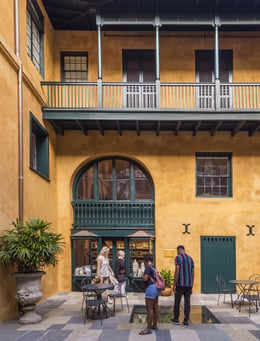
Turducken appeared regularly as a Thanksgiving-eve special at the Opelousas native’s French Quarter restaurant, K-Paul’s Louisiana Kitchen, which operated in a building at 416 Chartres Street now owned by the Historic New Orleans Collection. One of the earliest mentions of turducken in print comes from a 1982 Newsweek article: “K-Paul’s is closed on Thanksgiving but the occasion does not pass uncelebrated. The main attraction at dinner this week is called ‘turducken.’”
Eleven years prior, however, the 1971 book American Cooking: Creole and Acadian mentions a visit to Corinne Dunbar’s, a New Orleans restaurant on St. Charles Avenue, where the author ate a “stunning main course” described as a “poached phoenix.” The creation was effectively a turducken, but with six additional birds found “around town” stuffed inside. The nine-layer dish consisted of “a snipe that was stuffed into a dove that was inserted into a quail that was placed in a squab that was put into a Cornish game hen that was tucked into a pheasant that was squeezed into a chicken that was pushed into a duck that was stuffed into a turkey. All birds had been boned.”

Prudhomme’s own origin story stretches back even further. The claim goes that he invented the turducken as a 20-year-old in the early 1960s while working at a buffet in Sheridan, Wyoming. As the designated meat carver, Prudhomme prized neat-looking cuts. “Turkey always looked lousy,” he told a 1988 audience in Atlanta. “After you cut the meat away from the breastbone it starts looking fuzzy.” He tried deboning the turkey first to improve the look, but customers thought the resulting sliced meat looked like a processed turkey roll. He decided to improve the structure by stuffing a chicken inside the deboned turkey. “It was pretty good. So I said, ‘If I put one more, it will really work.’” After adding a duck and layers of dressing, the turducken was born.
Purdhomme’s turducken recipe says it takes 12–13 hours to prepare. In 2002, it took Madden approximately six secondsOpens in new tab to rip one in half with his bare hands (as he’d grown fond of eating it) live on the Thanksgiving broadcast of Monday Night Football. “This is what it looks like inside,” Madden said in what became one of his most infamous turducken segments, thumbing through the layers as cohost Al Michaels turned his head and grimaced. A minute before, Madden had used the broadcast booth’s telestrator to draw the proper turducken slicing pattern on a video feed of the roast, should one have a knife on hand.


Like deep-fried turkey in 1987, Madden’s 2002 turducken demonstration elicited an angry letter. “Kindhearted Philadelphia Eagles fans were appalled to see seriously overweight NFL announcer John Madden tear apart a turducken,” wrote the People for the Ethical Treatment of Animals (PETA), who decried the dish’s “‘maddening’ disrespect for sentient beings,” and suggested Madden start popularizing Tofurky instead.
PETA’s campaign was unsuccessful. In 2014, Merriam-Webster added turducken to the dictionary, an honor Tofurky has yet to attain. By then, national demand had grown strong enough that big box stores like Costco and Sam’s Club began stocking frozen Thanksgiving turduckens, saving America’s growing ranks of Cajun-curious home cooks from paying expensive shipping fees from Louisiana butcher shops. As a thank-you gift for his role in popularizing turducken across the country, Mistich sent one to Madden’s California home every Thanksgiving and Christmas until the NFL legend passed away in 2021.
In 2016, the New York Times published its own turducken recipe, describing it lovingly as “a marvelous treat, a free-form poultry terrine.” As recently as 2023, the outlet ran an in-depth multimedia feature on how to deep-fry a turkey written by Kim Severson, who “has been testing Thanksgiving turkey recipes professionally since 1999.” Acknowledging the fire risk, Severson declared that she “had never tasted a turkey as delicious—and I have cooked, tasted, or tested at least a hundred turkeys in my day.”

Related Stories

How Madame Bégué Invented Brunch, a Meal Born in New Orleans
What began as a decadent “second breakfast” for hungry French Quarter butchers became a global dining sensation.

Wine Jelly, the 1885 Version of Jell-O Shots
You won’t find a spiked dessert classier—and more fun—than this recipe for wine jelly from Lafcadio Hearn’s 1885 cookbook, La Cruisine Creole.
Related Collection Highlights

New Orleans Corner Store Menus
Ephemera from the HNOC Restaurant Menu Collection highlights the historic role of corner stores in New Orleans history.

Antoine’s Restaurant Collection
It’s the oldest continuously operating restaurant in the United States, and its archive at HNOC tells the story of a family business and its place in New Orleans history.
Related Books


Related Shop Items


Subscribe to Our Newsletter
