







How Madame Bégué Invented Brunch, a Meal Born in New Orleans
What began as a decadent “second breakfast” for hungry French Quarter butchers became a global dining sensation.
By Kelton Sears, editor
May 6, 2026
By Kelton Sears, editor
Elizabeth Kettenring Dutreuil Bégué—better known simply as Madame Bégué—joined the ranks of New Orleans’s earliest celebrity chefs not by serving breakfast, but rather, “breakfast.” Quotation marks nearly always accompanied writers’ descriptions of the peculiar new kind of meal Bégué served from her humble French Quarter restaurant on the corner of Decatur and Madison Streets from 1863 to her death in 1906.
“The usual claret wine accompaniment was an oddity for a ‘breakfast’ to all the ladies, but they seemed to enjoy it,” the Times-Picayune wrote in April 1910, chronicling a meal at Bégué’s during that year’s national Shriner Convention in New Orleans.
Today, Bégué is widely credited as the mother of brunch, a culinary tradition she invented in New Orleans before it took over the United States and, later, the world. Bégué never called her creation “brunch,” a portmanteau she may never have encountered before her death. Ironically, Guy Beringer, the British writer who coined the term in his 1895 Hunter’s Weekly essay “Brunch: A Plea,” did so lobbying, unknowingly, for the creation of the very meal Bégué had already been serving for 32 years on the other side of the Atlantic.

“The arguments in favour of Brunch are incontestable,” he wrote, noting that the meal should begin around noon, mix lighter breakfast fare with heavier lunch meats, and blend the typical morning coffee and tea with the social lubricant of alcohol. “In the first place it renders early rising not only unnecessary but ridiculous. You get up when the world is warm, or at least, when it is not so cold. You are, therefore, able to prolong your Saturday nights, heedless of that moral ‘last train’—the fear of the next morning’s reaction.”
While Beringer’s brunch was a Sunday morning hangover cure, a legacy the meal retains to this day, Bégué’s brunch was anchored in workweek practicality, designed for a group of men who never slept in.
As recounted in the foreword to her cookbook, Mme. Bégué’s Recipes of Old New Orleans Creole Cookery, Elizabeth Kettenring was 22 when she immigrated from Bavaria to New Orleans in 1853 to join her brother, Phillip Kettenring, who had arrived a few years earlier and set up as a butcher in the French Market’s meat stalls.
Through her brother’s community she met her first husband, Louis Dutreuil, a butcher who, like most of his meat market colleagues, hailed from the Gascony region of France. In 1863, the couple opened a saloon and café across the street from the market at 207 Old Levée Street (now 823 Decatur). They called it Dutrey’s Coffee Exchange—an Anglicized rendering of their name—with Bégué running the kitchen and Dutreuil managing the bar.

Market butchers typically started their dawn shifts with a bare-bones breakfast of French bread and coffee before heading out, sometimes as early as 2 a.m., for the physically taxing work of carving meat all morning. Bégué noticed that by the time business slowed down at 11 a.m., the butchers were ravenous. In what would prove to be a historic move, Bégué decided that Dutrey’s would only run food service from 11 a.m. to 3 p.m. and serve just one meal a day, a long three- to four-hour affair that she always called “second breakfast,” or zweites Frühstück.
Back in Bavaria, zweites Frühstück was usually some combination of coffee, sausage, a pretzel, and beer, taken as a light snack around 10 or 11 a.m. to bridge an early breakfast and noontime lunch (typically called “dinner” in this era). Bégué’s new take on the concept, however, was anything but light. Her “second breakfast” was a hearty six- to seven-course spread designed to satiate hungry butchers, blending breakfast fare like toast, fruit, eggs, and coffee with substantial meat and seafood dishes, replete with plenty of wine and sundry alcoholic beverages to help the tired workers blow off some steam.

Bégué’s midmorning masterpiece was soon dubbed “butcher’s breakfast” by working-class fans, and Dutrey’s became a go-to spot for the French Market’s early risers. The interior matched the clientele—a small, unpretentious room devoid of tablecloths or napkins that patrons, often in dirty, bloodstained workwear, entered through a narrow staircase.
Second breakfast didn’t become a national dining sensation until after Dutreuil passed away, in 1875. Bégué kept the kitchen running as a widow until one very enthusiastic regular joined the staff. Hypolite Bégué was a native of France who immigrated to New Orleans at 16 years old, eventually becoming a French Market butcher himself under his uncle’s employ. He loved the food at Dutrey’s so much that in 1877 he decided to put down his cleaver and become a bartender there. By 1880, he had married the widowed Elizabeth Dutreuil, and the couple changed the name of the eatery to H. Bégué’s Exchange, commonly shortened to Bégué’s (sometimes rendered Begué’s, or Begue’s). “Monsieur Bégué” became the proprietor, and his soon-to-be famous wife became “Madame Bégué.”


The egg officially cracked on second breakfast in 1884–85, when tourists visiting for the six-month-long World’s Industrial and Cotton Centennial Exposition found out about Bégué’s and began rhapsodizing about its curious culinary innovation. Even though the expo was an economic failure for New Orleans, it led to a financial boon for the restaurant, with word of Bégué’s new meal spreading far and wide.
“If you would breakfast with Begue, you must go to him at 11 o’clock, and if you are wise, you will have eaten nothing before that morning. You will be sorry if you have. The failure of your appetite be upon your own head. Begue should be approached with fasting,” Eve Brodlique wrote in a May 1897 issue of the Times-Democrat, one of countless lyrical odes to the restaurant that appeared in newspapers across the United States in the decades after the expo. Each testimonial was more extravagant than the last, sending even more peckish pilgrims to the corner of Decatur and Madison.


The crowd that arrived, however, was not the same one that had built the place. The clientele shifted from work-weary butchers to airy bohemians, a change that both Monsieur and Madame Bégué initially resisted, even though the new diners brought an influx of cash. “Soon the new custom drove the butchers away, and one memorable morning some ladies came guided by curiosity—and a bohemian friend,” Brodlique wrote. “They laughed and laughed, and failed so in appreciation that Begue swore no women should ever come again. But women did, and with them tablecloths and other small appurtenances of civilization.”
Eventually, the couple embraced the artists, well-to-do white-collar folk, and, yes, women who continued streaming into the restaurant to experience second breakfast. Taking advantage of this new class of diners’ literary bent and unbridled enthusiasm for Madame’s cooking, the Bégués decided to start keeping visitor’s registers—many of which are housed in the Historic New Orleans Collection’s Williams Research Center—where guests wrote post-meal poetry in praise of the restaurant.
Stuffed Stanzas


“‘A Begue Breakfast’ oftimes begets poetry, sentiment, corpulency and other things,” wrote the New Orleans States in its June 20, 1898, issue. “As the claret flowed, so did sentiment bubble and by universal consent the entire party dropped into poetry. Each man wrote a verse wherein ‘Bachus’ [sic] figured prominently.”
Those registers, filled with poems by the celebrities of the day, became nearly as famous as the food—earning a dedicated 26-page spread in Bégué’s original 1900 cookbookOpens in new tab, as well as appearances in regular newspaper coverage. The most celebrated entry belongs to children’s writer Eugene Field, author of the poem “Little Boy Blue.” His couplet was later repurposed as the cookbook’s epigraph:

“I’m very proud to testify, the happiest of my days
Is March 11, ’95 at breakfast at Begue’s.”
Some took a slightly less earnest approach. “My belt encircles—the largest breakfast of my life,” wrote singer, comedian, and vaudeville male impersonator Zelma Rawlston. A popular recurring pun in the register changed Bégué’s proper French “bay-gay” pronunciation to “be-gay.” “If you can’t Begue,” wrote Page M. Barker of New Orleans, “Begue as you can.”
Centennial Expo or not, Madame Bégué would not have joined the ranks of Antoine Alciatore and Jean Galatoire as a standard-bearer of Creole cooking if her food was not exceptional. A New Orleans States article published April 23, 1905, the year before her death, declared Bégué’s “deservedly the most famous place in the city.”
Exactly how Bégué developed her kitchen talents isn’t widely known. Her only officially sanctioned cookbook—originally published, of all things, by the Southern Pacific Railroad to promote tourism to New Orleans—offers just one sentence on the subject: “To her solid foundation of the art of German cooking the 22-year-old girl added what she soon learned of the cooking art in Old New Orleans.”

Beyond the structural launching point zweites Frühstück provided and her penchant for frying things in lard—like her most famous dish, Liver à la Bégué—the “art of German cooking” didn’t show up much on her menu, which was renowned for its “delicious Frenchiness,” as Brodlique wrote.
Indeed, Creole favorites like jambalaya, turtle soup, courtbouillon, gumbo, and crawfish reigned supreme, the latter of which Monsieur Bégué often taught out-of-towners to peel. “‘You do not know how to eat our crayfish? Voila!’ and with a swift movement of the fingers the head was off and the shell opened—‘like a telescope,’ monsieur explained,” the Times-Picayune wrote in 1910. Diners always knew they had reached the end of their decadent meal when the spice- and cognac-infused café brûlot arrived.
The French influence on the menu has its own origin debate. Monsieur Bégué is sometimes credited apocryphally with nudging his wife toward French culinary forms. Historian Rien Fertel proposesOpens in new tab that Gascony, the homeland of Bégué’s first husband and most of his fellow French Market butchers, was the bigger influence—especially when it comes to her other iconic dish, one that became synonymous with brunch as we know it today: the omelet.
“As France’s poultry center, Gascon cuisine is naturally rich in the bounty of fresh eggs,” Fertel writes in his 2006 essay “Begué’s Eggs.” “These south-west French omelets are not merely filled with ham, peppers, and cheese so ubiquitously found on American breakfast and brunch menus, but are rather stuffed with heartier meats.” Bégué made sure a hearty omelet appeared on her prix fixe breakfast menu every day of the week, whether it was stuffed with oysters, veal, or potatoes.
Diner Doodles


Another feature today’s brunch fans might recognize in Bégué’s is how impossible it was to get a seat. Celebrity or not, walk-ins were always turned away, and reservations were often booked up at least a week in advance, sometimes months. For the vast majority of Madame Bégué’s 43 years as a professional chef, she refused to increase the capacity of the dining room’s single, shared 30-seat table, only adding another 20-seater on the third floor near the end of her life.
In the years leading up to Bégué’s death, newspaper reports mentioned increasingly visible symptoms of her rheumatism. Frailty in her hands prevented her from continuing her lifelong cooking duties in 1903, the year she shifted from the stove to a supervisory role in the kitchen. Though she remained a genial presence in the restaurant visiting with guests, soon, she was relying on crutches for support. Near the end, she was confined to a chair in the dining room. On October 19, 1906, at the age of 75, she passed away in her room above the restaurant.

On February 8, 1905, a year and a half before Madame Bégué’s death, three diners wrote a poem in the register wishing the ailing chef well:
Here's to Madam Begue,
O'er life may she long hold sway.
From rheumatics much
She is now using a crutch.
It is our sincere hope
That with the help of doctor dope
At an early day
She may, like us now, again be gay.
“Not alone was Madame Begue famed for the way in which she could turn a steak, prepare a salad, or inflate an omelette, but she was loved for her camaraderie, her ‘bon mot,’ her cordial welcome to all who came to sit at her table opposite the kitchen door where she prepared her most famous dishes while you looked on,” the New Orleans Times-Democrat wrote in her obituary. “In her passing New Orleans loses one of its famous characters, a woman who was known and loved throughout the breadth of the land.”
News of Bégué’s death prompted additional obituaries across the country, including in the New York Times. Eight years her junior, Monsieur Bégué kept the business running with her original recipes, reopening a few days after her death. He eventually remarried the Madame’s apprentice, Françoise “Frances” Laporte (herself the widow of a French Market butcher), who took over the kitchen as the new Madame Bégué. While the original Madame Bégué never served anything other than brunch, the second decided to add 6 p.m. dinner service.
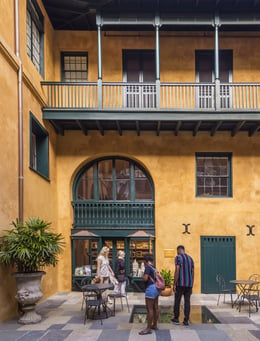
In 1914, three years before Monsieur’s death, Bégué’s was purchased by and merged into its longtime neighbor and main competitor, Tujague’s, the second-oldest restaurant in New Orleans. Tujague’s, which at one point had marketed its own “butcher’s breakfast” to attract diners turned away by the original, promptly moved into Bégué’s building at 823 Decatur. Until Tujague’s relocated to 429 Decatur in 2020, diners could experience brunch in the “Begue Room” at the very spot the meal was born—and today, it still nods to that history with a hearty brunch entrée called the Butcher’s Breakfast.
Related Stories

Serving History
HNOC’s diverse archive shows how restaurants preserve history and heritage through their menus.

Poppy Tooker Remembers Leah Chase
A recipe, a story, and the “craziest dream” about the celebrated New Orleans chef, who died in July 2019.
Related Collection Highlights

Antoine’s Restaurant Collection
It’s the oldest continuously operating restaurant in the United States, and its archive at HNOC tells the story of a family business and its place in New Orleans history.

New Orleans Corner Store Menus
Ephemera from the HNOC Restaurant Menu Collection highlights the historic role of corner stores in New Orleans history.
Related Books


Related Shop Items


New Orleans Stories,
Delivered to Your Inbox
