








Fleeing, Flooding, and Fun
Hallmarks of Summertime in New Orleans
Summer in New Orleans is like winter in the North—long and difficult but not without its pleasures. For centuries, residents have been finding a way to live or leave during the hottest months.
By Molly Reid Cleaver, senior editor
August 5, 2022
Summertime, and the living is not exactly easy here in New Orleans, where the heat and threat of hurricanes drag on for months. But for three centuries and counting, residents have found ways to not only survive but thrive through the season. For some, it means getting out of dodge. For others, it’s about cooling off by any means necessary—30-minute snoball lines included. Here’s a look at summer in the city as seen through our holdings.

Escape to the North
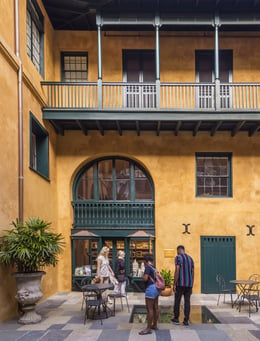
“Though a winter resort, New Orleans is preeminently a summer town—a city of galleried houses, of gardens, of flowers, and of shops which open wide upon the street,” writes Julian Ralph in an 1892 report from New Orleans for Harper’s New Monthly Magazine. While modern-day residents might scoff at the characterization of New Orleans as a “summer town,” Ralph goes on to describe the Caribbean–influenced architecture that makes summer heat tolerable—but just barely. Anyone who can afford to do so, he writes, leaves town: “The Americans . . . exchange the heat for the mountains and the forests. The wealthy among the creoles are apt to go to France, and there are many who divide the year thus.”
One option for people who preferred or could only afford to summer locally was the Claiborne Cottages, a Covington resort located “on a hill overlooking the lovely Bogue Falia [sic] River, flanked by lofty pines,” according to an advertisement in the St. Tammany Farmer. In addition to the “pure water,” proprietor Mrs. C. Wood of New Orleans promised good fishing, boating, lawn tennis, and bathing. In a bold statement, she claimed, “Mosquitoes almost unknown.” Lodgings cost $2.50 per day and $13 or $14 per week.

Snow and Ice to Beat the Heat
New York has its Mister Softee trucks, but New Orleans has its snoball stands. When temps are high, one can see groups of New Orleanians queueing loosely in front of matchbook-size storefronts, waiting for the sweet, ice-cold refreshment of powdered ice piled high and topped with brightly colored syrup. Entire books have been written about the joys of New Orleans snoballs (or “snowballs,” or “sno-balls”), such as Megan Braden-Perry’s Crescent City Snow: The Ultimate Guide to New Orleans Snowball Stands. Many residents stick with their preferred neighborhood spot, but others have been known to play snoball bingo, seeking to hit as many different stands around town as they can.


A Beach in the East
Lincoln Beach was Jim Crow’s answer to Pontchartrain Beach, the lakefront amusement park that catered only to whites during segregation. In 1954 the city opened Lincoln Beach on a 17-acre lakefront site in New Orleans East. Its amenities and diversions paled in comparison to the bigger, fancier Pontchartrain Beach, but it still had “two swimming pools . . . a bathhouse, a restaurant, and rides and attractions,” according to writer James Cullen’s history of the site for Antigravity magazine. For more than a decade it gave the city’s people of color a place to cool off in the summer. After the passage of the Civil Rights Act, in 1964, demand plummeted, as African Americans were eventually allowed entry to Pontchartrain Beach. Lincoln Beach closed a year later.


Stylin’ through the Sweat
Today, New Orleanians survive summer with a wardrobe of tank tops, shorts, boat shirts, and rash guards, but decorum and textile technology were very different in the 19th century. According to Harper’s writer Julian Ralph, women of the 1890s kept a summer wardrobe of soft colors and “white dresses by the dozen.” Promenading out-of-doors was a must, to avoid the stultifying indoor climes. Hats, apparently, were optional: “They [New Orleans women] go about without their hats, in carriages and the streetcars, visiting up and down the streets. Indoors one must spend one’s whole time and energy in vibrating a fan.”
For men of a certain status, suits and jackets were the norm, and menswear stuck to this position for decades. Seersucker, a common choice for clothing enslaved people in the early to mid-19th century, entered the world of white menswear starting in the 1880s and has become synonymous with southern summertime suiting. Other options can be seen in a 1926 brochure for the Chicago clothier Stevens Inc., which New Orleans department stores would have carried. One label, Kuppenheimer, offered buyers “an investment in comfort and good appearance for hot weather” with the introduction of “Air-O-Weaves,” a light wool suit with a relaxed shoulder fit. The illustration shows how to accessorize the ensemble, with a porkpie hat and cane—wicker lawn chair sold separately.

A City That Floods
Street flooding has been a part of New Orleans life since its inception. Particularly in the summer, storms find a way to press pause on daily life, despite the development of the city’s levee and drainage systems. Residents are well-acquainted with the ritual of moving their vehicles to higher ground in advance of heavy rains.

For children and the young at heart, street flooding presents an opportunity to step out of the ordinary. One perennial feature of summer storms is local news footage and photographs of people making the best of it, floating down their blocks in kayaks, canoes, and innertubes.
A Decadent End to the Season
Labor Day typically marks the official end of summer here in the United States, but in New Orleans, the real capstone to the season is Southern Decadence, the annual LGBTQ+ pride weekend that features parties galore and the hottest, sweatiest parade of the year. As the event’s official history goes, “Southern Decadence began in 1972 with a group of friends who playfully called themselves the ‘Decadents.’ . . . All were young, mostly in college or recently graduated, and counted among themselves male and female, black and white, and gay and straight.”
One of the Decadents was leaving town to return to Chicago and bemoaned the lack of entertainment happening over the holiday weekend, so the group held a going-away party “marked by spiked punch and a lot of drug use, especially marijuana and LSD.” (It was the ’70s, after all.) The next year, the group began its tradition of parading the Sunday before Labor Day, soon adopting the New Orleans custom of assigning a grand marshal to lead the procession.

Fifty years later, Southern Decadence is a New Orleans institution and mainstay of the tourism economy, attracting thousands of visitors to the city to partake in the fun.
Related Stories

From the Streets to the Fairgrounds
From the beginning, Jazz Fest sought to showcase culture bearers like Mardi Gras Indians and Black parading clubs alongside musicians.

Vintage Jazz Fest Photos That Make Us Want to Sing, Dance, Laugh, Cry, and Eat
Reliving the sights, sounds, and even smells of the Fair Grounds through images of Jazz Fests past.
Related Collection Highlights

Michael P. Smith Collection
Smith documented the music, parading, and Black folk traditions of New Orleans for decades.
Related Books
In the Spirit: The Photography of Michael P. Smith from the Historic New Orleans Collection
with essays by Jason Berry, Dan Cameron, John H. Lawrence, and Jude Solomon

New Orleans Stories,
Delivered to Your Inbox
