






Rare Music of Jazz Greats, Preserved on Glass
Bill Russell's American Music label captured the sounds of first-generation jazz musicians. The masters are part of a trove of unusual records now in HNOC’s care.
By Nina Bozak, curator of rare books, and Vasser Howorth, manuscripts cataloger
March 24, 2023
From October to December of 2022, we worked offsite one day a week in an office next to the French Market. Our task: inventorying and rehousing hundreds of glass, metal, and acetate discs with a significant history. These are the masters of jazz recordings made in the early 1940s by Bill Russell, working with a variety of first- and second-generation jazz musicians, for his American Music record label.
One of the cornerstones of the Historic New Orleans Collection is the William Russell Jazz Collection, a vast assemblage of research, correspondence, photographs, books, sheet music, and oral histories related to the history of early jazz in New Orleans. Its collector, Bill Russell (1905–1992), was a musician, composer, and music historian. Born in Canton, Missouri, Russell first visited New Orleans in 1937 and shortly thereafter began seeking out the pioneers of jazz. Through this work, Russell helped to revive the music career of Bunk Johnson (1879–1949), a trumpet player known to have played with Buddy Bolden.

Though Russell lived in Pittsburgh, working as a chemist, he visited New Orleans often from 1942 to 1945 to record Johnson and other early jazz musicians, such as clarinetist George Lewis and trombonist Jim Robinson. In 1944 Russell founded a label, American Music, to release many of these recordings. The sessions were difficult to schedule, as most studios in New Orleans would not work with Black musicians.
Some of the American Music sessions were done at radio stations, but for the most part Russell recorded on-site at musicians’ houses and at San Jacinto Hall (1436 Dumaine Street) using a portable disc-recording machine. Beginning in the 1930s, aluminum was the preferred base material for live sound recordings, but during World War II it was conserved for the war effort. Record manufacturers switched to thinly laminated glass, which comprises most of the American Music masters.

American Music did not prove to be commercially successful, with some original pressings taking decades to sell. Russell ended the label in 1953. In 1989 George H. Buck Jr., a fellow label owner who had purchased many small record labels and their catalogs over the years, bought American Music, making it part of the George H. Buck (GHB) Jazz Foundation family of labels. Since then, well over a hundred recordings from the American Music catalog—by musicians such as Bunk Johnson, Jim Robinson, George Lewis, and Kid Sheik—have been rereleased on CD and digitally by GHB, which donated the masters to HNOC in May 2022.
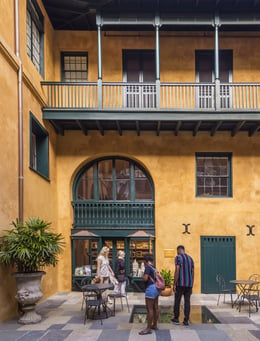
After the acquisition of the materials was approved, we visited the GHB Jazz Foundation at 61 French Market Place, above the Palm Court Jazz Café, to assess how much and what kinds of housing materials we would need. Most of the records were stored in their original wooden crates with plastic and acidic paper sleeves, which had degraded over time and were falling apart. The records range in size from 7 to 16 inches, but the bulk are on 12-inch glass discs in a variety of shades based on what was available during the war, typically brown, yellow, or green.


Because of the fragility and cumulative weight of the records, we decided to do the rehousing on-site at GHB. Working from a list of American Music masters, we determined which songs were present in the collection based on catalog numbers and notes on the records and sleeves in Russell’s handwriting. Sometimes we would find a note identifying a record as a copy or that it was recorded “inside out,” meaning, to hear the recording correctly, a person would need to put the needle at the center of the record, nearest the label, and play it from there.
As we rehoused the records, we attempted to put them in numerical order. This was sometimes an impossibility, as Russell often recorded the A and B sides out of sequential order. For example, one record has master no. 880 on side A—“Careless Love” by the Original Creole Stompers with Baby Dodds on drums—while side B, a Bunk Johnson version of “When the Saints Go Marching In,” is master no. 893. Russell recorded both sides at the home of George Lewis, at 827 St. Philip Street in the French Quarter.
Eventually, the newly rehoused records will be transferred to the Williams Research Center, where they will be stored and entered into HNOC’s catalog.
Related Stories

Promoting Tipitina’s in Its Raucous Early Years
Through unusual posters and interviews with two of Tipitina’s co-founders, we take a look back at the club's early years.

Not Their First Rodeo
Beyoncé is the latest artist to stir up conversation about country music and Blackness, but she’s not the first. Those roots go back to the beginning of American music.
Related Collection Highlights

Uganda Roberts Tape Collection
The New Orleans percussionist's audio and video tape collection documents his decades-long career, his musical influences, landmark events in the city, and his family and daily life.

The Fat Man / Detroit City Blues
Fats Domino’s first single, produced in New Orleans, is considered one of the first rock ’n’ roll songs in history.

Les lys et les roses
A bound volume of eight pieces for piano and voice sheds light on the role of women in New Orleans’s 19th-century music scene.
Related Virtual Exhibitions

New Orleans Medley: Sounds of the City
The music of New Orleans is the living product of dynamic cultural interactions played out over centuries in this diverse southern port city.

Shout, Sister, Shout!: The Boswell Sisters of New Orleans
Explore the musical legacy of New Orleans’s own Boswell Sisters, who where among the first stars of radio’s golden age.
Related Books

Ernie K-Doe: The R&B Emperor of New Orleans
by Ben Sandmel
with a foreword by Peter Guralnick

French Baroque Music of New Orleans
edited by Alfred E. Lemmon
with essays in English by Jennifer Gipson, Andrew Justice, Alfred E. Lemmon, and Mark McKnight, and in French by Jean Duron
New Orleans Stories,
Delivered to Your Inbox
