







Harold F. Baquet Archive
Explore the work of New Orleans photographer Harold Baquet who documented the city’s traditions, politics, and everyday people.
Photographer Harold F. Baquet (1958–2015) was a consummate New Orleans photographer—not in the sense that he documented icons and traditions of the city (though he certainly did), but rather because of his extensive work capturing everyday people. A seventh-generation New Orleanian, he photographed for two mayoral administrations, numerous print media outlets, and, for over 25 years, Loyola University.
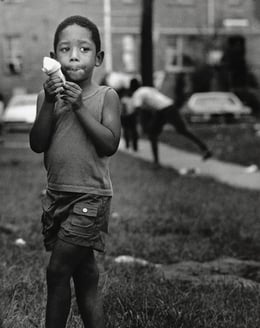
Baquet’s images captured African American civic, political, and social life at every level of the city, from children playing to businessmen shaping the economy. At the center of his photographic philosophy was respect for the individuals in front of his lens.
“First and foremost, I believe that people are by far the most worthy and interesting of subjects to photograph,” he said in a 2006 interview for the scholarly journal Callaloo. “To present the dignity and nobility of my subject is, for me, the central role of what I do.”

Baquet first showed an interest in photography at age 11, when he took a portrait of his cousin, who died a year later. That “treasure I could hold in my hand,” as he later described it, showed him the power of the medium as a tool of history. He attended St. Augustine High School in the Seventh Ward and began photographing professionally shortly after.
Throughout the 1970s and ’80s, his work appeared in the Louisiana Weekly, Figaro, Ebony, Essence, Rolling Stone, and other outlets. He exhibited at the 1984 world’s fair’s Afro-American Pavilion, and in 2011 he published a book, In the Blink of an Eye: Photographic Memories of a New Orleans No More, with his wife, Cheron Brylski.
Baquet died at age 56 in 2015, following a battle with colon cancer. Soon after, Brylski approached HNOC about donating his archive. From the outset, it was clear that Baquet’s view of the city, filtered through both his camera and life experiences, would be a wonderful addition to HNOC’s photographic history of New Orleans. The 2016 acquisition was a milestone for HNOC because it represented the institution’s first extended body of work by an African American New Orleans photographer.
All images HNOC, gift of Harold F. Baquet and Cheron Brylski
Local Politics


African American Life


The archive spans the late 1970s through the early 2010s and includes work made during the administrations of the first two African American mayors of New Orleans, Ernest N. “Dutch” Morial (1978–86) and Sidney J. Barthelemy (1986–94). Baquet’s inquisitive personality, as well as New Orleans’s relatively small number of photography firms, led to a wide-ranging practice: portraits, advertisements, hard news, stock photography, and his own projects. Consequently, his archive contains thousands of rolls of film, color slides, digital files, and printed photographs—the fruits of a busy and successful commercial practice.
Baquet covered weddings, christenings, political events, neighborhood life and festivals, Mardi Gras, and the face of the city as embodied in its people and architecture. Some of these topics skewed toward Baquet’s personal interests, including daily life in African American neighborhoods.
Baquet was a regular sight on Loyola’s campus, capturing quiet moments of student life as well as official university events. Loyola granted him the Coadjutor Optimus Award, the St. Sebastian Award, and the President’s Medal.
Desire and Lafitte Housing Projects


Versailles Arms Neighborhood


His work depicted many of the problems facing Black citizens, from crime to substandard housing and limited economic opportunities. Despite their clear-eyed appraisals of social inequities, his photographs also reflected their subjects’ compassion, pride, and tenderness, as well as their maker’s affection.
“You can’t just photograph somebody out the window of your automobile, like a drive-by shooting,” he told Callaloo, speaking about the sensitivity of photographing residents post-Katrina. “You have to get out and introduce yourself and legitimize yourself to a total stranger and try to gain enough of his or her trust to allow the photographer into a very intimate component of his or her life and experience.”
Editorial Work for New Orleans Tribune


Because of the vast size of Baquet’s archive, HNOC staff elected to catalog the images in groups and digitize contact sheets, available on the public catalog. Individual photographs are being digitized from negatives on a rolling basis. HNOC welcomes help from the public in identifying people in Baquet’s photographs. To submit an ID, fill out the form on this page.
By John H. Lawrence and Molly Cleaver
Explore the Archive
Explore the Harold F. Baquet Archive in our online catalog below. After following the link, scroll to the bottom of the catalog record and use the “hierarchy browser” to explore the the collection and view image previews.
HNOC welcomes help from the public in identifying people in Baquet’s photographs. To submit an ID, fill out the form on this page.

Photo Identification Form
Collection Highlights
Dive into the Collection’s holdings with image-rich previews of treasures from New Orleans history.

Related Events
The Photography of Harold Baquet
Related Stories

The Intimate Eye of George Dureau
Prospect.5 spotlights the New Orleans photographer’s “othered” portraits.

The 19th-Century Family Found in an Attic
When one New Orleans couple unsealed the attic of their Algiers house, they discovered a remarkable set of family portraits going back 135 years.
Related Collection Highlights

Pops Whitesell Photographs
The artist was an important figure in the French Quarter Renaissance, an effort by artists, authors, and architects to preserve and reinvigorate life in the historic neighborhood.

Michael P. Smith Collection
Smith documented the music, parading, and Black folk traditions of New Orleans for decades.

Braughn Family Photomontage
A dramatic composite photograph depicts a prominent New Orleans family in high style.
Related Virtual Exhibitions

From Daguerreotype to Digital
A look at over 20 different photographic processes and techniques represented in HNOC’s holdings, from the daguerreotype to the digital prints of today.

Enigmatic Stream: Industrial Landscapes of the Lower Mississippi River
Photographs by Richard Sexton capture the essence of a complicated, often mysterious section of the country’s largest waterway.
Related Books


Haunter of Ruins: The Photography of Clarence John Laughlin
with essays by Jon Kukla, John H. Lawrence, Andrei Codrescu, Ellen Gilchrist, Shirley Ann Grau, Jonathan Williams, Albert Belisle Davis, and John Wood

Subscribe to Our Newsletter
