







Les lys et les roses
A bound volume of eight pieces for piano and voice sheds light on the role of women in New Orleans’s 19th-century music scene.
Les lys et les rosesOpens in new tab, an elegantly bound album of eight pieces for piano and voice by Octavie Romey, opens a window on the role of women in New Orleans’s 19th-century music scene. Born in Paris in 1824, Octavie Romey was the daughter of prominent historian and translator Charles Romey, best known for his Histoire d’Espagne (1839). The exact date of her arrival in New Orleans is unknown, but she would become one of the city’s earliest known female composers. In her early years in the city, she collaborated with Eugène Prévost, composer and conductor for the French Opera House and the Orleans Theater. By the late 1850s, Romey was attracting local press coverage for her piano concerts.

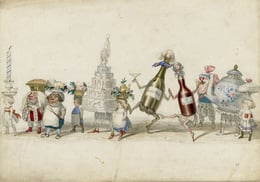
Les lys et les roses was published circa 1841, before Romey moved to New Orleans. The Parisian journal La France littéraire praised Romey’s compositions as “sweet and pure romances.” The lyrics are by French novelist, poet, and dramatist Mélanie Waldor, and lithographs by Paul Gavarni accompany the pieces.


During her years in New Orleans, Romey is known to have published three pieces of sheet music: “La Marseillaise et le Bonnie Blue Flag: Grand fantaisie de concert” (1864), which is also in the holdings of the Historic New Orleans Collection; “Le chant exile” (1858); and “4 Mars. Souvenir!! À la mémoire de Madame G. T. Beauregard” (1864). The latter piece was a tribute to the second wife of Confederate General P. G. T. Beauregard, Marguerite Caroline Beauregard, whose funeral on March 4, 1864, was a citywide event. After the Civil War, Romey directed and performed in a series of successful benefit recitals for Confederate widows and orphans, often featuring orchestras composed entirely of women.


Romey also organized “monster concerts” in New Orleans. A 19th-century musical vogue popularized by New Orleans–born Louis Moreau Gottschalk, monster concerts featured major works transcribed for multiple pianists performing on stage simultaneously. Romey presented monster concerts at Odd Fellows Hall in 1866 and at Grunewald Hall in 1874, both featuring 24 women on 12 pianos performing her transcriptions of four grand opera overtures.
Romey continued to appear in concerts into the 1870s, and was both the composer and conductor of masses for all-female choirs at Immaculate Conception Church and the St. Louis Cathedral in 1875. She returned to Paris in 1880, where she died the next year. Romey’s lasting legacy was her strong interest in developing and publicly presenting the talents of amateur female musical artists—a very unusual pursuit at a time when the musical skills of women were largely confined to entertaining family and close friends.

By Pamela D. Arceneaux
Related Stories

’Tis the Season . . . for Louisiana Holiday Music
From jazz to bounce, funk to klezmer, these songs add local flavor to the holidays.

Jenny Lind, Taylor Swift, and Another Era’s Tour
The Swedish singer was one of the first music icons of the early global age, causing frenzy on every stop of her world tour.
Related Collection Highlights

William Russell Jazz Collection
HNOC’s largest collection related to New Orleans jazz was the life’s work of this prolific collector, producer, historian, and photographer.

Leigh “Little Queenie” Harris Collection
A new collection documents the career of a “little” woman who made a big impact on New Orleans music.

The Fat Man / Detroit City Blues
Fats Domino’s first single, produced in New Orleans, is considered one of the first rock ’n’ roll songs in history.
Related Virtual Exhibitions

Shout, Sister, Shout!: The Boswell Sisters of New Orleans
Explore the musical legacy of New Orleans’s own Boswell Sisters, who where among the first stars of radio’s golden age.

New Orleans Medley: Sounds of the City
The music of New Orleans is the living product of dynamic cultural interactions played out over centuries in this diverse southern port city.
Related Books

French Baroque Music of New Orleans
edited by Alfred E. Lemmon
with essays in English by Jennifer Gipson, Andrew Justice, Alfred E. Lemmon, and Mark McKnight, and in French by Jean Duron

Ernie K-Doe: The R&B Emperor of New Orleans
by Ben Sandmel
with a foreword by Peter Guralnick
Subscribe to Our Newsletter
