







Lolita Nelson’s Maison Blanche Display Department Collection
Memories of the lost art of window dressing
Though first established in the United States before the Civil War, department stores became more commonplace around the turn of the 20th century, conveniently selling goods such as furniture, ready-made clothes, accessories, kitchenware and tableware, and stationery that were previously offered only by specialty stores. The epicenter of department stores in New Orleans was downtown Canal Street, where shoppers delighted in the wares at D. H. Holmes, Godchaux’s, Krauss, Kreeger’s, and Maison Blanche.
Considered by some to be the crown jewel of local department stores, Maison Blanche was founded in 1897 with the financial backing of Isidore Newman (1837–1909), a German-Jewish immigrant and philanthropist who is known for establishing the Isidore Newman School in 1903. By 1909, the store’s original building at 901 Canal Street was replaced with a formidable Beaux Arts building that held the department store on the first five floors, with the upper levels reserved for medical and business offices. The company was sold to Philadelphia-based City Stores in 1923, but it remained locally run.


Beginning in 1948 with a Gentilly location, Maison Blanche started expanding beyond the city’s urban core. Stores in Metairie, Gretna, New Orleans East, and Baton Rouge followed. However, many of these branches didn’t last through the 1980s, and Dillard’s eventually purchased Maison Blanche only to have the last remaining store, its flagship, close for good in 1997, 100 years after its founding. The building is now the home of the Ritz-Carlton hotel.

Maison Blanche was famous for its window displays, particularly Christmas scenes that included Mr. Bingle, its seasonal store mascot. The store’s visual merchandising department, colloquially known as the display department, was key in this regard, producing window installations, in-store displays, seasonal and promotional displays, and mannequin styling. The display department worked closely with other departments such as advertising and the fashion office to present exhibitions and displays that were cohesive storewide and utilized skilled workers such as carpenters, painters, artists, and decorators. Visual merchandising required a specialized skill set: Tony James, who was the director of the display department in 1973, stated that “a good color and design sense is essential along with an ability to put art forms together and a feel for fashion.”


Lolita “Tootie” Nelson (1920–1995) was a member of the display department for about 40 years, beginning at Maison Blanche’s flagship store in 1942 and finishing her career at the Clearview location in Metairie. Throughout her tenure, Nelson worked on window displays and special events such as the 1959 commemoration of the Canal Street flagship’s 50th anniversary. In 1966, she helped to produce the Best of the World Festival. Held at the store’s Canal Street location, the festival displayed 850 flags, had telephone stations at which shoppers could pick up a handset and listen to recorded greetings in different languages, included an authentic tearoom sent from Japan, and featured demonstrations from international chefs, textile workers, and wood-carvers.

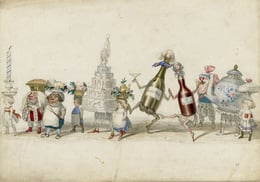
The Historic New Orleans Collection recently received a collection of Lolita Nelson’s Maison Blanche display department papers, donated by Nelson’s sister, Jacquelin Nelson Kellogg. Through photographic prints, negatives, and sketches, it provides documentation of Maison Blanche’s visual merchandising practices from 1921 through 1981. In addition to finished installations, the images also go behind the scenes to show the display team building and installing sets. The collection includes a series of mannequin catalogs, which depict changing fashion and style trends. Additionally, Nelson retained Maison Blanche’s employee newsletters Shop Talk and Entre Nous from 1944 to 1981, which document the changes in the store’s corporate culture over the years. The collection brings to the forefront a behind-the-scenes department that was responsible for making Maison Blanche a magical place for its shoppers and a local landmark.
By Nina Bozak, senior curator
Collection Highlights
Dive into the Collection’s holdings with image-rich previews of treasures from New Orleans history.

Online Catalog
Search or browse HNOC’s vast collections of photos, manuscripts, artifacts, books, artwork, and more in our online catalog.

Related Stories

For the Perfect Fit, They Went to the Jive Ass Shoemaker
Calvin Dayes was renowned for his specialty shoes fit for a king, as well as for those who needed them most.

For Decades, Mr. Bingle Ruled the Holidays on Canal Street
For generations of New Orleanians, “Jingle, Jangle, Jingle” ushered in the start of the holiday season.
Related Collection Highlights

Dr. Tichenor’s Bottle Label
Still sold today, the sharp New Orleans tonic has its roots in the Civil War.
Related Virtual Exhibitions
Goods of Every Description: Shopping in New Orleans, 1825–1925
Peer into shop windows of the 19th and early 20th centuries.

Related News

French Quarter Journal Names Shop at the Collection as a Must-Visit Holiday Destination


HNOC Loan Heads to the Met for Exhibition about Black Fashion
Subscribe to Our Newsletter
