








Anne and Dick Stephens Southeastern Louisiana Wildfowl Carving Collection
A flock of over 300 bird carvings reveals how generations of regional craftsmen transformed a hunting tradition into fine art.
Carefully observing ducks with weapons trained, Louisiana hunters were struck by beauty.
Their prey preened lustrous coats, delicately marbled and marked with ridges and crescents like their habitat’s waterways. A hunting art emerged—southeastern Louisiana wildfowl carving—that has united generations of bayou, river, lake, and coastal communities through centuries. Cajuns, Creoles, Indigenous peoples, Africans, Isleños, and Eastern Europeans all developed this multiethnic tradition, honing unique regional styles and techniques.

Louisiana hunters and sportsmen typically employed multiple decoy “rigs” in floating tableaux designed to lure and deceive. To fool live ducks, wooden counterparts were carved in a variety of poses: swimming, swallowing, grooming, and chasing fish. Eyes were either carved from the same wood as the head or crafted from hatpins, tacks, inset taxidermy eyes, and even glass from Jax beer bottles. To truly sell a false sense of safety to potential quarry, “confidence decoys” occasionally joined rigs as well—carvings of non-targeted species like egrets. Hunters gave their prey imaginative French names: wood ducks became branchiers for the trees they roosted in, coots became poules d’eau (water chickens), and redheads became violons (violins) for the sound their wings made mid-flight.


While decoys were originally reserved for personal use or gifted to family and friends, federal hunting restrictions on the use of live lures in 1918 led to a boom in public demand, prompting craftsmen to start selling their work commercially for the first time. Carvings that blended utility with exacting, decorative detail began fetching higher prices on the market, a philosophical shift some elder craftsmen, favoring function first, initially resisted. By the 1960s, mechanized wooden reproductions—pioneered by New Orleans’s Robert Couret—and an explosion of inexpensive plastic decoys gradually changed younger carvers’ focus from folk art to fine art, courting collectors that prized aesthetics more than attracting game.


With the debut of the annual Louisiana Wildfowl Festival in 1975, still held to this day in Mandeville, Louisiana, competition submissions from regional carvers got so detailed, they could fool humans, let alone ducks. Those talents earned Louisiana’s master craftsmen a bounty of winning titles at the artform’s premier global competition, the Ward World Championship in Maryland. Alongside wildfowl carving’s shift to fine art, interest grew in the increasingly rare antique decoys previous generations had developed.
“By then, most of the great old Louisiana birds were already in other collectors’ hands or beyond my financial reach,” says Richard “Dick” Stephens, who began his own wildfowl carving collection after accepting a job with the Louisiana Land and Exploration Company in 1965. “Some of these birds went for hundreds of thousands of dollars, a couple of them for over a million. Because of floods, storms, and hurricanes, a lot of the old Louisiana birds had simply gone out to sea and never returned. I concluded that my primary emphasis would be to acquire carvings from some of the best contemporary carvers, not the old-timers.”

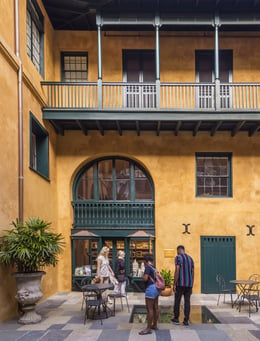
Charged with managing more than 600,000 acres of south Louisiana marshland, Stephens’ job put him in contact with many of the hunting, fishing, and trapping families in the region, a number of whom had developed multigenerational carving traditions. Through purchases and commissions—often arranged with the help of his bilingual, French‑born wife, Anne, who was able to speak fluently with Cajun and Creole artists—Stephens eventually amassed more than 1,200 bird carvings, a “tidal wave of decoys that inhabited the third level of our home in Metairie.” Although he never sold any of his birds, he and Anne gifted them to family, friends, and, notably, the Historic New Orleans Collection—now stewards of over 300 of his finest carvings. A large selection of those decoys appears in HNOC’s permanent exhibition A Vanishing Bounty: Louisiana’s Coastal Environment and Culture.
“We had a little conversation with the decoys as to where they might feel most comfortable for the next several hundred years or so,” Stephens says. “They then voted unanimously, along with our family, to make the Historic New Orleans Collection their permanent safe haven.” Explore work from a few of the multigenerational carving families represented in Stephens’s collection below.
TAN, JETT, AND JUDE BRUNET

Hailing from Bayou Lafourche in Galliano, Andrew “Tan” Brunet (1938–2019) was the first carver Stephens befriended, as well as the first he commissioned—“a wonderful beginning to the collection,” Stephens says. A self-described “hatchet man” because of his devotion to primitive tools, Brunet carved birds from a single piece of wood—rather than the usual two-piece head-and-body method—and achieved detailed color and softness through woodburning with a heated icepick. He became a five-time Ward champion before his death in 2019, a legacy the competition honored by creating the Best in World Tan Brunet Memorial Award. His sons, Jett and Jude, were already carving alongside him before they turned 10, mastering his single-piece technique to great effect. Jett (b. 1964) matched his father with five Ward championships of his own, while Jude (b. 1969) added two more, making the Brunets the only family to produce three Ward champions. Having mastered realistic birds, Jett has since moved on to abstract wildfowl carving, winning repeatedly in Ward’s “Interpretive category.


LAURENT VERDIN SR. AND JR.

Descended from Houma and French ancestors, Laurent Verdin Sr. (1909–1991) of Bayou Blue was considered one of the region’s last craftsmen dedicated to carving functional decoys. His reasonable prices and prolific output, over 1,000 decoys a year, made him one of the most frequently represented artists in the Stephenses’ collection after an associate introduced the two—though they nearly never met. “Monsieur Verdin Sr. spoke Cajun French; he didn’t speak English,” Stephens says. “When we went to see him, within a half mile of his place there was a big sign with the S’s painted backwards, and it read, ‘Don’t stop here or get shot.’” Once the associate assured Stephens it was safe to proceed, he and Verdin Sr. began a long collecting relationship, one that eventually extended to the artist’s son, Laurent Verdin Jr. (1936–2019). Carrying his father’s functional techniques into the fine art world, Verdin Jr. crafted far more non-duck confidence decoys, including one of Stephens’s favorite pieces at HNOC: a great horned owl with four faces, meant to simulate the blur of the bird’s rapid 270-degree head movements.


JIMMIE VIZIER

Even though Tan Brunet built his own family carving legacy, his career owed much to another Galliano-based, multigenerational carving clan, the Viziers. Brunet was related to them and lived next door. Jimmie Vizier (1933–2010) taught the young Brunet how to carve, and, like his student, he later earned a posthumous honor of his own—the Ward World Championship’s Jimmie Vizier Memorial Award, created after a number of repeat wins and 29 years of service as a judge. A third-generation carver raised on a houseboat, Vizier learned the craft by watching his father, Odee (1890–1969)—himself part of a lineage that began with Jimmie’s grandfather, Beauregard Julien Vizier (1848–1933). Between stints working boats in the Gulf, Jimmie served three years as a United States marine in Korea. When Stephens met Jimmie, he introduced an associate accompanying him as a marine veteran as well. “Jimmie suddenly jumped off his decoy workbench, hatchet still in hand, and said in no uncertain terms, ‘Once a marine, always a marine!’” Stephens says.


By Kelton Sears, editor
Online Catalog
Explore the Stephens Wildfowl Carving Collection
Browse images of more than three hundred carvings in our online catalog.
Related Exhibitions
A Vanishing Bounty: Louisiana’s Coastal Environment and Culture
Discover the beauty and history of Louisiana’s natural environment—as well as the threats to its continued existence.

Related Stories

How Nutria Took Over Louisiana
What started as a South American import to bolster the fur economy became an invasive threat. From sporting shootouts to nutria gumbo, the state has struggled to cope.

Grass Roots
The native plants of Louisiana’s coast form a vital part of the region’s ecosystem and cultures.
Related Collection Highlights

Audubon’s “Birds of America”
John James Audubon’s masterpiece of naturalist art is on display in a double-elephant folio as part of HNOC’s ongoing exhibition A Vanishing Bounty.

Zanatta Editions Environmental Art Prints
A collection of prints by Jacqueline Bishop and Douglas Bourgeois, donated by art publisher Zanatta Editions, probes the complex relationship between humans and the natural environment.
Related Books


Enigmatic Stream: Industrial Landscapes of the Lower Mississippi River
by Richard Sexton
with essays by Paul Schneider and John H. Lawrence
Shop the A Vanishing Bounty Collection
Browse our curated collection of products inspired by A Vanishing Bounty, now available from the Shop at the Collection.

Subscribe to Our Newsletter
