




Tennessee Williams’s Streetcar Typewriter
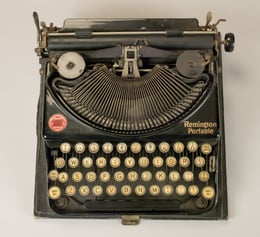
Working on a black Remington, Williams wrote his masterpiece in a French Quarter apartment near the Desire streetcar line.
“If you can imagine how a cat would feel in a cream-puff factory you can imagine my joy at being back in the Quarter,” Tennessee Williams wrote in a letter just after returning to New Orleans in 1945.
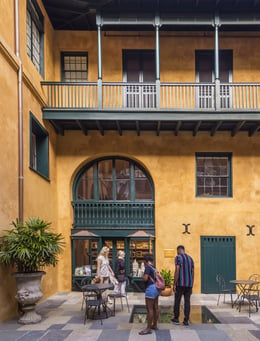
He first resided in the city in 1938 and ’39, renting a garret apartment at 722 Toulouse Street. (This apartment buiding, now owned by HNOC, later became the setting of his play Vieux Carré.) His wartime years were peripatetic, featuring stays in Hollywood, New York, and Provincetown, among other locales. But it was during his second stint in New Orleans that he composed his most famous work, A Streetcar Named Desire.

Staying in an apartment at 710 Orleans Avenue, he could see the back of the St. Louis Cathedral from this window and hear the bells—“the only clean thing in the Quarter,” as Blanche would say. He later moved around the corner to 632 ½ St. Peter Street, where he could hear the clatter of the Desire streetcar as it rumbled down Royal Street. The Desire streetcar line, which served the shopping areas along Royal and Canal Streets and the nightclubs on Bourbon Street, derived its name from its terminus on Desire Street in the Ninth Ward. The route ceased operation in 1948.

On a long refectory table in his St. Peter Street apartment, he pounded the keys of his old Remington typewriter. In an October 1946 letter to director and producer Margo Jones, Williams writes, “Got a lovely furnished apartment my second day, owned and furnished by an antique dealer with real good taste. A huge living room with the sort of worktable in it I’ve always wanted, about half a block long! With a skylight directly over it.”
He noted to his agent, Audrey Wood, that his apartment could be considered a work expense: “As the play has a New Orleans background it can be said that my residence here is for professional purposes.”


As the play developed, he called it by different titles—Interior Panic, The Moth, The Primary Colors, and The Poker Night, before settling on A Streetcar Named Desire. Throughout these various drafts, the setting and characters changed: The Primary Colors is set in Atlanta, where the Stanley character is named Ralph, an Irish immigrant rather than Polish. Another version was set in Chicago, featuring an Italian version of Stanley named Lucio.
Unboxing Tennessee Williams’s Typewriter
While writing Streetcar, Williams was in a tumultuous relationship with New Orleanian Amado “Pancho” Rodriguez y Gonzalez. The minor character Pablo Gonzalez in the play is thought to have been named after Pancho, whose frequent volatile episodes likely influenced the tone of Streetcar. (The character list in a 1947 draft has the typed name “Pancho” crossed out and “Pablo” handwritten to replace it.) According to Pancho, Williams would deliberately provoke arguments and use Pancho’s responses as material: His breaking light bulbs during one episode of anger, for example, became Stanley’s wedding-night smashing of light bulbs in Streetcar.


When Audrey Wood received an early draft of the play from Williams in March 1947, she knew they had something special. She instructed him to stop work on all other projects and focus all his energies on the play.
Williams gave the Remington typewriter to his close friend Maria Britneva (later named Lady St. Just) in 1951.
By Mark Cave, senior historian
More from Our Holdings
Collection Highlights
Dive into the Collection’s holdings with image-rich previews of treasures from New Orleans history.

Tennessee Williams Studies
HNOC is one of four main repositories of the playwright’s work. We produce an annual scholarly journal and conference devoted to Williams, among other research tools, articles, and exhibitions.

Related Events
Tennessee Williams Scholars Conference 2027

Related Stories

Ten Historic Objects That Tell the Story behind “A Streetcar Named Desire”
From Tennessee Williams’s typewriter to Vivien Leigh’s behind-the-scenes photos, items from HNOC’s holdings document the birth of a literary and film classic.

Pulling Back the Curtain on “A Streetcar Named Desire”
HNOC interviewed two Tennessee Williams scholars about the Tennessee Williams Annual Review and the cultural impact of Streetcar.
Related Collection Highlights

Tennessee Williams Family Letters
A new crown jewel in HNOC’s arts holdings finds the playwright in correspondence with one of his biggest influences—his older sister, Rose.
Related Books


Subscribe to Our Newsletter
