







Germans in Louisiana, Part IV
Music and Socializing

Introduction
Together with several benevolent organizations, the New Orleans German community was anchored and enriched by several singing societies. The earliest of these groups, the chorus of the Turn-Verein (1851), was joined by the Deutsche Männergesangverein (1873), the Liedertafel (1878), Frohsinn (1885), the Liederkranz (1889), and eventually the Deutsches Haus Sängerchor (1929), among others. The societies maintained detailed records that provide information about members, discussions of concerts, evening entertainments, excursions to nearby tourist attractions, and their daily operations.
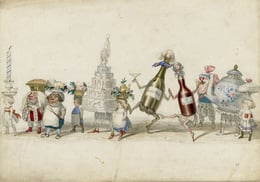
Some societies, such as the Liedertafel, admitted non-German-speaking members in an effort to raise revenues for their expensive spectacles. Eventually such policies led to dissension, and in the case of the Liedertafel, resulted in the formation of a new organization, Frohsinn, which pledged to avoid such dangerous courses of action. The musical productions of Frohsinn were elaborate affairs, requiring managerial skills to coordinate the activity of musicians, singers, soloists, scenic designers, stage bands, ticket sales, security forces, and the local brewery. The German love of music cannot truly be measured by attendance at programs of world famous performers, but rather by their overwhelming participation in the productions. Frohsinn specialized in short musical farces. Their music archive (primarily containing music printed in Germany) reveals much about their entertainments. The color lithographs illustrating the suggested costumes are representative of recurring themes: music, love, marriage, life, and fashion. This collection is referred to as the Deutsches Haus Musik Archiv and is part of the larger Deutsches Haus Collection (MSS 609).
Whenever possible, members of the local singing societies attended the North American Sängerbund Festival, the national convention of German singing societies. New Orleans was chosen for the site of the 1890 gathering, the first in the South. Hosting such an event was a massive undertaking. Five singing societies of New Orleans were expected to host 64 societies with some 1,700 singers. The entire population of New Orleans rose to the occasion. After rejecting the Fair Grounds, Spanish Fort, and the Washington Artillery Hall as sites, it was decided to build an architecturally attractive wooden hall that could seat 5,000 spectators with a stage accommodating 2,000 singers and orchestra. A site facing Lee Circle was chosen as the location for the Sängerfesthalle.
When the curtain rose on opening night (February 12, 1890), the massive hall (150 feet on St. Charles Avenue, 200 feet deep, with a 96-foot stage) held the largest known audience to date for a musical event in the Crescent City. A large pressroom, well stocked with food and a variety of liquid refreshments, accommodated the media. Mayor Joseph Shakspeare, who had studied German for the event, led the citizens in a brilliant display of hospitality during the festival.
Many German musicians who immigrated to the United States established themselves as music publishers. Some German musicians who settled in New Orleans followed that well-established pattern. Emile Johns, the earliest sheet music printer known in New Orleans, was born in Poland and educated in Vienna. His Album Louisianais is believed to be the first music with a New Orleans imprint. Other local German musicians-turned-publishers include Theodore von LaHache, Henri Lehmann, Philip Werlein, and Louis Grunewald. The Werlein and Grunewald firms were celebrated in music on various occasions with images of their stores gracing the sheet music covers.
The Germans of New Orleans remained in contact with other German societies throughout the United States, as well as in Germany. An example of such interchange is the memorial prepared by the Munich Chapter of the Allgemeiner Deutscher Musik Verein (German Music Association) in memory of Jakob Resch, a violinist, born in Munich who died in New Orleans in 1878. The memorial, addressed to the Musicians’ Benevolent Fund of New Orleans, praises Resch’s musical skills and the loving care his adopted city showed him. It is one of 25 items in the section of the Deutsches Haus Collection called “Musical Societies.”
Manuscripts Holdings

- Werlein’s ScrapOpens in new tabbooks. Acc. No. 2005.0154. 7 items.
- Louis Moreau Gottschalk Letter. MSS 301. 1 item.
- Opera in New Orleans Collection. 1898–1925. 82-88-L. 3 volumes.

Visual Materials
Ask a Librarian
Have a question about our holdings, or need more information about visiting the Williams Research Center? Our reference staff wants to hear from you.