






Aeolian Organ Demonstrations
Hear the latest in luxury home entertainment—circa 1920—with free, daily demonstrations of our Aeolian organ.
Want to experience the pinnacle of 1920s home entertainment? Join us for a short program exploring the history of our beautifully restored Aeolian residential player pipe organ.
In this 20-minute demonstration, listen and learn about the significance of this rare musical instrument, which is original to HNOC’s Seignouret-Brulatour Building. In addition to the usual rotation of tunes, seasonal selections are also played throughout the year.
Hear the Organ
Free demonstrations offered Tuesday–Sunday
11–11:20 a.m. and 3–3:20 p.m.
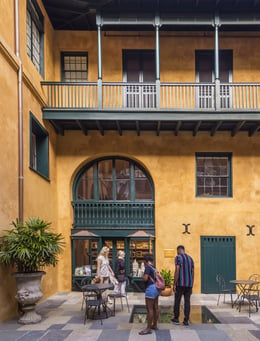
520 Royal Street, Seignouret-Brulatour Building, 3rd Floor
Barbara S. Beckman Music Room
Included with free museum admission, no registration required


The Aeolian organ and music room of the Seignouret-Brulatour house, between 1927 and 1956.
About the Organ
In the early 20th century, having a player organ in the home was a luxury reserved for the most opulent residences, allowing the owner to have access to recorded music before radios and phonographs were commonplace. Tobacco magnate William Ratcliffe Irby remodeled the property at 520 Royal Street—now part of HNOC’s Seignouret-Brulatour Building—to serve as his personal residence starting in 1918. In the process he installed a player organ in the entry room to his lavish third-floor apartment.
The instrument is one of approximately 1,800 built by the Aeolian Company of New York At the height of the trend there were more than a dozen of them along “Millionaires’ Row” on Fifth Avenue in New York City. Today, it is one of only a handful that has survived to this day in its original location and in working condition, after a meticulous restoration by the Holtkamp Organ Company.
Read More
Read about the organ and its restoration on our First Draft blog.


Related Stories

Six Things About the Five-String
Six items from our holdings that tell the story of a uniquely American instrument

Parlor Music and Player Pianos
Before stereos and Spotify, people’s musical lives looked and sounded drastically different.
Related Collection Highlights

Jordan Noble Drum
Noble achieved lasting fame for his role in the Battle of New Orleans. His drum is a cornerstone of HNOC’s holdings related to the conflict and the War of 1812.

Les lys et les roses
A bound volume of eight pieces for piano and voice sheds light on the role of women in New Orleans’s 19th-century music scene.
Subscribe to Our Newsletter
