






Music to My Eyes
Material Culture of Southern Sound
Williams Research Center
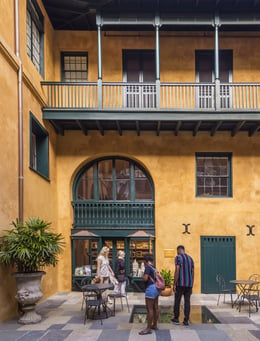
410 Chartres Street
About
From our earliest instruments through mid-twentieth-century recording devices, music has been essential in southern homes, churches, and communities. Attendees of the 2023 New Orleans Antiques Forum will be immersed in the objects and art that embody the development of “southern sound.” Sessions will explore the material culture of parlor entertainment, First Nations social dances and storytelling, musical furniture, early country and western costumes, nineteenth-century opera in the French Quarter, and much more.

Download the Program
Registration
Registration for the 2023 New Orleans Antiques Forum is limited and opens to HNOC members on Tuesday, May 30, at 9:30 a.m. (CDT) and to the general public on Monday, June 5, at 9:30 a.m. (CDT). Single-day registration is available for Friday, Saturday, or Sunday, or attendees can register for the full forum for a discounted price. The champagne reception is included for all attendees. Tickets for optional activities must be purchased separately.
Registration Options
Forum Registration
- Single-day Friday sessions $150
- Single-day Saturday sessions $150
- Single-day Sunday sessions $50
- Full Forum $300 (save $50)
- Young participants (ages 21–30) enjoy half-price tickets for single-day admissions.
Optional Activities
- Preconference Activity (limited to forum registrants) $150
- Brunch at Arnaud’s $85
Parking
Parking is not included with forum admission. A discounted rate of $15 per day will be available to forum participants. Information about how to access this rate will be included in your registration confirmation.
Hotel Accommodations
Discounted rooms are available at the Hotel MonteleoneOpens in new tab, 214 Royal Street, just a few blocks from THNOC. To receive the discounted rate, make your reservations by following this linkOpens in new tab before July 1, 2023. or call the hotel at (800) 535-9595 and identify yourself as a participant in The Historic New Orleans Collection Antiques Forum. Hotel parking is available for an additional fee.

Schedule
Optional preconference activity (additional charge), Backstage at the Museum(s)
8:30 a.m.
Registration
9:30 a.m.
Welcome
Welcome and Introduction Daniel Hammer, the Historic New Orleans Collection, and Tom Savage, moderator, Colonial Williamsburg Foundation
9:50 a.m.
Unbinding Gentility: Southern Parlor Performance in the Nineteenth Century
Dr. Candace Bailey, North Carolina Central University
The artifacts of women’s musical culture in the nineteenth century have historically been dismissed as ephemera, which has resulted in misrepresentations of repertoire, music as a social construct, and degrees of musical accomplishment. Serious study of these items, however, reveals a wealth of information about how music functioned in women’s lives. This presentation focuses on women’s musical culture in Louisiana, with an emphasis on New Orleans, in order to illustrate a multifaceted and nuanced culture that used music as a means to mediate class, race, and education among antebellum women.
10:30 a.m.
Music for All: The Square Piano and the Democratization of Music in Antebellum America
Alexandra Cade, University of Delaware, Sigal Music Museum (virtual)
In the antebellum American South, the accessibility of the square piano transformed the landscapes and soundscapes of domestic music making. With an increasing number of piano makers working in urban centers across the country, the instrument’s design, technology, and availability underwent rapid changes in the decades preceding the Civil War. Closely intertwined with sheet music production and music education, the square piano imparted privileged southern women with a vehicle for aural agency. Through examination of surviving instruments and advertising ephemera of this significant nineteenth-century American industry, this presentation considers how piano makers catered their businesses toward the southern market.
10:50 a.m.
Break
11:05 a.m.
Porch and Dancehall Culture: Louisiana’s Homemade Instruments
documentary video premiere featuring Nick Spitzer, American Routes
11:35 a.m.
The Guitar in American Art: The Evolution of an Icon
Dr. Leo Mazow, Virginia Museum of Fine Arts
The guitar figures prominently in the visual stories Americans tell themselves about themselves—their histories, identities, and aspirations. As meaningful to hear as it is fun to play, the guitar has unique expressive possibilities in the visual arts. This lecture explores the guitar’s symbolism in American art from the early 19th century to the present, demonstrating the instrument’s capability of denoting myriad historical topics, from race and ethnicity to class and gender—and the American music industry itself.
12:15 p.m.
Lunch (on your own)
2 p.m.
Living with Automatic Music from the Past
Robert Skinner, independent scholar
For centuries, self-playing instruments have been a part of musical history as important as their human-played counterparts. From the grand Aeolian organ (such as the one displayed at HNOC) to the humble music box, these automata have delighted people in parlors, exhibition halls and museums. Robert Skinner has had the privilege of collecting and working with these musical examples of decorative art for decades and will present an overview of this almost-forgotten era of recorded sound, the mechanisms, and their makers. This presentation will also include examples of the music created by wonderful machines from the sublime to the over-the-top.
2:45 p.m.
Ambiance in the Air: How the Phonograph Brought Music to American Homes
John McCusker, author and independent scholar
Sound recording technology existed for more than two decades before the phonograph became a typical item in American homes. Why the lag, and how was consumer hesitance addressed by phonograph makers? What is the difference between a phonograph, a Victrola, and a Gramophone? How did the emergence of American music genres—jazz, blues, ragtime—drive the recording industry and the place of music in American homes?
3:30 p.m.
Break
3:45 p.m.
Canebrake: Rivercane and Rattlesnakes in the Music of the Gulf South
Dr. Jeffery U. Darensbourg, tribal councilperson of the Atakapa-Ishak Nation of Southwest Louisiana and Southeast Texas, with Dr. John DePriest, enrolled member of the Choctaw Nation of Oklahoma, Tulane University
From basketry to blowguns, giant rivercane (Arundinaria gigantea) has been arguably the most important plant for the creation of material culture among many Indigenous southeastern communities for thousands of years. The canebrake is also the home of the rattlesnake, or the sinti hollo, or holy snake, whose likeness appears on clothing and in the dances of the Gulf South. This talk focuses on rivercane and rattlesnakes’ roles in music and dance, specifically the creation of flutes and regalia, both for Indigenous communities as well as in the north Mississippi fife and drum tradition.
4:30 p.m.
The Cajun Accordion: From the Front Porch to the Dancehall
Andre Michot, member of the Lost Bayou Ramblers, with Dr. Nick Spitzer, American Routes
Sometimes called “squeeze boxes,” diatonic button accordions came to Louisiana from Germany in the late 19th century, eventually becoming a staple of Cajun music. The accordion became prevalent after World War II, and soon its syncopated style could be heard on front porches and in dance halls across southwestern Louisiana. Musician and accordion maker Andre Michot continues to preserve and maintain cultural traditions centered around the Cajun accordion. Dr. Nick Spitzer, host and producer of American Routes, and Michot will discuss the important history of the Cajun accordion in Louisiana’s heritage.
5:15 p.m.
Champagne Reception
featuring Grammy Award–winner Andre Michot and friends
8:45 a.m.
Registration
9:30 a.m.
Welcome and Introduction
Daniel Hammer and Tom Savage
10 a.m.
“From Every House a Constant Tuting May be Listnd to Upon One Instrument or Another”
Amanda Keller, Colonial Williamsburg Foundation
In the colonial era, music was as pervasive as it is today. Music could be heard in daily life in the work fields, in the campsites of the militia, in the slave quarter, the church, the theater, the ballroom, and the parlor. Writer and politician Landon Carter wrote in his diary during a visit to Williamsburg in 1771, “From every house a constant tuting may be listnd to upon one instrument or another, whilst the vocal dogs will no doubt compleat the howl.” This lecture will explore how people in the greater Williamsburg community interacted with music in their daily lives and how music brought these culturally diverse communities together in a variety of different spaces in the eighteenth century. These musical exchanges allowed for cross-cultural exchange, including American Indian and enslaved and free Black musical influences, which ultimately helped create something that sounded entirely new in early America.
10:45 a.m.
Break
11 a.m.
New Acquisitions and Highlights from The Collection
Lydia Blackmore and Nina Bozak, the Historic New Orleans Collection
The Historic New Orleans Collection actively collects books, documents, art, and artifacts relating to the history and culture of New Orleans, Louisiana, and the Gulf South. Curators Nina Bozak and Lydia Blackmore will present some recent highlights of the collection.
11:45 a.m.
Visual Evidence: Unraveling the Story of the 8th Cavalry Mexican Military Band
Dr. Josh Kun, University of Southern California, with Oscar Rossignoli
This talk will explore the history of the 8th Cavalry Mexican Band as told through various historical objects—sheet music, ephemera, and photographs—associated with their presence in New Orleans in the late 1800s. In addition to revisiting the archives, Kun will also discuss his 2021 artistic project for P.5 (Prospect New Orleans 5), Over and Over the Waves, which connected the Mexican Band’s history to 21st-century histories of music and migration in New Orleans through an original sound mix, an exhibition, and live performances of newly commissioned compositions inspired by the band’s repertoire. Kun will be joined by acclaimed New Orleans pianist Oscar Rossignoli.
12:15 p.m.
Lunch (on your own)
1:45 p.m.
Suiting the Southern Sound: Country and Western Costumes
Holly George-Warren, author and independent scholar
Since the 1930s, country music has been closely identified with visual style, with fashion playing a key role in defining artists’ public personas. Decorative western suits, embellished with figurative embroidery, colorful fringe, and sparkling rhinestones, became de rigueur among artists like Louisiana’s Webb Pierce, Faron Young, and Jimmy C. Newman; Alabama’s Hank Williams; and Texas-born stars Gene Autry, Ernest Tubb, Lefty Frizzell, and George Jones. These lavish outfits often boast imagery symbolizing hit songs or the artist’s name, and were created by custom tailors—Nudie Cohn, Rodeo Ben, Nathan Turk, and Manuel Cuevas—who immigrated to America from Eastern Europe and Mexico. Mississippi-born Marty Stuart, who outfits his band in custom-made suits and has amassed a collection of historic costumes, says country artists “wore rhinestones as if they were badges on a uniform.”
2:30 p.m.
Opera and Its Material Culture in Nineteenth-Century New Orleans
Dr. Charlotte Bentley, Newcastle University, United Kingdom
This talk explores how opera permeated the social and cultural life of nineteenth-century New Orleans by looking at a range of music-themed materials intended for use within the city’s theaters and beyond their walls. Together, these items help us understand the fascinating position New Orleans occupied within the rapidly expanding operatic world of the period, and they also give us new and exciting glimpses into the lives of the people whose efforts made the city a flourishing hub for opera.
3:15 p.m.
Break
3:30 p.m.
Ceremonial Objects of the Easter Rock Traditions, with short documentary film screening
Dr. Joyce Marie Jackson, Louisiana State University
The Easter Rock is an annual ritual centered on the death and resurrection of Jesus Christ and involves spiritual-based music and the performance of circular movements or ring shouts in a plantation church in Northern Louisiana. A carefully constructed assemblage of symbolic icons and intricate performance practices, the Easter Rock ritual is drawn from a variety of contexts: baptisms, funerals, jubilees, revival camp meetings, as well as non-Protestant African-derived religious traditions. This pre–Civil War ritual provides an alternative lens to view African American women in this rural sacred space through “hidden transcripts.” For this research, Dr. Jackson draws heavily on ethnographies of current participants and observations. Accompanying the presentation will be the fifteen-minute documentary film Easter Rock./p>
4:30 p.m.
Bubbles at Brennan’s Happy Hour (optional, with special pricing available for forum attendees)
Roost Bar in Brennan’s Restaurant, 417 Royal Street
8:45 a.m.
Registration
9:30 a.m.
Welcome and Introduction
Daniel Hammer and Tom Savage
9:45 a.m.
Decorative Arts of the Gulf South Field Report
Sarah Duggan, the Historic New Orleans Collection, with DAGS field work interns
The Decorative Arts of the Gulf South (DAGS) project at the Historic New Orleans Collection catalogs historic objects made or used in Louisiana, Mississippi, or Alabama dating from the eighteenth century to 1865. Its discoveries about Gulf South material culture are available in a free online database hosted by the Louisiana Digital Library and managed by HNOC staff. These artifacts shed light on everyday life in the past and the complex economic networks fueled by the enslavement economy. Annual DAGS summer internships give graduate students and emerging professionals the opportunity to learn about Gulf South history while gaining hands-on cataloging experience. This year’s team documented historic objects in Iberia Parish and other parts of the Bayou Teche region in south Louisiana.
10:15 a.m.
Congo Square: The History of a Sacred Place Told through Its Objects
Freddi Evans, author and independent scholar
This presentation will cover the known material culture of the nineteenth-century Sunday gatherings of enslaved and free people of African descent in Congo Square. It will include musical instruments that the gatherers modeled after prototypes from their homelands; the wide range of clothing that gatherers wore, such as tignons, a headwrap that both enslaved and free women wore; and popular food items that were part of the economic exchange, such as pralines, calas, and ginger beer. Other items of material culture include slave passes and emancipation papers, which some gatherers carried with them daily.
11 a.m.
Break
11:15 a.m.
Preserving Landmarks of New Orleans Music History
Jordan Hirsch, ACloserWalkNola.com
This presentation will cover the preservation efforts currently underway at several music history landmarks in New Orleans, including the Eagle Saloon, Iroquois Theater, and Karnofsky building on the 400 block of South Rampart Street; Perseverance Hall in the Seventh Ward; and the Dew Drop Inn and Buddy Bolden house in Central City. It will explain how each site’s architecture relates to the city’s musical heritage, from the birth of jazz to rhythm and blues.
Noon
Closing Remarks
Daniel Hammer and Tom Savage
12:30 p.m.
Brunch (optional, with additional charge)
Arnaud’s Restaurant, 813 Bienville Street
Events are held in the Boyd Cruise Room, Williams Research Center, 410 Chartres Street, unless noted otherwise.
Optional Activities
Thursday, August 3 • 2–7 p.m.
$150 per person, food and beverages included
The music of New Orleans and the Gulf South region is world famous, rich in history, and foundational to the area’s culture, traditions, and economy. This “backstage pass” will provide participants with exclusive access to objects and experiences that help tell the stories of our music and musicians. This experience is only available for participants of the Antiques Forum.
Participants will meet at the Williams Research Center (WRC), home to more than a million objects in the holdings of The Historic New Orleans Collection. Our experts will present a carefully curated selection of artifacts of interest to forum attendees including items belonging to the Boswell Sisters, Louis Moreau Gottschalk, and new acquisitions from the estate of Chris Owens. Also on view will be the only known photograph of Buddy Bolden, stunning dance cards from long-ago Mardi Gras balls, and antique instruments, including a drum used by four-war veteran Jordan Noble and a clarinet owned by jazz legend Sidney Bechet.
Participants will enjoy refreshments in a private historic courtyard at the WRC (weather permitting) after viewing the objects.
Next, participants will be shuttled to the Jazz Museum on Esplanade Avenue where the museum’s director and music curator will host an afternoon behind the scenes at the museum. Participants will have a chance to preview an exhibition on jazz musician King Oliver, view rare objects from the museum’s holdings, and enjoy a private concert of “antique” music by world-class musicians.
Finally, participants are invited to join Jazz Museum supporters and VIPs at the opening reception for the King Oliver exhibition before returning on the shuttle. Participants will receive a drink token for the cash bar at the event.
Attendees will meet at the Williams Research Center at 2 p.m. Shuttles will depart the WRC at 3:30 p.m. and arrive at the New Orleans Jazz Museum at approximately 4 p.m. The shuttles will depart the Jazz Museum at 7 p.m. and make stops at the WRC, the Premium Parking lots on Decatur Street (if requested), and the Hotel Monteleone.
Sunday, August 6 • 12:30–2 p.m. $85 per person
Celebrate the conclusion of the 15th New Orleans Antiques Forum. Socialize, meet the speakers and staff, and enjoy classic Creole cuisine in one of the city’s most prestigious restaurants.
Menu
1st Course
Shrimp Arnaud—Gulf shrimp marinated in our famous tangy Creole remoulade sauce on assorted lettuces
2nd Course
Herb-crusted Gulf fish—succotash, stone-ground mustard and caper chardonnay cream
3rd Course
Blueberry upside-down cake
Includes house wine and champagne, mimosas, Bloody Marys, milk punches, as well as soft drinks, iced tea, hot tea, and coffee
Speakers

Tom Savage
Tom Savage
In 2021, Tom Savage was appointed director of educational travel and conferences for the Colonial Williamsburg Foundation, following a sixteen-year career at Winterthur Museum, Garden, and Library as director of museum affairs and director of external affairs. From 1998 to 2005, he was senior vice president and director of Sotheby’s Institute of Art, where he directed Sotheby’s American Arts Course, and from 1981 to 1998 he served as curator and director of museums of the Historic Charleston Foundation. A native of Virginia, Savage received a BA in art history from the College of William and Mary and a master’s degree in history museum studies from the Cooperstown Graduate Program of the State University of New York. Savage currently serves on the board of governors of the Decorative Arts Trust. He is a former trustee of the Royal Oak Foundation, the Attingham Summer School, and the Sir John Soane’s Museum Foundation. In addition, he served as a presidential appointee to the Committee for the Preservation of the White House from 1993 to 2002.

Dr. Candace Bailey
Dr. Candace Bailey
John C. Neville Distinguished Professor of the Visual and Performing Arts Candace Bailey teaches musicology at North Carolina Central University. Her research examines women’s musical practices of the nineteenth-century South. She has published widely on topics in this area, including Music and the Southern Belle (2010), Charleston Belles Abroad (2019), and Unbinding Gentility (2021). Bailey’s recent work includes a study of social networks among people of color in antebellum New Orleans, the idea of the salon in New Orleans, and transatlantic sites of memory and music. She has held fellowships from the NEH, the National Humanities Center, and Duke University, among other awards, and she currently serves as a Fulbright Specialist in American studies.

Alexandra Cade
Alexandra Cade
Alexandra Cade is a PhD candidate in the history of American civilization at the University of Delaware and an adjunct curator at the Sigal Music Museum. An interdisciplinary scholar and musician, Cade studies the material culture of music, performance, and tourism in the early 19th-century Atlantic world. She has worked at the Colonial Williamsburg Foundation and has undertaken fellowships at the Winterthur Museum, Garden, and Library and the Museum of Early Southern Decorative Arts. Cade received her BM in viola performance from the Eastman School of Music and her MA from the Winterthur Program in American Material Culture, where she completed her thesis on amateur-made antebellum American pianos.

Nick Spitzer
Nick Spitzer
Nick Spitzer is a folklorist and a professor of anthropology and American studies at Tulane University. He specializes in American music and the cultures of the Gulf South, and received a PhD in anthropology from the University of Texas in 1986, with a dissertation on zydeco music and Afro-French Louisiana culture and identities. As Louisiana State Folklorist (1978–85), he created films, festivals, exhibits, and recordings of regional music, and he co-produced a 90-minute Folk Festival USA special on Louisiana music for NPR, helping to bring Cajun music and zydeco to national visibility. Spitzer directed the film Zydeco: Creole Music and Culture in Rural Louisiana (1986) and has produced or annotated two dozen documentary sound recordings. In 2002 he co-curated Raised to the Trade: Creole Building Arts of New Orleans at the New Orleans Museum of Art. His weekly radio show, American Routes, reaches nearly a million listeners each week on more than 268 stations and via its website.

Dr. Leo Mazow
Dr. Leo Mazow
Leo G. Mazow has been the Louise B. and J. Harwood Cochrane Curator of American Art at the Virginia Museum of Fine Arts (VMFA) since 2016. A specialist in 19th- and 20th-century American painting and cultural history, he received his PhD at the University of North Carolina at Chapel Hill. Most recently he curated and wrote the accompanying publication for Storied Strings: The Guitar in American Art, which opened at VMFA and is on view at the Frist Art Museum in Nashville through August 2023.

Robert Skinner
Robert Skinner
Robert Skinner has been collecting and restoring automatic instruments for more than forty years for private collections, individuals, and museums. He has been a member of AMICA (Automatic Musical Instrument Collector’s Association) and will be the host for the annual convention held in New Orleans in July 2023. AMICA’s mission is to educate the public about this unusual genre of music with lectures, presentations, and concerts.

John McCusker
John McCusker
John McCusker is a New Orleans native who worked as a photojournalist for three decades at the Times-Picayune and later at the New Orleans Advocate. He was part of the team that shared the 2006 Pulitzer Prize for Journalism for covering Hurricane Katrina. He is author of Creole Trombone: Kid Ory and the Early Years of Jazz (2012) and coauthor of Jockomo: The Native Roots of Mardi Gras Indians (2019), both published by University Press of Mississippi. McCusker builds cigar box guitars and repairs antique phonographs.

Dr. John DePriest
Dr. John DePriest
John DePriest is a linguist, musician, educator, and songwriter based out of Bulbancha (New Orleans, Louisiana). He earned a PhD from Tulane University studying the interactions of language and music in the brain and has been teaching there in the Center for Global Education since 2016. An enrolled member of the Choctaw Nation of Oklahoma, he is actively working to preserve the Choctaw language and music, including current work on an album of Choctaw music, set to be released in early 2024. He is also the singer, banjo player, and songwriter for the band Bogue Chitto.

Dr. Jeffery U. Darensbourg
Dr. Jeffery U. Darensbourg
Jeffery U. Darensbourg is a writer, performer, multidisciplinary artist, researcher, and activist for Indigenous place names and languages. He is a Louisiana Creole whose lineage includes French, West African, Choctaw, and Atakapa-Ishak ancestors, and he is a member and tribal councilperson of the Atakapa-Ishak Nation. For over a decade he has spearheaded efforts at reviving the original name of the city where he lives, Bulbancha (Choctaw for “The Place of Speakers of Other Languages”), which many know as “New Orleans.” He holds a doctorate in cognitive science, and his artistic work and research show a strong linguistic orientation.

Andre Michot
Andre Michot
Growing up in Pilette, Louisiana, between Broussard and Lafayette, Andre Michot was immersed in south Louisiana music from birth—first joining Les Frères Michot—the band his father and uncles formed in the 1980s —and playing along with greats like Raful Neal, Phil Guy, Larry Garner and others as a teenager. In 1999 Andre and his brother Louis formed the Lost Bayou Ramblers and began to play around south Louisiana, and eventually all over the world. In 2018 the band won a Grammy for their album Kalenda. Michot is also an accomplished woodworker and accordion builder. In 2006, with encouragement from friend and mentor Ray Abshire, he began learning first to tune in the old style, then eventually to build accordions from master builder Randy Falcon. With an incredible and growing collection of handbuilt accordions from all over the globe, his friends often joke that he could found Louisiana’s first accordion museum at his workshop in Broussard, Louisiana.

Amanda Keller
Amanda Keller
Amanda C. Keller is the manager of historic interiors and associate curator of the household accessories collection for the Colonial Williamsburg Foundation. For the past fifteen years, she has been researching and furnishing the historic exhibition buildings to create authentic interiors and designing the faux-food table displays. She has specialized in creating temporary installations that help bring the interiors to life. In addition to writing furnishing plans for the exhibition sites, she was given curatorial responsibilities for Colonial Williamsburg’s household accessories collection and the musical instruments collection. Her first musical instrument exhibition, Making Music in Early America, opened in 2022 in the Leckie Gallery at the Art Museums of Colonial Williamsburg. Currently, Keller is developing furnishing plans for the Williamsburg Bray School, Powder Magazine, and the Thomas Everard parlor.

Nina Bozak
The Historic New Orleans Collection
Nina Bozak
Nina Bozak is a senior curator at HNOC who works with acquisitions, rare books, and performing arts collections. She received her undergraduate degree in history at Loyola University in New Orleans and her master’s degree from the Palmer School of Library and Information Science at Long Island University, concentrating on rare books and special collections. Her 15 years at HNOC were preceded by four years in the special collections libraries at Tulane University and Dillard University, as well as three in the rare book trade of New York at Swann Auction Galleries and Bauman Rare Books.

Lydia Blackmore
The Historic New Orleans Collection
Lydia Blackmore
Lydia Blackmore is a curator at HNOC specializing in material culture, design, Carnival, and architecture. She earned an MA and certificate in museum studies from the Winterthur Program in American Material Culture at the University of Delaware. She also holds a degree in history from the College of William and Mary. As a curator, Blackmore oversees research, acquisition, and preservation of decorative art, fine art, material culture, and design collections. She is also coordinating preservation projects at HNOC’s historic 533 Royal Street campus. In her 12 years at HNOC, Blackmore has curated or cocurated several exhibitions, including Making Mardi Gras (2022), A Vanishing Bounty (2024), and Unknown Sitters (2024). Outside of HNOC, she is a member of the board of trustees of the Historic BK House and Gardens.

Josh Kun
Josh Kun
Josh Kun is a MacArthur Fellow and an author, curator, and cultural historian. He is professor of communication and journalism at the USC Annenberg School, where he holds the chair in cross-cultural communication.

Oscar Rossignoli
Oscar Rossignoli
The sounds that flow from Honduras-born Oscar Rossignoli when he sits down at the piano reflect the path he has taken, starting at age six in his church’s worship band. He attended high school at the National Conservatory of Music in Tegucigalpa, Honduras, where he began his classical training, while at the same time being captivated by the fearless improvisations of Chucho Valdés, Arturo Sandoval, and Michel Camilo. During the day Rossignoli devoted untold hours to his classical studies; at night, with fellow students, he experimented with Afro-Latin jazz improvisation. Sparked by the swinging, blues-inflected playing of the great Oscar Peterson, he embarked on a deep exploration of American jazz piano. At the same time, he began adding improvisational touches to the suites of Chopin and Debussy, blending the harmonic flavors of European classics with his own compositions. Upon completion of his studies at the conservatory, Rossignoli was awarded a scholarship in piano performance at Louisiana State University. “While I came here interested in studying classical and jazz,” Rossignoli says, “New Orleans showed me a world of possibilities in many genres and how they can all blend together. This city is loaded with world-class musicians, so it wasn’t long before I found a group of friends with the same passion, and I got to play with amazing musicians like Brian Blade, Herlin Riley, Jason Marsalis, Nicholas Payton, John Boutté, Donald Harrison, Dee Dee Bridgewater, Victor Goines, Joe Dyson, Bill Summers, the Masakowski family, and so many others.” In short order, Rossignoli’s calendar was full, with musicians calling on him to lend his exquisite touch to modern jazz, traditional New Orleans jazz, funk, bebop, gospel, and more.

Holly George-Warren
Holly George-Warren
Holly George-Warren is the award-winning author or coauthor of eighteen books, including works on music and fashion, including How the West Was Worn (2001) and the forthcoming Behind the Seams: My Life in Rhinestones, with Dolly Parton. Her biographies include Janis: Her Life and Music (2020) and Public Cowboy No. 1: The Life and Times of Gene Autry (2007). She has served as a western wear consultant and featured speaker for several museum exhibitions and documentary films, and her writing has appeared in the New York Times, Rolling Stone, and many other publications. A two-time Grammy nominee, she teaches at the State University of New York–New Paltz and New York University’s Clive Davis Institute of Recorded Music.

Dr. Charlotte Bentley
Dr. Charlotte Bentley
Charlotte Bentley is a lecturer in music at Newcastle University in the United Kingdom, where her research and teaching interests include cultural transnationalism in the nineteenth century and operatic globalization. She was previously a research fellow and affiliated lecturer at the Faculty of Music, University of Cambridge. Her monograph New Orleans and the Creation of Transatlantic Opera, 1819–1859 was published by the University of Chicago Press in November 2022, and her writing has appeared in Cambridge Opera Journal and Journal of the Royal Musical Association, as well as in various edited collections of essays.

Dr. Joyce Marie Jackson
Dr. Joyce Marie Jackson
Joyce Marie Jackson PhD is chair of the LSU Department of Geography and Anthropology and holds the James J. Parsons Endowed Professorship. She earned her PhD from Indiana University–Bloomington in folklore and ethnomusicology, and her core research centers on African and African diaspora performance-centered studies, sacred and secular rituals, carnivalesque identities, and cultural and community sustainability. Her research and publications have scanned the genres of gospel, blues and traditional jazz, and she has produced several documentary recordings with interpretive liner notes published by Smithsonian Folkways Recordings, Capitol Records, and the Louisiana Folklife Recording Series. She has also authored many scholarly works, including Life in the Village: A Cultural Memory of the Fazendeville Community (2003); curated numerous exhibitions with documentary photographer J. Nash Porter; and produced a documentary film Easter Rock, which premiered at the Ethnografilm festival in Paris, France, in 2016.

Sarah Duggan
Sarah Duggan
Sarah Duggan is the project manager of the Decorative Arts of the Gulf South (DAGS) project at the Historic New Orleans Collection, an initiative that documents and shares information about pre-1865 material life in Louisiana, Mississippi, and Alabama. She leads DAGS’s work through data management, cataloging fieldwork, archival research, and two internship programs. In 2021 she cocurated the exhibition Pieces of History: Ten Years of Decorative Arts Field Work. Duggan holds a master’s degree from the Winterthur Program in American Material Culture at the University of a Delaware, and a bachelor’s in history and religious studies from the College of William and Mary.

Freddi Evans
Freddi Evans
Freddi Williams Evans is an independent scholar who is internationally recognized for her scholarship on New Orleans’s Congo Square. She is the author of Come Sunday, A Young Reader’s History of Congo Square (2017) and Congo Square: African Roots in New Orleans (2011), which received the Humanities Book of the Year award from the Louisiana Endowment for the Humanities and is published in French. Her research and advocacy influenced the New Orleans City Council ordinance that made the popular name “Congo Square” the official name of the location. She is also the founder of congosquareconnection.org, which promotes the study of Congo Square.

Jordan Hirsch
Jordan Hirsch
Jordan Hirsch is a writer, researcher, and advocate for the culture bearers of his native New Orleans. He has edited ACloserWalkNola.com—the award-winning interactive map of New Orleans music history—since its launch in 2017. His writing has appeared in Slate, Bitter Southerner, the Lens, and ANTIGRAVITY, among other outlets, and he was a staff writer for the HBO series Treme. Since 2006 he has also worked through the Ponderosa Stomp Foundation to document the lives and promote the careers of the unsung heroes of American music.
Support
The 2023 New Orleans Antiques Forum is made possible by generous support from our sponsors.







Explore the Antiques Forum
Since 2008, HNOC’s New Orleans Antiques Forum has brought together antiques aficionados, scholars of material culture, and fans of finery in a weekend-long celebration of history and aesthetics.

Related Stories

The Curious Mourning Tradition Involving Human Hair
Making keepsakes out of loved ones’ hair may seem gothic now, but hairwork was a Romantic trend of the 19th century.

Stories from 10 Years of Scavenging Attics, Porches, and Parlors
Since 2011, young scholars have spent their summers cataloging historic objects made or used in the Gulf South before 1865.
Material Culture from our Holdings

Leila’s Collectible Boxes
A look inside the Williams Residence offers insight into some of the interior decorating styles of the late 1940s and early ’50s, as well as Leila Williams’s personal collecting interests.

Meeks Dresser
A fine example of early 19th-century furniture, this dresser has a hidden drawer.
Related Virtual Exhibitions
Goods of Every Description: Shopping in New Orleans, 1825–1925
Peer into shop windows of the 19th and early 20th centuries.

Related Books


Complementary Visions of Louisiana Art
with essays by William H. Gerdts, George E. Jordan, and Judith H. Bonner
Subscribe to Our Newsletter
