

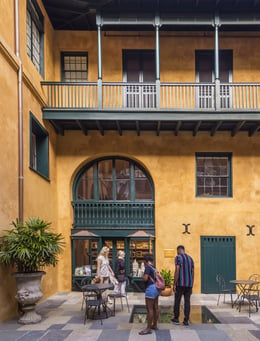








Leila Williams’s Collectible Boxes
A look inside the Williams Residence offers insight into some of the interior decorating styles of the late 1940s and early ’50s, as well as Leila Williams’s personal collecting interests.
A look inside the Williams Residence offers insight into some of the interior decorating styles of the late 1940s and early ’50s, as well as Leila Williams’s personal collecting interests. In this video, Interpretation Assistant Kurt Owens takes you through several rooms of the house, examining the unique little boxes—tea caddies, card boxes, and more—that can be found throughout the home.
By Xiomara Blanco, media producer
Williams Residence
Currently closed for repairs, the historic townhouse offers a window into the day-to-day life of HNOC’s founders in midcentury New Orleans.


Meet Our Founders
Kemper and Leila Williams turned their interests in Louisiana history and French Quarter preservation into a lasting legacy.
Online Catalog
Search or browse through HNOC’s vast collection of manuscripts, artifacts, books, artwork, and more in our online catalog.

Related Stories

Beyond the Planter’s Pen
Two decorative arts fellows are part of a growing wave of scholars challenging established norms in the field.

What to Do If Your Belongings Are Damaged in a Disaster
Damage from fire, water, and debris can ruin prized possessions. HNOC shares tips for DIY remediation and when to seek professional help.
Material Culture from our Holdings

Meeks Dresser
A fine example of early 19th-century furniture, this dresser has a hidden drawer.


Streetcar Operator’s Cap
A cap from the Marie Finhold Streetcar Collection anchors an in-gallery display of streetcar memorabilia and artifacts.
Related Virtual Exhibitions
Goods of Every Description: Shopping in New Orleans, 1825–1925
Peer into shop windows of the 19th and early 20th centuries.

Related Books


New Orleans, the Founding Era
edited by / édité par Erin M. Greenwald
translated by / traduit par Henry Colomer

Furnishing Louisiana: Creole and Acadian Furniture, 1735–1835
by Jack D. Holden, H. Parrott Bacot, and Cybèle T. Gontar, with Brian J. Costello and Francis J. Puig
edited by Jessica Dorman and Sarah R. Doerries
Subscribe to Our Newsletter
