






How the Circus Helped Define Childhood, and Vice Versa
For a long time, the circus was no place for children. With the rise of mass manufacturing in the late 19th century and new ideas about childhood, that changed.
By Betsy Golden Kellem, guest contributor
June 24, 2025
By Betsy Golden Kellem, guest contributor
 Delight & Distraction: Material Culture of Southern Amusement
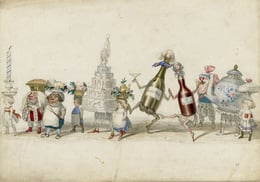
Once upon a time in America, a show of untold spectacle and wonder traveled the country. A motley crew would roll into town on the rails, raise a sprawling canvas city in a matter of hours, and draw in so much of the local population that schools and workplaces wouldn’t even pretend to open for the day. No one would dare miss Circus Day—children, least of all.
For a long time, however, the circus had been no place for children. It became America’s model family entertainment thanks to a special mix of events, people, and trends that came together in the late 1800s.
Entrepreneurs were eager to court the growing middle class and their disposable income. Childhood was increasingly understood as a separate, sensitive phase of life with its own needs and wants. And thanks to developments in merchandising and technology, the circus was happy to create and sell artworks, souvenirs, and toys that kept circus dreams alive long after the train had chugged onward.

Prior to the Civil War, circuses had to square up against the fact that many religious communities thought of them as peddling immoral, idle entertainment. A menagerie might be excused: animals, after all, were at least a means to learn about natural history and see creatures from Biblical allegory. But circuses, with their skimpy costumes and often political humor? They were not respectable.
Entrepreneurs like P. T. Barnum and the Ringling Brothers changed public opinion for good. Barnum’s initial rise to fame in the mid-19th century came on the success of his American Museum in New York City, a multistory palace of wonder dedicated to what Barnum deemed “instructive entertainmentOpens in new tab.” Under one roof, Barnum offered many of the same components that would come together in his Greatest Show on Earth: human curiosities, remarkable performances, live animals, exotic arts, and antiquities. He was careful to assure audiences that only moral entertainments would be offered, in an affordable, alcohol-free environment. Likewise, when Wisconsin’s Ringling Brothers got into the circus business in the 1880s, they so carefully catered to respectable families with their performances that they came to be known in the biz as a “Sunday-school show.”


This worked in part because, at the time of the circus’s rise, Americans were starting to understand childhood in a new way. Instead of thinking of kids as property, miniature adultsOpens in new tab, or convenient sources of labor, society began to see children as blank slates, with minds and hearts that should be well molded by a moral, nurturing home life.
“Families no longer were as dependent on children and their mothers to provide labor on farms or to serve as additional income earners in factories,” writes Jennifer Lemmer Posey, curator for the Ringling Museum, in the circus journal BandwagonOpens in new tab.
Improvements in health care and in living conditions also lowered the mortality rate for children. Culturally, childhood was being reconceptualized as a special time of growth and intellectual development, a series of developmental stages. These new attitudes brought about the professionalization of teaching and the introduction of compulsory schooling laws. And so childhood and learning became increasingly linked.
The circus was perfectly suited to the idea that children should be held and educated in a protective state of innocence. This is clear when we look at the material culture of the circus.

Thanks to advances in manufacturing, lithography, and distribution, playful merchandise became part of the circus experience from the 1880s onward. Merchandise was an important way to extend the experience of the show forward and backwards in time. Anticipatory posters built up excitement in the imagination; the show itself captivated crowds; and take-home storybooks and keepsakes allowed children (and their parents) to keep the show alive in memory. Since the circus was a naturally engaging topic for children, circus toys, games, and books helped encourage play—increasingly understood as a child’s best path towards learning.
Charles Martin Crandall’s construction setsOpens in new tab turned acrobats’ human pyramids into an exercise in building and balance. In the early 1900s, cast-iron pull toysOpens in new tab allowed children to mimic the street parades that announced circuses’ arrival in town. Stuffed toys, safe and cute, “have educational value in teaching children about animal life,” according to a 1920 trade magazineOpens in new tab. BooksOpens in new tab taught about the alphabet, natural history, and colonialist incursion into far-away lands. Toy trainsOpens in new tab honored the massive logistical effort that brought the circus from town to town each year, and modeled industrial development. Even Barnum’s animal crackersOpens in new tab (created in 1902 by the National Biscuit Company, then portrayed in the typical cage wagonOpens in new tab) brought the circus tangibly into everyday life.

Barnum’s animal crackers became ubiquitous over the 20th century thanks in no small part to its clever packaging design, fashioned after cage wagons or railcars used to transport circus animals. Nabisco released them from their cages in 2018, introducing a new design that depicts the animals roaming free on an African savannah.
Sometimes merchandising was more a matter of striking while irons were hot, rather than incorporating an educational agenda. When Barnum featured the elephant Jumbo in the circus in the 1880s, the animal’s outsized presence led brands to use him as a mascotOpens in new tab for everything from castor oil to sewing thread.
Though circus attendance has declined in recent decades, its iconography remains a part of the cultural landscape. Whether didactic, collectible, or just plain fun, toys cross between generations as vehicles for wonder and nostalgia. In the playroom, it is always Circus Day.
Betsy Golden Kellem is an independent scholar. Her writing has appeared in outlets including The Washington Post, Atlas Obscura, The Atlantic, Smithsonian, and Vanity Fair. Read more on her blog, Drinks with Dead People.
Delight & Distraction: Material Culture of Southern Amusement
Related Stories

African American–Made Furnishings from the Pre–Civil War Gulf South
The work of the Decorative Arts of the Gulf South project has revealed stories of African American material culture throughout the region.

Stories from 10 Years of Scavenging Attics, Porches, and Parlors
Since 2011, young scholars have spent their summers cataloging historic objects made or used in the Gulf South before 1865.
Material Culture from our Holdings

Meeks Dresser
A fine example of early 19th-century furniture, this dresser has a hidden drawer.

Leila’s Collectible Boxes
A look inside the Williams Residence offers insight into some of the interior decorating styles of the late 1940s and early ’50s, as well as Leila Williams’s personal collecting interests.
Related Virtual Exhibitions
Goods of Every Description: Shopping in New Orleans, 1825–1925
Peer into shop windows of the 19th and early 20th centuries.

Related Books


New Orleans, the Founding Era
edited by / édité par Erin M. Greenwald
translated by / traduit par Henry Colomer
Subscribe to First Draft
