








Williams Residence
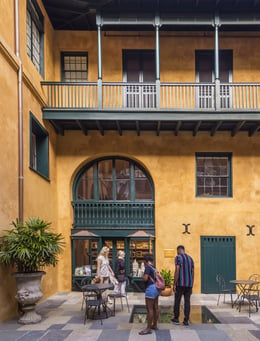
Italianate townhouse, built ca. 1889
This property is a keystone of the 533 Royal Street site, with access to three surrounding courtyards. It was used as a private residence and furnished apartments before being purchased and subsequently renovated by Kemper and Leila Williams. It remains in its 1940s condition as HNOC’s historic house museum.

Timeline
1797: The lot is the site of Merieult’s stables and slave pens.
1850s: Theodore Moreau builds a warehouse on the site.
1889: Jean-Baptiste Trapolin purchases the front half of 718 Toulouse, rejoining the front and back halves of the lot. Trapolin builds an Italianate townhouse that abuts his Royal Street property. This private home sits back from Toulouse Street with a yard in front, an unusual feature in the French Quarter. The Trapolins may have lived in some parts of the house at some point, but as early as 1894 the property was advertised as “Furnished Rooms, with or without board.”

1921: The property is purchased by Louise Brana, famous French cook of the Café de L’Entre Act at the French Opera House. Madame Brana’s home becomes a center of French expat society in the French Quarter.
1938: Kemper and Leila Williams purchase the property along with the Merieult House at 533 Royal Street. While the Williamses make renovation plans for their French Quarter properties, they allow the city to use the first floor for the WPA Art Gallery, with two apartments on the second floor.

1945: Leila and architect Richard Koch renovate the house to turn it into a comfortable mid-century home.
1964: The Williamses moved to the Garden District but maintain the furnishings of their French Quarter residence, with the goal of “preserving the way of life in the Quarter in bygone days.”

1966 and 1971: Leila and Kemper Williams die, respectively, establishing the Historic New Orleans Collection through their wills.
1974: The Williams Residence opens for guided tours as a historic house museum.
Williams Residence
Currently closed for repairs, the historic townhouse offers a window into the day-to-day life of HNOC’s founders in midcentury New Orleans.


Related Stories

The Story Behind Some of TV’s Most Haunting Ruins
Before appearing in HBO’s “True Detective” and Beyoncé's “Lemonade,” Fort Macomb provided a crucial line of defense for New Orleans and the country at large.

Discovering Stained Glass in New Orleans
How a Michigan widower found inspiration in the sacred glasswork of the Crescent City.
Related Collection Highlights


Mother St. Croix Photographs of Ursuline Convent
The ebullient nun documented her cloisters, sisters, and pupils with care and skill. In doing so she became the earliest known woman to photographically record daily life in New Orleans

Clarence John Laughlin Archive
Through his dreamlike black-and-white images, the surrealist Louisiana photographer explored, amplified, and commented on the mystique of the South.
Related presentations
Vieux Carré Survey Case Study

Related Books


Haunter of Ruins: The Photography of Clarence John Laughlin
with essays by Jon Kukla, John H. Lawrence, Andrei Codrescu, Ellen Gilchrist, Shirley Ann Grau, Jonathan Williams, Albert Belisle Davis, and John Wood

Spanish New Orleans and the Caribbean / La Nueva Orleans y el Caribe españoles
edited by Alfred E. Lemmon
Related News

NOLA.com: Former K-Paul’s Louisiana Kitchen Gets a New Life and a New Name

NOLA.com Features HNOC’s Paul Prudhomme Building Among 19 Award-Winning Historic Renovation Projects

NOLA.com: This Former French Quarter Restaurant Will Now Tell New Orleans History After $6.4M Renovation
Subscribe to Our Newsletter
