







One Single Place
Louisiana and the Shaping of the Early American Republic
Williams Research Center
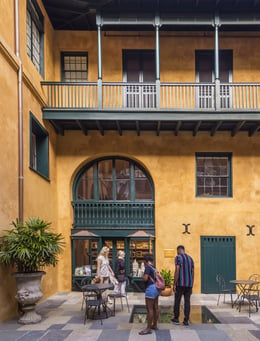
410 Chartres Street
This event is sold out
About
In celebration of the United States’ 250th anniversary, HNOC and the New Orleans Foundation for Francophone Cultures (Nous) will copresent a daylong multimedia program that traces the shaping of our American identity through presentations, films, and musical performances. The 2026 History Symposium focuses on the years following the Revolutionary War, when cultural exchange and trade—particularly between Native Americans and Francophone colonists along the Mississippi River—changed the perception of what it means to be American. From folktales and musical traditions to the interplay of nationalism and ethnic heritage, join us as we explore a pivotal era in US history through lively discussion and entertainment.

Register
Admission for the 2026 History Symposium is $50 per person, and includes access to activities and sessions on Friday, March 20 and Saturday, March 21.
Note: Registration is closed; this event is sold out.
AccomModations
History Symposium participants are invited to book discounted rooms at the Omni Royal Orleans Hotel,Opens in new tab located conveniently near HNOC’s Williams Research Center.

To receive the rate of $239 per night (excluding taxes/incidentals), interested attendees should call Julie Yates, sales manager/loyalty ambassador, at (504) 529-7020 and provide promotional code “Nous Foundation.”

Schedule: March 20
All Friday activities will be held at HNOC’s Williams Research Center (410 Chartres Street).
Williams Research Center, 410 Chartres Street
Daniel Hammer, president and CEO, the Historic New Orleans Collection
Scott Tilton, executive director and cofounder, Nous Foundation
Dr. Walter Isaacson, author and Professor of History, Tulane University
Dr. Walter Isaacson, bestselling author and professor of history at Tulane University, will deliver the symposium's keynote address. Isaacson will examine the famous Declaration of Independence passage beginning “We hold these truths to be self-evident,” unpacking its words and origins to reveal how this revolutionary sentence shaped the American dream and what it means to our American identity today. A complimentary copy of Isaacson’s new book The Greatest Sentence Ever Written will be provided to registered History Symposium attendees.
Following the keynote address, join us for a champagne toast and book signing in the Williams Research Center’s Boyd Cruise Room for Dr. Walter Isaacson’s new book, The Greatest Sentence Ever Written.
Schedule: March 21
All Saturday activities will be held at HNOC’s Williams Research Center (410 Chartres Street), except for the closing reception which will take place at HNOC’s museum (520 Royal Street).
Williams Research Center, 410 Chartres Street
Dr. Daniel H. Usner, Holland N. McTyeire Professor of History Emeritus, Vanderbilt University
Exploring some of the most significant political, economic, and cultural impacts that Native American nations had on French colonial Louisiana, this discussion will furthermore invite careful consideration of how decades of Indigenous-colonial interaction across the Mississippi Valley proved to be consequential for the formation of a national identity in the early American republic.
Williams Research Center, 410 Chartres Street
Brian Hawkins, artist and filmmaker
Dr. Will Thompson, Dunavant Professor of French, University of Memphis
Dr. Thompson will focus on the historical and cultural context of the Pays des Illinois, that area of the American Midwest explored and settled by the French during much of the 18th century. He will discuss how this part of Nouvelle France was intricately connected with the French-speaking populations to the north (in Quebec) and to the south (in modern-day Louisiana) and beyond. He will also provide examples of how this French heritage continues to be manifested and celebrated in the region.
Hawkins will present a selection of his animations and documentary video as he discusses the ways in which the folklore of the Pays des Illinois has continually evolved to reflect the ethos and heterogeneous roots of the region. While there are common threads of cultural expression that run throughout North America’s French communities, Hawkins will share how people in Old Mines and Ste. Genevieve, Missouri, have made certain traditions, songs, and stories their own—from legends of La Chasse-galerie to the begging quests La Guiannée and Mardi Gras. These living traditions show how Missouri Creoles fit into the constellation of American French communities, and they serve as an anchor, keeping successive generations in touch with their culture as they navigate the process of American assimilation.
Attendees break for lunch on their own in the French Quarter. Lunch will not be provided by HNOC.
Dr. Claire-Marie Brisson, Preceptor in French, Harvard University
Dr. Rachel Doherty, Assistant Director for Programming and Special Projects, University of Louisiana at Lafayette
Dr. Brisson will discuss how in early America, French was not experienced in a single way. For some, especially Huguenot émigrés fleeing religious persecution, adopting English was a conscious choice rather than a loss, shaped by the failures of the French monarchy itself. For others, French remained central to community life, though its meaning shifted across regions: from elite, metropolitan circles to contested borderlands and Indigenous treaty spaces where French served entirely different political functions. This session explores how Frenchness evolved differently across early American spaces and how language shifted between prestige and erasure depending on place, politics, and alliances.
Dr. Doherty will present on nationalist movements and discourses impacting identity formation for Acadian, Creole, and Franco-American people during the 20th and 21st centuries. This discussion is anchored in examples from French and Creole literatures, arts, pop culture, and folklife revival movements, and the consistent presence of occult folklore figures in contemporary arts and literatures.
The speakers will follow their presentations with a conversation considering how these varied experiences shaped who could belong—and on what terms—in an emerging American nation.
Williams Research Center, 410 Chartres Street
Bruce Sunpie Barnes, musician and cultural historian
Dennis Stroughmatt, preservationist, musician, and instructor specializing in Illinois-Missouri French traditional music
This discussion will provide insight into the shared musical traditions of former French settlements along the Mississippi River. The panelists will discuss and present examples of how these common traditions influenced quintessentially American music, from jazz to the blues and rock and roll.
Dr. Jeffery U. Darensbourg, researcher and performer
Joseph Darensbourg, researcher and performer
Multimedia artists and scholars Dr. Jeffery U. Darensbourg and Joseph Darensbourg (enrolled members of the Atakapa-Ishak Nation of southwest Louisiana and southeast Texas) will close out the day, presenting music and stories from the Atakapa-Ishak Nation and discussing the shared musical and cultural traditions of Native people and French colonists in our emerging country.
Williams Research Center, 410 Chartres Street
Celebrate the 2026 History Symposium with refreshments, enjoy live music, and view HNOC’s new interactive exhibition, American Revolution: The Augmented Exhibition, designed and produced by Histovery (a French technology firm).

Speakers

Bruce Sunpie Barnes
Bruce Sunpie Barnes
Bruce Sunpie Barnes is a New Orleans musician, actor, photographer, author, former park ranger, former high school biology teacher, former college football All-American, and former NFL player. With his musical group Sunpie and the Louisiana Sunspots, he has performed at festivals and concerts in over 53 countries, playing his own style of what he calls Afro-Louisiana music incorporating blues, zydeco, gospel, and Caribbean and African influences. He is a multi-instrumentalist, mastering accordion, harmonica, and piano along with rubboard, talking drum, and djembe. Barnes has recorded seven critically acclaimed CDs, has had compositions featured in 16 Hollywood films, and has acted in such productions as Tremé, NCIS: New Orleans, and Queen Sugar. He is deeply involved in New Orleans parade culture and coauthored the critically acclaimed 2015 book Talk That Music Talk: Passing on Brass Band Music in New Orleans the Traditional Way, which features more than 300 of his photographs. His most recent book, Le Kèr Creole: Creole Compositions and Stories from Louisiana (University of New Orleans Press, 2019), includes a 15-song disc of music composed in Louisiana Creole. He is the Big Chief of the Northside Skull and Bone Gang, one of the oldest existing Black Carnival groups in New Orleans. Barnes is also a member of the Black Men of Labor Social Aid and Pleasure Club.

Dr. Claire-Marie Brisson
Dr. Claire-Marie Brisson
Claire-Marie Brisson is a scholar specializing in North American Francophone cultures, cultural history, and language. She teaches French at Harvard University, where her work bridges literature, film, media, and culturally responsive teaching. Her research explores North American Francophone identity, memory, and place, with particular attention to regional histories across the United States and Canada, including the Great Lakes. A recipient of multiple teaching and sustainability awards, she is the author of the forthcoming book Michiganaise: Tracing Francophone Identity in the Great Lakes (Wayne State University Press, 2026). She is committed to connecting academic research with public dialogue and cultural institutions.

Dr. Jeffery U. Darensbourg
Dr. Jeffery U. Darensbourg
Jeffery U. Darensbourg is a writer, performer, multidisciplinary artist, researcher, and activist for Indigenous place names and languages. He is a Louisiana Creole whose lineage includes French, West African, Choctaw, and Atakapa-Ishak ancestors, and he is a member and tribal councilperson of the Atakapa-Ishak Nation. For over a decade he has spearheaded efforts at reviving the original name of the city where he lives, Bulbancha (Choctaw for “The Place of Speakers of Other Languages”), which many know as “New Orleans.” He holds a doctorate in cognitive science, and his artistic work and research show a strong linguistic orientation.

Joseph Darensbourg
Joseph Darensbourg
Joseph Darensbourg is a native of Bulbancha (Choctaw for “place of many tongues,” aka “New Orleans”) from the Faubourg Tremé, the oldest free people of color neighborhood in the country (predating the United States itself). This neighborhood of gens de couleur libres is a triracial ethnic blend composed of Native Americans, Europeans, and African ethnic Creoles who speak a lingua franca known as Kouri-Vini as well as colonial Louisiana French. A performer of ethnic folk musics, Darensbourg is a singer, violinist, and percussionist member of the Les Cenelles ensemble, which specializes in music inspired by resistance and protest poetry and Les Cenelles gens de couleur libres, civil rights activists who opposed the Code Noir during Reconstruction. He focuses on the Bayou Ballads plantation songs (1840s–1880s). A bookbinder by trade—trained at the oldest bookbindery in the United States (Harcourt, Boston)—he is also a visual art alum of the New Orleans Center for Creative Arts, as well as a member of the oldest early music ensemble in the Americas, New Orleans Musica da Camera (founded in 1965, as was Darensbourg).

Dr. Rachel Doherty
Dr. Rachel Doherty
Rachel Doherty is assistant director for programming and special projects at the Center for Louisiana Studies, a public-facing research center at the University of Louisiana at Lafayette (UL). She taught French at UL while she completed her PhD in Francophone studies. She also taught in French immersion schools in the early 2020s. In 2017 and 2018, Doherty was a fellow at the Canadian Research Chair on Acadian and Transnational Studies at Université Sainte-Anne in Nova Scotia. Since moving to Louisiana in 2012, she has worked closely with populations invested in expanding access to French arts in minority Francophone areas. Doherty is the current president of the Louisiana Folklore Society. Folklore is central to her analysis of the way occult legends are recycled in French North America. She is particularly interested in the history and evolution of nationalist movements in Louisiana, Canada, and the Caribbean, examining the ways that folklore figures are continuously recurring metaphors in modern art and literary movements.

Brian Hawkins
Brian Hawkins
Brian Hawkins is an artist and filmmaker from Kansas City, Missouri, whose work is concerned with the patchwork of memories, historical narratives, and fiction that helps us form a deeper understanding of ourselves and our place in the world. He has produced a series of intricate cut-paper animations that draw inspiration from the music, folklore, and history of his native state. Since 2016, Brian has been collaborating with folklorists, linguists, and the people of Old Mines, Missouri, to produce a body of work inspired by Missouri French culture called Toujours Icitte (We’re Still Here).

Walter Isaacson
Walter Isaacson
Walter Isaacson is a professor of history at Tulane University and an advisory partner at Perella Weinberg Partners, a financial services firm based in New York City. He has been the CEO of the Aspen Institute, the CEO of CNN, and the editor of Time magazine. Isaacson’s most recent publication, The Greatest Sentence Ever Written (Simon and Schuster, 2025), takes readers on a fascinating deep dive into the creation of one of history’s most powerful sentences: “We hold these truths to be self-evident, that all men are created equal, that they are endowed by their Creator with certain unalienable Rights, that among these are Life, Liberty, and the pursuit of Happiness.” Isaacson is the bestselling author of biographies of Elon Musk, Jennifer Doudna, Leonardo da Vinci, Steve Jobs, Benjamin Franklin, and Albert Einstein. He was awarded the National Humanities Medal in 2023 by President Joseph Biden. Isaacson is a member of the American Academy of Arts and Sciences, the Royal Society of Arts, and the American Philosophical Society. He serves on the boards of United Airlines and Bloomberg Philanthropies.

Dennis Stroughmatt
Dennis Stroughmatt
Dennis Stroughmatt, from southeastern Illinois, is a multi-award-winning Illinois-Missouri French speaking fiddler, vocalist, preservationist, and educator who carries on the French cultural traditions that have existed in “Old Upper Louisiana” for over 300 years. Beginning in the early 1990s, Dennis studied with regional French Creole fiddlers and singers including Roy Boyer, Charlie Pashia, Pete Boyer, Annie Pashia, and Ida Portell, among others. He has been featured on NPR’s All Things Considered, at the Smithsonian Folklife Festival, at the Library of Congress, and at the New Orleans Jazz and Heritage Festival, and is a winner of Southeast Missouri State University’s Arthur H. Mattingly Award in Historic Preservation. Stroughmatt is a full-time instructor of music and theater at Wabash Valley College in Mount Carmel, Illinois. For more information, please visit www.creolefiddle.com.

Dr. Will Thompson
Dr. Will Thompson
Will Thompson is Dunavant Professor of French at the University of Memphis, where he is also director of the International and Global Studies program. He currently serves as president of the American Association of Teachers of French. Thompson has been named a chevalier dans l’Ordre des Palmes Académiques by the French Ministry of Education. His research focuses on French heritage in the American Midwest, with an emphasis on the community of Old Mines, Missouri, as well as the manner in which the French Creoles of the Midwest were described in early travel and other writings.

Dr. Daniel H. Usner
Dr. Daniel H. Usner
Daniel H. Usner, the Holland N. McTyeire Professor of History Emeritus at Vanderbilt University, was born and raised in New Orleans and taught university students for 44 years, half of that time at Cornell and the other half at Vanderbilt. He is author of several books that include most recently American Indians in Early New Orleans (Louisiana State University Press, 2018) and Native American Women and the Burdens of Southern History (Louisiana State University Press, 2023). His current work, From Bayou Teche to Fifth Avenue: How Basket Diplomacy Saved the Chitimacha Indian Nation, is scheduled for publication by the University of Nebraska Press in spring 2026.
Support
This program is presented in collaboration with the New Orleans Foundation for Francophone Cultures (Nous), recipients of a grant from the National Endowment for the Humanities, and is presented in commemoration of the United States’ semiquincentennial.

Explore the History Symposium
Since its debut in 1996, HNOC’s History Symposium has become one of Louisiana’s leading public history events. Every year we bring together scholars, experts, and community members to unpack a different topic from our region’s ever-changing narrative.

Related Stories

The Rise and Fall of John Law
The Scottish financier set off a speculation bubble that accelerated development in the early Louisiana colony—and nearly ruined the French economy.

Marie Grissot, the Midwife Who Battled Bienville
In 18th-century Louisiana, bringing new life into the world was difficult and dangerous. So why did Bienville slash the salary of the colony’s only midwife?
Related Collection Highlights

Ursuline Music Manuscript
This nearly-300-year-old songbook is the oldest known music manuscript in Louisiana history.

Robert R. Livingston’s Louisiana Purchase Letter
The coded midnight letter that foreshadowed the largest land transfer in US history

Fortier Embroidery Sampler
A 200-year-old piece of needlework by a young student at the Ursuline Convent sheds light on the lives of Catholic Creole girls in early 19th-century Louisiana.
Related Books

Charting Louisiana: Five Hundred Years of Maps
edited by Alfred E. Lemmon, John T. Magill, and Jason Wiese; consulting editor, John R. Hébert

New Orleans, the Founding Era
edited by / édité par Erin M. Greenwald
translated by / traduit par Henry Colomer

Subscribe to Our Newsletter
