






In Search of Julien Hudson
Free Artist of Color in Pre–Civil War New Orleans
A special retrospective exhibition explores the second-earliest documented painter of African descent in the United States and the first known native Louisiana artist.
Williams Gallery
533 Royal Street
Included with free museum admission
This exhibition is the first retrospective of Julien Hudson (1811−1844), the second-earliest documented painter of African descent in the United States and the first securely known native Louisiana artist. The son of a mixed-race mother and white British father, Hudson was born into freedom. Before the Civil War, communities of free people of color, or gens de couleur libres,flourished in several cities, including Baltimore, Charleston, and especially New Orleans—which was home to the largest such population in the United States.


Hudson’s untimely, mysterious death at age 33 brought his enigmatic career to an end; only a small body of work survives, and it is brought together here for the first time. The exhibition also features works by Hudson’s European and American instructors, colleagues, and competitors, including examples by other free artists of color—who, like Hudson, made indelible impressions upon the art and history of New Orleans.


Support
In Search of Julien Hudson: Free Artist of Color in Pre-Civil War New Orleans is organized by the Historic New Orleans Collection and the Worcester Art Museum. The exhibition is supported in part by an award from the National Endowment for the Arts. Related programming is made possible in part by the National Endowment for the Arts as part of American Masterpieces: Three Centuries of Artistic Genius.
Initial research support for the project was provided by a grant from the Terra Foundation for American Art.

Related Books
In Search of Julien Hudson: Free Artist of Color in Pre–Civil War New Orleans
edited and with an introduction by Erin M. Greenwald, with essays by William Keyse Rudolph and Patricia Brady

Related Stories

What’s the Difference Between Cajun and Creole—Or Is There One?
The answers are tied up in race, class, language, and, of course, history.

The Truth and Beauty of Boyd Cruise, Godfather of HNOC
An artist, curator, and preservationist, Cruise shaped the foundation of the Historic New Orleans Collection.
Related Collection Highlights

Cane River Collection
Over 1,400 legal and financial documents amount to a detailed record of one slice of 19th-century Black Creole life.

La Famil[l]e de Pajaud
The New Orleans–born visual artist pays homage to his roots in this subdued, impactful watercolor.

I Am the Black Woman
A rare series of 14 linocuts by Elizabeth Catlett carries her manifesto on behalf of Black American women.
Related News

Gambit: Musical Louisiana Concert Highlights Works of Underrecognized Creole Composers

WWL Radio: Daniel Hammer Discusses Pope Leo XIV and Upcoming Exhibitions
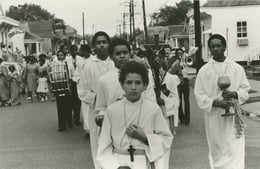
NPR: Why Black Catholics in New Orleans Feel a Special Connection to Pope Leo XIV
Subscribe to Our Newsletter
