






HNOC Launches Improved Collins C. Diboll Vieux Carré Digital Survey
The popular resource for researchers received its first major overhaul since the survey was fully digitized by HNOC in 2012.

The Historic New Orleans Collection is excited to unveil its newly redesigned Collins C. Diboll Vieux Carré Digital Survey.Opens in new tab This free online resource contains detailed property data about every building and lot in the French Quarter, from the French colonial period to the present.

Users of the revamped website will appreciate an improved interface that is easier to use and responsive to modern devices. The changes are part of a multiyear plan to modernize the database and were developed in-house by Web Developer Joshua McKendall with an advisory team led by Kent Woynowski, manager of digital assets and initiatives. The release of the improved survey follows the launch of HNOC’s new website earlier this year.


“After we launched HNOC’s redesigned website, it became apparent that the older research databases needed a redesign as well,” says Woynowski. “Since the VCS is our most-used database, we decided it would be the first to get a redesign. We have worked to incorporate the same user-focused principles that guided the design of the website.”
Originally launched in 2012, the digital survey allows users to access photographs, plans, chain of title records, and citations, with the option to search by keyword, owners’ names, architectural rating, and even whether the owner was a free person of color. It is an extensive survey incorporating maps, major site plans, old drawings, engravings, sketches, paintings, newspaper clippings, property records, and more.

Some survey listings cite documents from the city’s colonial past, such as this plan for a French barracks, located where Antoine’s Restaurant stands today.
The original Vieux Carré Survey was begun in the 1960s to bolster local preservation efforts. Made possible by a grant from the Edward G. Schlieder Education Foundation, survey was managed by the Louisiana Landmarks Society and the Vieux Carré Commission. HNOC cofounder L. Kemper Williams served on the project’s advisory board and provided space for workers and the board to meet on his property in the French Quarter (now part of HNOC’s campus).
After years of steady usage, the survey’s paper pages became fragile and worn. With two goals in mind—preservation and increased access—HNOC undertook the painstaking work of digitizing the survey. Following an extensive data analysis conducted in 2000, HNOC staff began entering property transaction information into a database. The Collins C. Diboll Private Foundation assisted with financing the project, and their support made it possible to complete the transformation. In the end, it took more than 10 years to enter the 53,794 property transactions into the database.


“Personally, this has been an exciting project for both me and Josh,” adds Woynowski. “The digitization of the survey was one of my first projects when I started working at HNOC 16 years ago. And when our web developer, Josh McKendall, first pursued a job at the Collection, he brought a mocked-up VCS redesign to his interview. It has been very rewarding for both of us to bring the survey to where it is today for a new generation of researchers.”
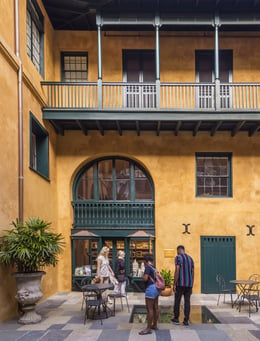
The survey is freely available to the public through HNOC’s websiteOpens in new tab or may be accessed onsite at the Williams Research Center, located at 410 Chartres Street in the French Quarter.
To make an appointment or ask a question about anything related to the survey or HNOC’s holdings, please contact reference@hnoc.org or call (504) 598-7171.
Vieux Carré Survey
Begun in 1960 to bolster local historic preservation efforts, the survey contains detailed property data about every building and lot in the French Quarter from the French colonial period to the present.


Research Tools
Through the Williams Research Center (WRC), HNOC offers scholars access to extensive collections related to the Gulf South, particularly New Orleans and Louisiana.

Williams Research Center
Explore centuries of Gulf South culture with unparalleled access to rare documents, art, and historic treasures.

Subscribe to Our Newsletter
