“If you can imagine how a cat would feel in a cream-puff factory, you can imagine my joy at being back in the Quarter.”
Tennessee Williams, letter to Audrey Wood, January 3, 1946

Enjoy free admission every day. Visit the museum, shop, and café, or resesarch our collections at the Williams Research Center.
Immerse yourself in America’s fight for independence in this new exhibition experience designed and produced by French technology firm Histovery. On view until January 17, 2027.
August 7–9, Material Belief: Objects of Faith, Spirit, and Tradition will explore a rich landscape of antiques shaped by belief, devotion, and spiritual practice across cultures.
Dive into the Collection’s holdings with image-rich previews of treasures from New Orleans history.
June 8–12, Curator Camp is a weeklong summer program for teens who get excited by history, artifacts, and storytelling! Daily hands-on workshops and experiences introduce skills that bring history and museums to life.
The bold personality of New Orleans’s legendary cartoonist and writer springs from the page in this first monograph of his work by Alison Fensterstock and Michael Tisserand. Preorders available August 1.
On October 29, join us in celebrating six decades of preserving, collecting, and making history. Save the date for music, memories, and more at what is sure to be a fantastic night out in the French Quarter.
“If you can imagine how a cat would feel in a cream-puff factory, you can imagine my joy at being back in the Quarter.”
Tennessee Williams, letter to Audrey Wood, January 3, 1946
On March 25, the annual Tennessee Williams Scholars Conference, held in conjunction with the Tennessee Williams and New Orleans Literary Festival, returned to HNOC’s Williams Research Center for its first in-person conference since 2019. Scholars and theater directors from the US and abroad traveled to New Orleans to discuss their work, enjoy each other’s company, and share the audience’s “joy at being back in the Quarter,” as Williams himself described the feeling in a 1946 letter to his agent. The conference’s unconventional format—lively, unscripted exchanges among panelists instead of papers read one at a time—brought more than a dozen speakers into a day-long conversation with each other and the audience.
After two long years without a live conference because of the pandemic, speakers and viewers were more than ready for this year’s focus on joy. The event began with the conference’s first-ever hybrid (in-person and virtual) session: a lightning round of scholars’ favorite images. Audiences enjoyed Xingyue Wang’s pictures of early productions of A Streetcar Named Desire in China, Jeniffer Cruz’s People magazine photograph of an actor in a wheelchair playing the role of Laura Wingfield on Broadway, Anwesha Mukherjee’s reading of the doctor-patient relationship in a still from Streetcar, and original art created by Eric Solomon, whose work traces connections between grief and Williams’s home in Key West.
The second session, “And Tell Glad Stories of the Lives of Queens” (a play on Williams’s drama And Tell Sad Stories of the Deaths of Queens), aimed to correct a popular misperception of Williams’s works—a simplified view that overemphasizes tragedy at the expense of the humor, complexity, and vibrancy in the plays and their transgressive characters. Moderated by Villanova University theater professor Bess Rowen, a panel of scholars brought the joy in many forms: Benjamin Gillespie showed pictures of a gender-fluid Streetcar production whose use of homoerotic postmodern pastiche highlighted agency and levity, and Stephen Cedars discussed “double-edged camp” that both relies on and skewers cliché concepts of southernness. In an examination of the sailor as iconic figure, Michael S. D. Hooper’s provocative pairing of a well-known Norman Rockwell image with a work by artist Tom of Finland (famous for homoerotic drawings of men) drew gasps of surprise and delight from the crowd.
After lunch and a virtual benediction from professor emeritus Robert Bray (who founded the conference in 1995 and directed it until 2021), theater director–scholars Tom Mitchell and Jef Hall-Flavin joined Rowen in a conversation about unconventional stagings and treatments of Williams’s work. Hall-Flavin described his interactive lecture-performance “Cut Blanche,” which uses an audience poll to remove potentially disturbing elements from a scene in A Streetcar Named Desire, illustrating the ways in which censorship—sometimes assumed to be a thing of the past in the US—is alive and well, working invisibly.
The second virtual panel of the day brought in scholars from New York City (Annette J. Saddik) and Germany (Basil Wiesse and Kerstin Schmidt) to discuss recent European productions of Williams’s plays. Particularly memorable were the panel’s images from director Pınar Karabulut’s eye-popping 2019 production of Streetcar in Vienna, in which Stanley and his poker-playing friends strutted around in high heels, wigs, and flowered suits, on a stage lit with colored lights and doused with a waterfall. The actors performed the second half on a flooded stage, and Stanley’s final violent act was to lobotomize Blanche with an ice pick.
Following the panels, the Cruise Room was itself transformed into a stage by another inventive but gentler, more introspective performance: Amor Perdido / Lost Love, a series of Williams’s short stories adapted by Mitchell for the stage and performed by a theater troupe from the University of Illinois and the Celebration Company of Urbana. Live guitar music accompanied a six-person cast—dressed in nostalgia-evoking sepia-colored costumes—who introduced each act by announcing one after another, “I am not Tennessee Williams!” The metatheatrical frame invited the audience to track Williams himself in the stories, which featured a struggling artist on the eve of success, a writer and his soulmate in the French Quarter, and a lonely, haunted young woman resembling The Glass Menagerie’s Laura Wingfield.
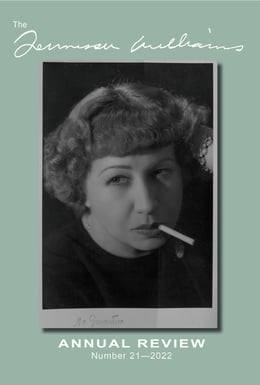
The event was capped off with a reception in HNOC’s Brulatour courtyard, where attendees were treated to after-hours access to Backstage at “A Streetcar Named Desire,” an exhibition commemorating the 75th anniversary of Streetcar’s Broadway debut. A special feature devoted to the exhibition, augmented with additional photographs of early productions of Streetcar from around the globe, appears in the 2022 issue of the Tennessee Williams Annual Review, published by HNOC and debuting in print this week.
Will Brantley, a scholars conference participant every year for the last 20 years—who this year moderated the conference’s first-ever virtual session—spoke for many when he observed “how nice it was to be back in New Orleans, to interact with new Williams scholars, and to see the Festival return to normalcy—a word that Tennessee Williams would probably not have cared for, except in this context.”
An experimental theater production sheds new light on one of Tennessee Williams’s most beloved characters.
HNOC interviewed two Tennessee Williams scholars about the Tennessee Williams Annual Review and the cultural impact of Streetcar.
Tennessee Williams’s most enduring work is produced all over the world, taking on new life as modern dramaturgists apply contemporary themes to the timeless text.
An iconic character’s World War II service and its meaning to postwar audiences
Dialect coach Francine Segal and local actors discuss accents and acting styles seen in the classic film.
From Tennessee Williams’s typewriter to Vivien Leigh’s behind-the-scenes photos, items from HNOC’s holdings document the birth of a literary and film classic.
Subscribe to Our Newsletter