

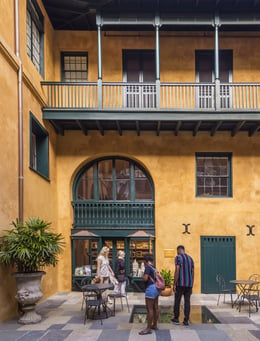


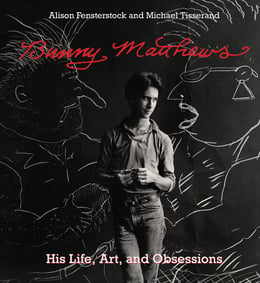
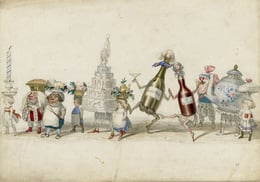

The heart-shredding narratives of Tennessee Williams and the humorous pen-and-ink sketches of Al Hirschfeld symbolize an unprecedented perception of humanity in the arts as much as the history of the American theater itself.

Drawn to Life
Al Hirschfeld and the Theater of Tennessee Williams
by Mark Cave and David Leopold
No other artist so thoroughly documented Tennessee Williams in the playwright’s own lifetime. Hirschfeld’s drawings give a real sense of the performance and personality of the actors who inhabited these roles.

Drawn to Life: Al Hirschfeld and the Theater of Tennessee Williams
HNOC 2010
softcover • 8½" x 11" • 88 pp.
30 color images; 50 b&w
ISBN 978-0-917860-58-4
$15.00
Published in 2011 to commemorate the centennial of Tennessee Williams’s birth, Drawn to Life covers the six decades in which Al Hirschfeld (1903–2003) drew almost all of Williams’s productions, on and off Broadway, as well as two film adaptations, including his landmark series of works based on the 1951 film A Streetcar Named Desire. No other artist so thoroughly documented Tennessee Williams in the playwright’s own lifetime. Like Williams, Hirschfeld was unconstrained by reality, merging literal details with the playwright’s poetic vision. His contribution, Hirschfeld said, was to take the character and reinvent it for the reader. He created a fascinating archive of Williams’s career, one that gives viewers, then and now, a real sense of the performance and personality of the actors who inhabited these roles.
Hirschfeld and Williams both relied on symbols. Hirschfeld interpreted performances through a sophisticated palette of graphic symbols to capture the essence of what the playwright wrote as translated by actors, directors, and designers.


Research
Tennessee Williams Studies
HNOC is one of four main repositories of the playwright’s work. We produce an annual scholarly journal and conference devoted to Williams, among other research tools, articles, and exhibitions.

Related Events
Friday
March 19, 2027
9 a.m.–4:45 p.m.
Signature Program
30th Annual
Tennessee Williams Scholars Conference 2027
Founded in 1995, the Tennessee Williams Scholars Conference is a full day of sessions led by highly acclaimed Williams scholars from across the US and abroad.
Signature Program

Related Stories

First Draft
Local Actors Reveal the Power of “A Streetcar Named Desire”
Dialect coach Francine Segal and local actors discuss accents and acting styles seen in the classic film.

First Draft
Tennessee Williams’s First French Quarter Home
In an attic apartment, the young playwright came into his own as an artist. A new video explores the historic building, which HNOC has owned since 1945.
Related Collection Highlights

Tennessee Williams Family Letters
A new crown jewel in HNOC’s arts holdings finds the playwright in correspondence with one of his biggest influences—his older sister, Rose.
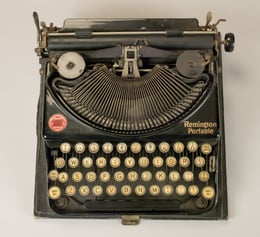
Tennessee Williams’s “Streetcar” Typewriter
Working on a black Remington, Williams wrote his masterpiece in a French Quarter apartment near the Desire streetcar line.
Related Books


Stay Connected
Subscribe to Our Newsletter
