





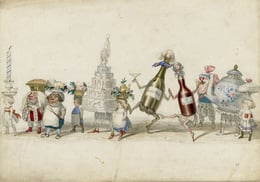


HNOC, acquisition made possible by Mr. and Mrs. R. Hunter Pierson Jr., 2012.0388.25
O Fortuna!
How “A Confederacy of Dunces” made it to the stage and influenced the work of artist Dawn DeDeaux
A 1993 play remains one of the few adaptations of John Kennedy Toole’s Pulitzer Prize-winning novel. Artist Dawn DeDeaux, the play’s production designer, discusses her vision for the show and its influence on her work.
By Molly Reid Cleaver, senior editor
September 30, 2022
A Confederacy of Dunces, John Kennedy Toole’s novel set in 1960s New Orleans, is one of the city’s most iconic pieces of literature, yet adaptations of the work have been rare. In the 42 years since the book’s release—it was published posthumously in 1980, 17 years after Toole first drafted the novel and 11 years after he committed suicide—several planned film adaptations have fizzled. Full-scale stage adaptations have been rare, starting with a 1984 musical and followed by a 1993 play, produced by the Baton Rouge–based Swine Palace, that toured the state and was later revived. The Historic New Orleans Collection is home to the play’s design history, which comprises a series of costume drawings and set designs acquired in 2012 from artist and production designer Dawn DeDeaux.

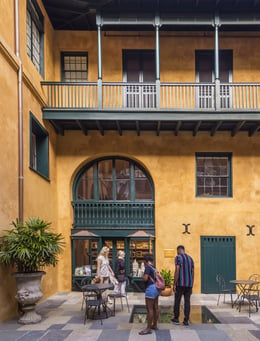
The acquisition came about through THNOC’s participation in Prospect.2, the citywide art exposition held in 2011–12. DeDeaux, a featured artist, created a nighttime multimedia art installation based on the book and its themes, which was installed in The Collection’s historic Brulatour Courtyard in the French Quarter. Titled The Goddess Fortuna and Her Dunces in an Effort to Make Sense of It All, the show called forth the book’s whirling, dark absurdism to explore Roman, medieval, and southern history; reflect on post-Katrina life; and recreate costumes and design elements from the 1993 play.
In Toole’s novel, protagonist Ignatius J. Reilly is a misanthropic medievalist who lives at home with his mother in New Orleans. No hero’s journey, the narrative follows Ignatius as he tries and fails to keep a job, rails against humanity in the modern age, and spews judgment and bodily gases at every opportunity. The book situates Ignatius as a maladjusted antihero surrounded by a memorable cast of supporting characters, who revolve around him in a kind of absurdist dance of life. Echoing that revolution is the theme of the wheel of fortune, represented by the Roman goddess Fortuna, with whom Ignatius dialogues in his daydreams.

Translating such an offbeat ensemble piece to film has proved elusive, but for DeDeaux and her cohort, bringing the book to the stage in 1993 was a rewarding challenge. Barry Kyle, who had recently joined the LSU theater department following a career with the Royal Shakespeare Company, directed; his wife, Lucy Maycock, wrote the playscript; and Kyle asked DeDeaux to serve as production designer. DeDeaux had only one other theater credit to her name, but Kyle, who had seen her solo show Soul Shadows at the Contemporary Arts Center, reassured her. “I didn’t think I was the right person,” DeDeaux recalls. “He said, ‘I don’t care. You’re the person. You may not have the theater language, but you have the theater instinct.’”
DeDeaux designed the set, stage, and costumes, drawing on her upbringing in the city to translate the book’s Pulitzer Prize–winning portrait of New Orleans and its people to the stage. “I’m a New Orleanian, and I knew the book well, so I tried to treat the characters as people just down the street, you know,” she says. “Because New Orleans has such a multitude of characters in every neighborhood.”
Designing Ignatius was simple enough, as clothes are a key component of his character in the book: “He himself is dressed comfortably—in a flannel jacket, baggy pants, and large hunting cap with ear flaps—and regards this as the ideal outfit for a sensible and intellectual person,” Toole writes in the first chapter. The green hunting cap functions as a kind of security blanket for Ignatius and a symbol of his nonconformity; he refuses to take it off throughout the novel.

For the character of Irene, Ignatius’s put-upon mother, “That was easy,” DeDeaux says. “I grew up going to Canal Street with my grandmother, in her little white gloves, to D. H. Holmes. We’d shop and get cake in the café.” DeDeaux also knew something of Toole’s own mother, Thelma Toole, whom she had met years earlier through mutual friends. “She was intense,” DeDeaux says. “She had a very high opinion of herself and was very grand in a theatrical way—a lot of fun. She taught elocution, so every roll of a vowel on her tongue was articulated. And she was a fierce defender and champion of her son and his work. Of course, she’s the whole reason the book was finally published.”
DeDeaux browsed thrift shops for articles and ideas to suit the book’s 1960s setting. One such find, a striped housedress-type shift, became the basis of her design for Santa Battaglia, Irene’s brassy, Italian American friend.


DeDeaux also drew from history, particularly in designing the set. “[Ignatius] didn’t want to face the modern world,” she says. “He lived in this medieval structure in his mind; that’s what he liked. So he was trapped between these two worlds.” DeDeaux materialized the world of Ignatius’s mind, employing Gothic arches centered on a large orb—the wheel of fortune. Stagehands, dressed as medieval dunces in conical hats, changed out the set pieces onstage.

For the character of Lana Lee, the shady owner of the Night of Joy strip club, DeDeaux borrowed from mod fashion, dressing her in tight black pants and a sheer sleeveless mock turtleneck, with a beehive updo. Burma Jones, the Night of Joy’s underpaid, subversive African American janitor, wears black gloves—a nod to the Black Panther movement of the 1960s, DeDeaux said.

DeDeaux and Kyle began working on the Dunces production in late 1991, and in September 1993 the play opened at the LSU Theatre in Baton Rouge, where it enjoyed a solid run. DeDeaux’s “larger-than-life” stage design earned special mention in the Baton Rouge Advocate’s review, as did the lead performance by John “Spud” McConnell, who became so known for the role that in 1996 he served as the model for a life-size statue of Ignatius Reilly that still stands on Canal Street.
When DeDeaux returned to the realm of Dunces nearly 20 years later with The Goddess Fortuna and Her Dunces in an Effort to Make Sense of It All for Prospect.2, she transformed HNOC’s Brulatour Courtyard into Ignatius’s bedroom and inner sanctum. Visions of the goddess Fortuna, portrayed by bounce artists Katey Redd and Big Freedia, were projected on the courtyard walls.

From the upper windows and balconies of the buildings surrounding the courtyard a host of medieval dunce sculptures looked down on the proceedings. The dunce’s caps, she says, were intentional references to the Ku Klux Klan and the double entendre of the book’s titular confederacy. (The phrase “a confederacy of dunces” comes from 18th-century satirist Jonathan Swift, but it also refers to the Confederacy of the American South and, by extension, to the idea of sedition.) The Klan’s connection to Mardi Gras—“the dark side of the frivolity,” DeDeaux says—was represented in a motif of haunting white masks made to resemble those worn by masked Carnival krewes.

When DeDeaux began working on the show, in 2010, New Orleans was still finding its way after Hurricane Katrina, and a massive earthquake in Haiti had just killed roughly a quarter million people. “Things were helter-skelter,” DeDeaux says. “I said, ‘When disasters like this keep happening, you can only turn to the goddess Fortuna.’”
Related Stories

Daniel F. Galouye’s Fantastic Sci-Fi Future
Long before Black Mirror and Severance, science fiction magazines were a potent way to channel modern anxieties into entertainment media. One New Orleans writer became a leading world builder of weirdness.

The Life and Death of Tennessee Williams’s Beloved
Frank Merlo was the poet’s companion for 15 years. In a previously unpublished poem featured in the 2024 Tennessee Williams Annual Review, Williams grieves his death.
Related Collection Highlights

A Confederacy of Dunces
A modern classic, Toole’s absurdist romp through New Orleans almost didn’t get published.

Bob Kaufman Broadside Poems
Three large-format poems represent some of the earliest published works of the “Black American Rimbaud.”

Mosquitoes
William Faulkner’s second novel was inspired by a trip across Lake Pontchartrain.
Related Books


New Orleans Stories,
Delivered to Your Inbox
