







“I discovered that the story of jazz was not being told from a holistic perspective. . . So, I made a conscious decision to accept the challenge, and the rest is music history.”

Tremé’s Homegrown Historian
Founder Al Jackson’s scholarship and personal history come together in Treme’s Petit Jazz Museum.
By Dhani Adomaitis, programming coordinator
February 19, 2026
By Dhani Adomaitis, programming coordinator
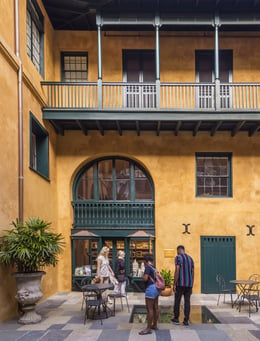
In the Tremé neighborhood, a small museum sits tucked into the corner at 1500 Governor Nicholls Street. Treme’s Petit Jazz Museum is a two-room powerhouse of history and memory that highlights the African and Caribbean roots of jazz and traces the music’s New Orleans origins with the warmth of a neighborhood storyteller. The museum represents the life and collection of Alvin Jackson, a cultural historian and dedicated community advocate whose life story is inseparable from the history of New Orleans.

Born in 1943, Jackson grew up on Orleans Avenue in the Tremé, amid a vibrant Creole community. His mother, who lived with the Holy Family nuns for six years in the French Quarter, kept a close eye on her son. When she sensed he “might be becoming a knucklehead with these front-a-town boys,” as he puts it, she sent him to school at St. Katherine’s on Tulane Avenue, across the street from Charity Hospital. While there, he met Sister Mary Florence, an educator from Belize (then British Honduras) who made an impression that would last a lifetime. “She would always remind us that speaking more than one language was critically important,” Jackson recalls. “And she would never fail to mention, el español es facil—Spanish is easy.”
Motivated by her encouragement, young Al embarked on a quest to become bilingual, but language lessons went beyond the classroom. His maternal grandmother lived just two houses down from the Autocrat Club, which often hosted Spanish-speaking sailors at its concerts and dances. “She didn’t speak Spanish,” he remembered with a belly laugh, “so she could call on me, and I would try to interpret what they wanted.”

Growing up in the Tremé meant being surrounded by music and tradition. Parade clubs and Black Masking Indian tribes formed part of everyday life. His father, a pizza baker at Toney’s Spaghetti House on the 200 block of Bourbon Street, created rituals that tied his son to the rhythms of the city. Every Sunday after Mass at St. Peter Claver, Al and his brothers walked straight up St. Philip to Bourbon Street to visit him at work in the French Quarter. It being the 1950s, the restaurant was segregated, but Jackson and his brothers had a routine for getting some mad money to sweeten their Sunday. “All the waitresses would come outside to give us change,” he says. “[Then] we walked in and straight back into the kitchen. We didn’t stop or try to sit down. We’d talk to Dad, take our change, and walk all the way over to the Carver Theater, where my Uncle Dave was the manager and cousins sold candy. That was just what we did.”

Like seemingly “everybody at that time between Canal Street and Elysian Fields and St. Bernard,” Jackson attended Joseph A. Craig Elementary School. It wasn’t until years later that he realized many of his schoolmates were related to important jazz musicians. Speaking of his friend Benny Jones of the Treme Brass Band, “[as a kid] he had no idea that his dad, Mr. Jones—Chester—was at one time Louis Armstrong’s drummer.” Such revelations were common in Tremé, where cultural royalty lived on every block. Mr. Maurice Justin, the saxophonist/clarinetist for Olympia Brass Band, gave Al his first clarinet. That clarinet is on display at Treme’s Petit Jazz Museum.

Parade culture coursed through the neighborhood, and even as a young boy, Jackson chased parades through the streets—the Square Deal Boys, The Jolly Bunch, The Treme Sports, Treme High Steppers, and others. Jackson’s first experience masking Indian was in 1959 with the Yellow Jackets tribe under Big Chief Thomas Sparks. In 1960, he joined North Side Skull & Bone Gang under Ronald Morris, who is the first cousin of the late Chief Al Morris. On February 17, 2026, Al came out the door as Northside's Gatekeeper, a position long held by the late Ronald Lewis, whom we lost in 2020 to COVID-19. As an adult, Jackson also became a founding member of the Black Men of Labor, marking his first formal membership in a social aid and pleasure club.


Tremé’s cultural life has always been intertwined with activism. Jackson recalls the formation of the organization Tambourine and Fan in the 1970s under Jerome “Big Duck” Smith, with support from community leader Don Hubbard and Rudy Lombard. “This was in the wake of the Black Panther Party’s clashes with police,” Jackson says. “Tambourine and Fan aimed to ‘save young Black lives—especially young Black men.’” The group taught parade culture and civic responsibility while offering a powerful anti-drug message. “Some great guys came out of that,” Jackson said, noting figures such as educator and organizer Dr. Raynard Sanders and activist Fred Johnson.

After graduating from Joseph S. Clark High School, Jackson joined the US Air Force and was sent to Europe. Suddenly, the languages and cultures he’d absorbed in childhood became tools for navigating his life in the military. “Now I’m in a strange place, but I’m not a stranger, because I’d grown up around foreign folk before,” Jackson says. “Most folks would ask, ‘Where are you from? Why do you speak Spanish? You’re not Puerto Rican. You’re not Cuban!’ And I’d laugh and say, ‘No, soy negro puro—I am pure Black.” For six years, Jackson lived in Wiesbaden, Germany, traveling wherever he could—Paris, Madrid, Amsterdam, and Luxembourg. When he was granted several days’ leave, he often flew straight to Spain or boarded the train to Paris, which felt like home. While those years broadened Jackson’s worldview, New Orleans eventually called him back. Even during his absence, “I never lost touch with the culture,” Jackson says.
Returning stateside after his time in the military, Jackson pursued studies in political science, history, and Spanish at Southern University at New Orleans. Jackson went on to hold a number of civic roles under several administrations—Mayor Moon Landrieu, Mayor Ernest “Dutch” Morial, and Governor David Treen. Marriage, four children, and work filled his days. Jackson fondly remembers speaking Spanish to his children in the womb, ensuring that language—like music—remained a family inheritance. He watched his son and daughter mask Indian as children, carrying on the culture that had fascinated him as a young boy. “There’s a photo somewhere of [my] his daughter stepping through the row of marabou [feathers] sewn into the bottom of her apron while eating a bag of CheeWees.”

After a divorce in 1992, Jackson returned to the Tremé for good, rejoining a community that was both familiar and changed. Getting reacquainted meant rediscovering old neighbors, reconnecting with parade culture, and embracing the evolving community. Throughout it all, his affection for the neighborhood remained steady. “We really were a community,” he says. “Somebody’s mother or grandmother would whip your butt if you acted up in the street. We’ve lost some of that. But the culture—it’s still here.”
And so is Alvin Jackson.
Part of his commitment to his neighborhood and to New Orleans has included the collecting of cultural ephemera. From 1995 to 2000, Jackson acted as research curator for the American Federation of Musicians Local 496. He started collecting in 1998, after purchasing the former home of the Negro Musicians Union with Paul Sylvester, the owner of Sweet Lorraine’s Jazz Club and the second great-grandson of Victor-Eugène Macarty, an Afro-Creole pianist. A few years later, Jackson expanded his collection to include artifacts from his trips to the Caribbean. After returning to the Tremé, he says, “I discovered that the story of jazz was not being told from a holistic perspective or, rather, a more inclusive narrative, of the various cultures that contributed towards its development. So, I made a conscious decision to accept the challenge, and the rest is music history.”


Jackson opened the museum in 2012. Jackson’s personal collection includes early musician contracts, commissioned portraits of Creole musicians and composers, rare photographs, parade memorabilia, festival ephemera, and more. Visitors to the museum might stop in expecting artifacts—and they’ll certainly find them—but the true Treme’s Petit Jazz Museum experience is sitting in a chair with a cup of coffee while Jackson unspools the history he loves. He particularly enjoys discussing 19th-century Black composer Edmond Dédé—“born in the Tremé neighborhood and educated in Paris, France”—and Louis Armstrong. His storytelling is equal parts scholarship and lived memory.
This rare combination motivated HNOC and the Louisiana Philharmonic Orchestra to partner with Jackson in developing their 2026 Musical Louisiana concert, “Echoes of Innovation.” Jackson helped curate the program, centering on composers with Louisiana connections who have been overlooked by music history. “Classical music was a mind-blowing experience for me,” Jackson says, recalling the college music-appreciation course that introduced him to the Western canon. “Bach, Beethoven, Mozart, Chopin. Lo and behold, I discovered Dédé, Barès, Lambert, and Macarty. I was flying high. Black composers? 1800s? No way! Yes, way.”

Jackson’s first foray into music curation was a concert held at the New Orleans Jazz Museum in 2018, and soon after he met and found himself inspired by Givonna Joseph of OperaCréole. “My adrenaline has not stopped since then,” he says. “The world, en masse, needs to learn what I learned about classical music in my city.” Jackson’s work might be rooted at 1500 Governor Nicholls, but rather than a project with an end point, Treme’s Petit Jazz Museum has become a container for the calling he continues to answer.
DITS narratives
Dancing in the Streets: Social Aid & Pleasure Club Narratives
Told in the voices of the interviewees themselves, new narratives shed light on the lineages of parading organizations and the neighborhood traditions and practices of second-line parades.

Related Stories

First Draft
Keeping the Beat
Music educators are working to ensure that New Orleans’s marching band tradition continues for generations to come.

First Draft
Not Their First Rodeo
Beyoncé is the latest artist to stir up conversation about country music and Blackness, but she’s not the first. Those roots go back to the beginning of American music.
Related Collection Highlights

Jimmy Maxwell Orchestra Papers
Photographs, diaries, and promotional materials documenting a father and son’s 80 combined years in the music business

Uganda Roberts Tape Collection
The New Orleans percussionist's audio and video tape collection documents his decades-long career, his musical influences, landmark events in the city, and his family and daily life.

Vintage Tipitina’s Posters
HNOC cataloger Emily Perkins picks her favorites from the Tipitina’s posters in the Michael P. Smith Collection.
Related Virtual Exhibitions

Jazz
New Orleans Medley: Sounds of the City
The music of New Orleans is the living product of dynamic cultural interactions played out over centuries in this diverse southern port city.

Jazz
Shout, Sister, Shout!: The Boswell Sisters of New Orleans
Explore the musical legacy of New Orleans’s own Boswell Sisters, who where among the first stars of radio’s golden age.
Related Books

French Baroque Music of New Orleans
edited by Alfred E. Lemmon
with essays in English by Jennifer Gipson, Andrew Justice, Alfred E. Lemmon, and Mark McKnight, and in French by Jean Duron

Ernie K-Doe: The R&B Emperor of New Orleans
by Ben Sandmel
with a foreword by Peter Guralnick
FIRST DRAFT NEWSLETTER
New Orleans Stories,
Delivered to Your Inbox
