







Views of the Vieux Carré
An HNOC exhibition showcases a diverse selection of paintings that reflect the unique character of New Orleans’s French Quarter.
December 15, 2025
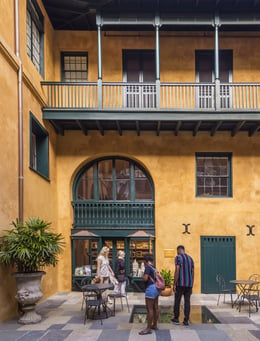
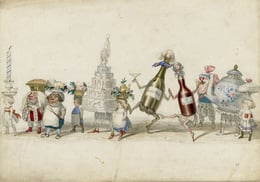
For centuries, artists from around the world have worked to capture and share their impressions of New Orleans’s most iconic and historic neighborhood. HNOC’s French Quarter Life: People and Places in the Vieux CarréOpens in new tab exhibition pairs paintings with literary quotations, offering a multifaceted perspective of the French Quarter, its residents, and the city’s lively culture. These works, drawn from HNOC’s permanent collection, includes gifts from noted Louisiana art collector Laura Simon Nelson. The exhibition explores the architecture, characters, and streetscapes that define life in the Vieux Carré—from private courtyards to public street corners, from the bustling French Market to picturesque Jackson Square.


“I dined at a score of different restaurants . . . none of the great and famous ones. I couldn’t afford them. But the standard of good cooking is higher in New Orleans than in the North. There were little French restaurants which served wine with the dinner, just as in France. Oysters, fresh from the bayous, were ten cents a dozen over the bar . . . and how delicious they were! I made the acquaintance of many dishes new to me, such as shrimp remoulade, jamalai, the famous New Orleans risotto, full of shrimp, peppers, and other mysterious ingredients.”
—William C. Odiorne, unpublished memoir in HNOC’s holdings (ca. 1933)

“New Orleans has accrued centuries of street-level stoop culture, many Creole cottages and shotgun houses built right up to the sidewalk, neighbors communicating concern and sharing news throughs stoop sitting and ‘door popping.’”
—Anne Gisleson, The Futilitarians: Our Year of Thinking, Drinking, Grieving, and Reading (2017)

“New Orleans is like your first raw oyster. You must suspend your squeamishness and take it on its own terms to enjoy it. If you keep your distance, you’ll never get it. If you go for it, though, you will be rewarded with the fulfillment of lust. Lust is an urge you need to have to live in this city successfully. Without lust, you’re probably better off living somewhere else.”
—Tom Fitzmorris, Tom Fitzmorris’s Hungry Town: A Culinary History of New Orleans, the City Where Food Is Almost Everything (2010)

“It has been said that a Scotchman has not seen the world until he has seen Edinburgh; and I think that I may say that an American has not seen the United States until he has seen Mardi-Gras in New Orleans.”
—Mark Twain, in a letter to Pamela Moffat (March 1859)

“I alight at Esplanade in a smell of roasting coffee and creosote and walk up Royal Street. The lower Quarter is the best part. The ironwork on the balconies sags like rotten lace. Little French cottages hide behind high walls. Through deep sweating carriageways one catches glimpses of courtyards gone to jungle.”
—Walker Percy, The Moviegoer (1961)

“The [spinster] tantes had been stored up in the attic along with the other excess and unattractive furniture, and from the two little dormer windows in the roof they had seen what little of the world they believed existed outside of their own monde of slanderous gossip, needlework, and cyclical recitations of the rosary.”
—John Kennedy Toole, A Confederacy of Dunces (1980)
Related Exhibitions
French Quarter Life: People and Places in the Vieux Carré
Artistic impressions of New Orleans’s most iconic neighborhood

Related Stories

The French Quarter That Made Cosimo Matassa
Before his recording studio changed the course of American popular music, Cosimo Matassa grew up in a teeming French Quarter community that no longer exists.

In Rolland Golden’s Sketchbook, a Changing, Timeless French Quarter
The New Orleans artist’s midcentury sketches of the Vieux Carré form a charming time capsule, showing how much has changed—and how much has stayed the same.
Related Collection Highlights


Homage to the French Quarter
The bohemian scene of midcentury New Orleans comes to life in this exciting acquisition.

Dorothea “Torchy” Wilde Papers
HNOC expands its LGBTQ+ holdings with the papers of a nightlife fixture who chronicled the Quarter’s denizens.
Related Books

Garden Legacy
by Mary Louise Mossy Christovich and Roulhac Bunkley Toledano
with a foreword by S. Frederick Starr

New Orleans, the Founding Era
edited by / édité par Erin M. Greenwald
translated by / traduit par Henry Colomer

Shop the French Quarter Life Collection
Shop our curated selection of art prints from the French Quarter Life exhibition, now available at the Shop at the Collection.

Subscribe to Our Newsletter
