






When the Drag Queens of Club My-O-My Ruled the Lake
Straddling gender and parish lines on piers over Lake Pontchartrain, tourists flocked to see “The World’s Most Beautiful Boys in Women’s Attire.”
By Kelton Sears, editor
June 16, 2026
By Kelton Sears, editor
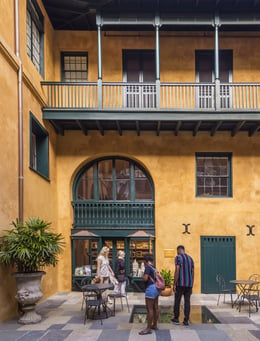
The Duke and Duchess of Windsor dazzled New Orleans during a 1950 Carnival visit, watching the Rex parade before taking in Comus from the balcony of 520 Royal Street (today the main museum building of the Historic New Orleans Collection). After breathless public debate as to whether they would, the British royals bowed to the king and queen of Rex and Comus at each krewe’s grand ball, a gesture met with wild fanfare. But the Duke wasn’t done greeting local royalty just yet. He was curious about another court altogether—the drag queens of Lake Pontchartrain.


“The Duke asked an officer of the elite carnival club Rex about the Club My-O-My,” writes Thomasine Bartlett in her 2004 Tulane dissertation, “Vintage Drag.” The duke allegedly heard about the female impersonator club from playboy and Woolworth heir Jimmy Donahue, who would begin a long affair with the duchess just three months later, despite having led an exclusively homosexual love life up to that point.
While the duke and duchess never made it to Club My-O-My, from 1947 to 1975 busloads of visitors packed the house for its three nightly shows, starring “The World’s Most Beautiful Boys in Women’s Attire.” Alongside Finocchio’s in San Francisco and the 82 Club in New York, Club My-O-My was frequently ranked among America’s top three midcentury drag clubs—a reputation that regularly drew locals, domestic tourists, and waves of European visitors to New Orleans to see postwar gender norms rewritten in ruffles and raunch.


As its handbills declared, “The most interesting women are not women at all,” a claim validated by the club’s long list of celebrity visitors, including Judy Garland, Joan Crawford, Mae West, Liberace, Richard Nixon, Tennessee Williams, Bobby Kennedy, and Willie Nelson. Nelson was such a fan, he spent years after his visit sending tunes to My-O-My master of ceremonies Jimmy Callaway, hoping the “Sensational Song Stylist” would use them in his sultry stage performances. The club was barely legal, wildly popular with heterosexuals, and allegedly grossed over $2 million a year at its peak in the 1950s and ’60s.
Club My-O-My’s story begins at the Powder Puff, New Orleans’s first female impersonator club, which began operating out of a back room in the Standard Fur Company at 125 Decatur Street in 1933. Three years later, police raided the French Quarter club and arrested six drag queens for disturbing the peace, booking them all under their legal names except for one performer who refused to answer to anything but Peaches “The Duchess” Buckingham.


When proprietor Emile Morlet was denied an injunction to stop the many repeat raids that followed, he relocated to the foot of West End Park in 1938, renaming the venue the Wonder Club. Suspended on pilings over Lake Pontchartrain next to Fitzgerald’s seafood restaurant, it quietly prospered. Then in 1947, Herman Brunius of Gretna decided to open a competing female impersonator club on the same strip. While talking up his plans with an entertainment photographer in the Quarter, an older woman in the studio overheard and gasped, “My oh my!”—inadvertently handing Brunius the perfect name for his racy new enterprise, which soon popped up on its own pilings just a few doors down.

Morlet and Brunius didn’t choose this specific lakefront strip—the “East End at West End”—for the scenic views. Since 1896, New Orleans city code had criminalized cross-dressing under an ordinance banning public “masked or disguised” appearances, Mardi Gras and Halloween night the lone exceptions. Just as their performers straddled gender lines, the Wonder Club and My-O-My straddled a municipal one: their West End Park pier entrances sat in Orleans Parish, while the clubs themselves, hovering over the water, technically occupied Jefferson Parish at the edge of Metairie’s Bucktown neighborhood. Police from both jurisdictions largely looked the other way, and the resulting legal gray area blossomed into a miniature vice district. Next door to My-O-My, Swanson’s seafood restaurant literally marked the parish line on the floor—demarcating exactly where its slot machines became legal in Metairie, and where nudging a cash register a few feet over meant ducking premium Orleans taxes for lower Jefferson rates.


Alabama native Jimmy Callaway recalls a friend slipping him a Wonder Club brochure when he was still just a tap-dancing 15-year-old Carmen Miranda impersonator. “I slept with it under my pillow,” he told Bartlett. He eventually made his way to New Orleans to work at the Wonder Club, which had begun running discreet Yellow Pages ads that were conspicuously silent about its female impersonators. Not long after My-O-My opened a few piers down, boldly advertising “The World’s Most Beautiful Boys,” Morlet died. In the aftermath, show producer Pat Waters took most of his performers—including Callaway—to the neighboring venue, effectively folding the Wonder Club into what handbills now advertised as “Mr. Pat Waters Very Smart Club My-O-My,” giving the upstart establishment an immediate infusion of seasoned and sequined talent.

Trans trailblazer Katherine Marlowe Bies (then writing as Kenneth) recounted in her 1964 memoir, Mr. Madam: Confessions of a Male Madam, how she joined the fledgling club as a dancer in the late 1940s. “All the cast was really a club. We got thicker than thieves. We had potlucks together. We had orgies together. We went to the beach together. All of us were always together. I found that when you worked at the My-O-My, you were part of the clique.” According to Callaway, the club’s emcee for two decades, the queens also hung out of the My-O-My’s windows and fished together between shows.
On misty moonlit nights, as the lake breeze drifted in and the slot-machine seafood joints cast their neon glow across the water, visitors would cross the pier into the My-O-My as the park’s prismatic fountain shot colorful water jets 100 feet into the air. The club lights would fade as the show began. A spotlight would reveal Callaway center stage, and the place would erupt in howls of disbelief and applause. The roar that greeted his shimmering floor‑length gowns and scandalously scooped necklines—three or four shows a night—echoed across the neighborhood so reliably that it earned its own nickname: the “Thunder over Bucktown.”

He’d open with a musical number, pivot into stand-up, then reappear between every act in a new outfit, sweeping up the tip money with a broom and dustpan before launching into more tunes by Cole Porter, Peggy Lee, and Gershwin. A live 7-inch record of his “Hello Dolly” performance at the My-O-My preserves some of his bawdy comedy set, the sleeve art depicting Callaway in “dairy queen” drag, clinging to a milk truck in heels. “I was walkin’ down Canal Street today and a man come up to me and says, ‘Pardon me, but where’s the Canal Street ferry?’ I said, ‘I’m speakin’! Whatcha wanna know?’”
While lip-synching is an inextricable part of contemporary drag, My-O-My was a strictly live affair—every queen had to use her own voice and studied glamour to convince the room she was the real deal. The club’s undisputed vocal crown belonged to headliner Gene La Marr, billed as “Cuba’s Famous Soprano” and “America’s No. 1 Prima Donna.” A Wonder Club veteran with genuine opera training, La Marr could hit a B-flat above high C. In a 1988 Facing South article, he recalled stopping his My-O-My arias just before the highest note, eyeing the audience, dropping into his huskiest male register, and saying, “Don’t worry, I’ll make it!” before sailing past it. “The women in the audience would gasp in disbelief,” La Marr said.

Between all the song, dance, and comedy, management encouraged queens to mingle with the crowd (sometimes trailed by a roaming accordionist), a practice explicitly banned in most drag clubs around the country—and a major part of My-O-My’s appeal. The primary purpose was to hustle alcohol sales in a practice called B-drinking. Through boisterous flirting and sheer va-va-voom, guests were swayed to buy rounds for themselves and the queens. Drinks for the queens were charged to customers at full price, even though the house secretly served them with little to no alcohol to save money.
Tom Carlino, who performed as Bobby Lane, hated B-drinking and turned the practice on its head to his own benefit. He’d seek out the most intoxicated patrons, spill their drinks on his gown, blame their clumsiness, and accept cash for the “cleaning bill.” “As my friend Poppy Lane said, ‘Bobby, this is the asshole of show business, but it’s still show business,’” Carlino told WYES-TVOpens in new tab. Bies found her own angle, offering guests dirty stories and keepsake glamour shots for a dollar. “Tourists loved to be able to dance with a man in women’s clothing, and we collected a quarter a dance to let them be able to brag about it back home,” Bies writes, noting that she often hustled tables alongside fellow queen Tossy Wayne. “We wore blouses and full skirts with nothing on under them.”


Callaway recalls New York mafia boss Frank Costello dropping in one night with Al Capone’s brother. Costello asked Callaway to sit in Capone’s lap before declaring, “You sure are beautiful, and if you was a woman, I’d marry you.” Despite its largely heterosexual crowd, groping was commonplace, and the flirting frequently crossed from satirical to sincere. Many queens supplemented their income turning tricks with audience members; management looked the other way as long as the propositions were consummated off-premises.
“You always made real sure that they knew you were a boy, no doubt about it,” Callaway said of those side hustles. In a 1996 Tribe interview, he remembered one particularly wealthy visitor from Tulsa, “Dudley something,” who left $4,000 on his pillow—roughly eight times his weekly My-O-My wages. “The next morning, the first thing I did was get on the phone and have them start digging a swimming pool in my backyard. I’d always wanted a swimming pool!”


Gentlemen callers or not, queens had to completely transform back into men before leaving the club’s doors. Though some police moonlit for My-O-My management as in-house protection and didn’t enforce city code, other officers lay in wait to harass or arrest any performer crossing the pier back into Orleans Parish still wearing a “disguise.” (Queens commonly appended “Mr.” to their names on club brochures to avoid similar legal confusion.) In 1949, practically the entire cast was arrested before dawn on Halloween morning at the Old Opera House on Bourbon Street after accepting an invitation to a party the night before—in full drag. “All of the impersonators wore lipstick, rouge, perfume, and nail polish on their fingers. Several of them were six feet tall,” the States-Item reported, listing every queen’s name, age, and address in the article.
The ensuing chaos in the paddy wagon, as Bies recounted it, was pure theater. “‘Will you help me up, honey?’ said Tossy Wayne. ‘Oh do I have everything . . . where’s my purse!?’ ‘Oh, dear, what will mother say?’ ‘Watch those hands, sonny!’ yelled another queen in a deep voice.” One queen frantically threw amphetamine pills from her purse out the cell window. The troupe reportedly lifted their skirts for their group mug shot, thrilled at the prospect of making front page news.


Resilient as the queens were in the face of the law, the My-O-My itself burned, collapsed, and burned again, being forced into four different locations over 28 years.
On May 5, 1948, just a year after opening, a lit cigarette caught a stage curtain and took the club and neighboring Swanson’s down in flames. “The poor ‘straight’ firemen!” Bies wrote. “All the bitches were running back and forth, getting in the way, screaming about their furs, their pearls, their shoes and gowns. ‘I have to send clear to Chicago to get my size 11’s made special,’ one of them was crying.” Three weeks later, My-O-My rose from the ashes next door in the defunct Wonder Club’s spot.
In 1965, Hurricane Betsy destroyed that location as well. The club relocated to an unused wing of the nearby Kirsch’s seafood restaurant until January 5, 1972, when a second fire sent 50-foot flames into the sky and left little standing but the marquee. The Times-Picayune recorded the value of what was lost in the ashes: Val de Vere’s $1,500 gown and $2,000 worth of clothing and makeup belonging to Bunny Bates.
“I looked around, and all the girls were there with me, forming a sort of semicircle at the water’s edge,” Callaway told Tribe. “We could tell, just by the sight of the mess, that nothing was left.” He found only a scrap of the 40 yards of bright pink fabric from one of his signature outfits left in the rubble.

A few weeks later, Club My‑O‑My made its final move, settling at 940 Conti Street in the French Quarter—not far from the old Powder Puff location—before closing for good in 1975. The club’s gender-bending shock value had been defanged by the shifting moral codes of the American countercultural movement. By the 1970s, drag queens walked the French Quarter in broad daylight. The exaggerated, avant-garde aesthetics that define the artform today had replaced the girl-next-door illusions My-O-My’s midcentury queens had painstakingly perfected (and in some cases, like Carlino’s, parlayed into celebrity hair and makeup jobs).
Even as Callaway watched his drag era pass, he remained a fixture in the local queer community until his death in 1998, hosting parties with his long-term lover, a blonde sea captain, and keeping the stories of gay old New Orleans alive for anyone who would listen. “Wasn’t he pretty?” he said to the Times-Picayune’s David Cuthbert, looking at a photograph of his younger self in drag. “Um-hmmm! Propped up there, lookin’ like a hussy!”
Celebrate Pride with HNOC

Related Stories

When Praying the Gay Away Didn’t Work, He Turned to Activism
In an excerpt from his new memoir, activist Larry Bagneris recounts how his adolescent struggle to shed his homosexuality led to a political awakening and a lifelong purpose.

The Gay Panic That Brought the LGBTQ Rights Movement to New Orleans
Anita Bryant’s 1977 crusade against homosexuality sparked a nationwide movement, prompting the first gay rights demonstration in New Orleans history.
Related Collection Highlights

Harvey Ferguson LGBT Mixtape Collection
A dance music lover’s dream, 60 mixtapes capture the sound of gay nightlife in New Orleans.

Dorothea “Torchy” Wilde Papers
HNOC expands its LGBTQ+ holdings with the papers of a nightlife fixture who chronicled the Quarter’s denizens.

Andrée Loisel Collection
After contracting HIV in 1988, a New Orleans–born artist and musician returned home to become one of the earliest public faces of the AIDS crisis.
Related Virtual Exhibitions
Storyville: Madams & Music
Explore the history of Storyville, New Orleans's legally sanctioned prostitution district that helped give birth to jazz.

Related Books


Guidebooks to Sin: The Blue Books of Storyville, New Orleans
by Pamela D. Arceneaux
with a foreword by Emily Epstein Landau
Related Shop Items


Subscribe to First Draft
