





Hospital Banner Newsletters
An unusual periodical, written and produced by residents of the state mental hospital in the mid-20th century
In 1906, the Louisiana Hospital for the Insane of Louisiana was established in Pineville “to accommodate the insane of both races,” relieving overcrowding in parish prisons. First proposed in 1902 as the Insane Asylum for Colored People of the State of Louisiana, it ultimately opened as a multiracial, segregated facility. It became known as Central Louisiana State Hospital (CLSH) in 1924, and by 1940 had a daily average of 2,000 patients from across the state. The hospital integrated in 1965 and is still in operation today.
The hospital’s founding reflected important strides in mental health care that began in the mid-19th century. The country’s first state-run mental hospitals were built based on a plan by physician Thomas Story Kirkbride (1809–1883), which recommended patient wards that had communal spaces and private rooms for each patient. The Kirkbride Plan also called for extensive grounds for farming and physical activities that required patient participation as part of their therapy. In keeping with Kirkbride’s recommendations, CLSH provided many opportunities for patients to participate in occupational activities, including farming, cooking, sewing, and library work.


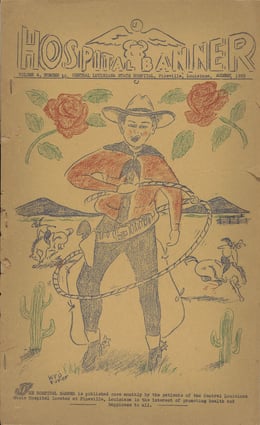
In 1951 the hospital began providing another occupational activity—Hospital Banner, a newsletter published by the facility’s patients. The Historic New Orleans Collection recently acquired 21 issues of the publication, which offer an extraordinary look at the hospital’s facilities, staff, and patients during the 1950s and ’60s. Hospital Banner included editorials by staff, but the illustrations and articles were contributed by patients, who described their daily activities, submitted poetry, wrote jokes, and discussed hospital news including personnel changes and progress on new buildings. In one issue, a writer described the freedom of being placed in an unlocked ward of the hospital, saying, “To be on an open ward is to know that you are trusted.” In another issue, a news item reads, “Mr. Levy, patient of Wd. 23, who was working as assistant librarian has left for home. Best of luck, Mr. Levy, we miss your kind smile and willing hand around here.”

This sort of patient-led periodical was not unique to CLSH; two other regional examples are The Whit, a publication of the Mississippi State Hospital that served as the inspiration for Hospital Banner, and The Pelican from the Louisiana Training Institute, a juvenile home for boys in Monroe. These titles carry on the tradition of the country’s first patient-led newsletter, The Meteor, published at the Alabama Insane Asylum from 1872 to 1881—but they can also be seen as related to prison publications such as The Angolite, which is created by incarcerated people at the Louisiana State Penitentiary at Angola and remains in print today.

These publications are subject to the oversight of administration and may provide only a limited glimpse into the lives of their creators. Still, they serve many purposes: They provide meaningful activity for institutionalized people, demonstrate to administrators and government bodies how their money is being spent, and create a positive connection between the outside world and those who are hospitalized or incarcerated.
By Nina Bozak, curator of rare books
More from Our Holdings
Collection Highlights
Dive into the Collection’s holdings with image-rich previews of treasures from New Orleans history.

Related Stories

Patriotism in Print
As the young republic formed and took its first steps, print media served a crucial role in uniting the nation.

In 1860s New Orleans, Black Activists Fought and Died for the Right to Vote
Nearly a century before the passage of the Voting Rights Act, Reconstruction-era actvisits won—then lost—Black male suffrage.
Related Collection Highlights

The Land We Love
After the Civil War, a one-man publisher aimed to reeducate the Southern gentry with a magazine devoted to both practical skills and the arts.

Bunny Matthews Archive
In a substantial new acquisition, the archive of a distinctly New Orleans cartoonist comes to HNOC.
Related Books


Afro-Creole Poetry in French from Louisiana’s Radical Civil War–Era Newspapers
translated and introduced by Clint Bruce
with a foreword by Angel Adams Parham

Bunny Matthews: His Life, Art, and Obsessions
by Alison Fensterstock and Michael Tisserand
Subscribe to Our Newsletter
