






The Land We Love
After the Civil War, a one-man publisher aimed to reeducate the Southern gentry with a magazine devoted to both practical skills and the arts.
The Land We Love was a magazine “devoted to literature and fine arts” published from May 1866 to March 1869 in Charlotte, North Carolina, by Daniel Harvey Hill (1821–1889), a math professor at Washington (now Washington and Lee) University who became a lieutenant general in the Confederate Army. Hill thought the problem with the South, and a main reason it lost the Civil War, was its lack of education in practical knowledge such as farming, mining, and engineering, in favor of education in the classics for future politicians and other thinkers. As a result, The Land We Love published many articles on topics such as animal husbandry and household homeopathy alongside works of poetry and fiction by southern writers such as Francis Orray Ticknor and Margaret Junkin Preston. Hill also insisted his publication become a sort of repository for war records and personal stories, which he used to populate the column “From the Haversack.” Hill was one of only a few publishers at that time to compensate his contributors, paying two to three dollars per page, which ensured he didn’t have to rely on amateur writers for content.

By December 1866, circulation of The Land We Love reached 12,000 and included subscriptions from Oregon, California, Pennsylvania, and New York. It was available in New Orleans at Blelock and Co. Booksellers, located on Canal Street, where two issues now in HNOC’s holdings were purchased by Charles Winthrop Lowell (1834–1877). Lowell was a lawyer from Maine who served as a commanding officer in the 80th Regiment of the United States Colored Infantry during the Civil War. He settled in New Orleans and purchased property north of the city after his military service ended in 1867. Lowell was elected to the Louisiana House of Representatives in 1868, where he served as speaker that year and again in 1872. His signature can be seen on both issues of The Land We Love, and one has a short Blelock and Co. catalog tipped into it.

In an excerpt from this epic poem, “The Fight in the Nameless Isle,” which was published over several issues, the author (uncredited in this issue) depicts a battle drawn from Arthurian legend. Young Tristan challenges Moraunt to a duel to claim his knighthood, which ultimately wounds him and sends him to Queen Isolde for healing, leading to their tragic love affair. Tales of medieval kings, queens, and chivalry were popular in antebellum culture and took on heightened reverence after the Civil War as part of “Lost Cause” ideology.
It is curious that a former Union soldier and member of the Louisiana Reconstruction government would own issues of a magazine devoted to the South, and, indeed, given the condition of the two issues acquired by HNOC, it’s likely he never read them. One issue in particular would have been impossible to read and remains so: owing to a production error, the folded “leaves” (large sheets of paper on which multiple pages are printed, to be folded and cut into individual bound pages) were never severed from each other. As a result, they remain in pristine, imperfect condition.
By Nina Bozak, curator of rare books
More from Our Holdings
Collection Highlights
Dive into the Collection’s holdings with image-rich previews of treasures from New Orleans history.

Related Stories

Patriotism in Print
As the young republic formed and took its first steps, print media served a crucial role in uniting the nation.

In Civil War New Orleans, Black Poets Fought for Civil Rights
Amid the American Civil War, a new civil rights movement was forming in New Orleans—in French.
Related Collection Highlights
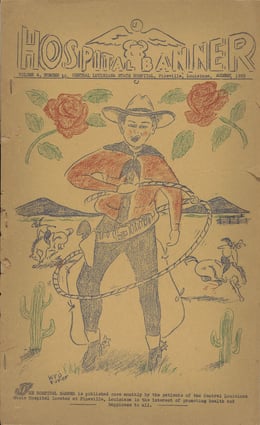
Hospital Banner Newsletters
An unusual periodical, written and produced by residents of the state mental hospital in the mid-20th century

Bunny Matthews Archive
In a substantial new acquisition, the archive of a distinctly New Orleans cartoonist comes to HNOC.
Related Books
Bunny Matthews: His Life, Art, and Obsessions
by Alison Fensterstock and Michael Tisserand

Afro-Creole Poetry in French from Louisiana’s Radical Civil War–Era Newspapers
translated and introduced by Clint Bruce
with a foreword by Angel Adams Parham

Subscribe to Our Newsletter
