

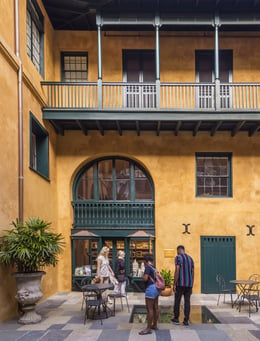








Ice House
Three-story brick structure, built 1907
The three-story Ice House is named for its history as an ice manufacturing plant. Housing offices for several HNOC departments, which are accessed at 606 Toulouse Street, the Collection leases the ground-floor corner storefront at Chartres and Toulouse Streets.
Timeline
1828: François Marie Perrilliat purchases the corner lot at Chartres and Toulouse. The lot includes a main house fronting Chartres Street, a rear courtyard, and a group of shops fronting Toulouse Street. HNOC will eventually buy two other properties developed by Perrilliat, the Williams Research Center and Perrilliat House.

1830–51: The lot and its structures change hands five times, with several transfers related to a family drama centering on Marie Ursule Moquin, Perrilliat’s widow. The parcel stays in the extended Perrilliat family for the rest of the 19th century. Among the businesses to lease the Toulouse Street storefronts is a publisher operated by Justin L. Sollée. His shop prints a number of French-language materials and also briefly houses the Spanish paper La Patria.

1906: Eugene Braquet, one of Perrilliat’s grandsons, sells the lot to Cosmopolitan Ice Co., which begins construction on a new three-story brick building on the site. The following year it opens as an artificial ice plant, producing up to 150 tons of ice per day using a steam-powered process.
1913: Cosmopolitan sells the plant to Panama Ice Co. The ice manufacturing business continues to boom through the 1930s. It becomes an $8 million industry in New Orleans, employing around 1,500 people at 49 plants throughout the city.
1940: As advances in home refrigeration signal a decline in large-scale ice manufacturing, Panama Ice sells the plant to prominent antiques dealer Ulrich Rosen. Rosen runs a thriving antiques shop out of the building.
1973: Irving Rosen, Ulrich’s son, leases the building to WDSU-TV, which already operates out of the adjoining Seignouret-Brulatour Building at 520 Royal Street.

2009: M. S. Rau Antiques, located around the corner on Royal Street, acquires the property, using the ground floor as a showroom and upper floors as storage.
2015: M. S. Rau sells the building to HNOC, which uses the ground floor as a classroom for the education department. Publications and Communications are among the departments that move their offices to the upper floors, which are accessed at 606 Toulouse Street.
Our Buildings
HNOC’s Architectural Treasures
Every building has stories to tell. Learn more about HNOC’s historic French Quarter properties.


Related Stories

Masonic and Odd Fellows Buildings in New Orleans
Society halls and temples have had a lasting impact on the local architectural landscape. Here’s where to find them.

The Woman behind New Orleans’s Famous Pontalba Buildings
The Baroness de Pontalba survived gunshot wounds and left her husband in France before constructing two of New Orleans's most iconic structures.
Related Collection Highlights


Clarence John Laughlin Archive
Through his dreamlike black-and-white images, the surrealist Louisiana photographer explored, amplified, and commented on the mystique of the South.

Mother St. Croix Photographs of Ursuline Convent
The ebullient nun documented her cloisters, sisters, and pupils with care and skill. In doing so she became the earliest known woman to photographically record daily life in New Orleans
Related presentations
Vieux Carré Survey Case Study

Related Books


Furnishing Louisiana: Creole and Acadian Furniture, 1735–1835
by Jack D. Holden, H. Parrott Bacot, and Cybèle T. Gontar, with Brian J. Costello and Francis J. Puig
edited by Jessica Dorman and Sarah R. Doerries

Guidebooks to Sin: The Blue Books of Storyville, New Orleans
by Pamela D. Arceneaux
with a foreword by Emily Epstein Landau
Related News

NOLA.com: This Former French Quarter Restaurant Will Now Tell New Orleans History After $6.4M Renovation

NOLA.com Features HNOC’s Paul Prudhomme Building Among 19 Award-Winning Historic Renovation Projects

NOLA.com: Former K-Paul’s Louisiana Kitchen Gets a New Life and a New Name
Subscribe to Our Newsletter
