







Merieult House
Spanish colonial merchant mansion with dependent wings, originally built 1793–97
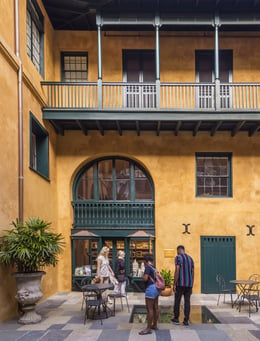
HNOC’s flagship location is anchored by the Merieult House, built 1793–97 and renovated in the 1830s, 1870s, and 1938–65. The house had residential space on the second floor, over retail shops on the first floor. The large rear courtyard is flanked by a three-story service wing and a counting house, a two-story building containing a ballroom and business offices. The site has been used as retail space, a city residence, banking offices, a hotel, a boardinghouse, antiques stores, art galleries, and a museum.
Timeline

1792: Merchant Jean François Merieult purchases the plot at auction, three years after a devastating fire destroys 80 percent of the colonial city, including the early- and mid-colonial structures on the site. Merieult signs a contract with William Cobb for 7,200 pieces of lumber to be floated down the river from Natchez. Merieult contracts with builders Jacob Cowperthwaite and Robert Jones to lead the construction.
1794: The main house is completed and survives another disastrous fire in the French Quarter.
1795–97: Supporting buildings surrounding the rear courtyard are constructed to serve as a service area, counting house, warehouse, and slave pens for Merieult’s merchant business. Between 1792 and 1812, Merieult bought and sold over 400 enslaved Africans on this site.

1832: Lizardi Brothers, international bankers who backed the slave trade through bonds and investments in New Orleans real estate, purchase the old property and upgrade it in the Greek Revival style, adding granite posts and lintels on the front facade and a second story to Merieult’s old counting house. They lease the ground floor to retail merchants and the second floor as a boardinghouse.
1878: Jean-Baptiste Trapolin purchases the property and renovates the central passageway to add a graceful stair to a hotel on the second floor.

1932: The property is broken up into apartments. Commander and Mrs. Alvin Hovey-King live on the second floor, above antiques and rare books dealers on the ground floor. Lillian Hovey-King establishes Hové Parfumers here, a business that continues in the Quarter today.

1938: Kemper and Leila Williams purchase the property and work with architect Richard Koch to stabilize the structure and renovate the first floor, including shifting the open passageway and rebuilding the stairs to the second floor.
1960s: Kemper Williams, Koch, and curator Boyd Cruise begin a full restoration of the second floor and dependent wings.
1970: The Historic New Orleans Collection officially opens to the public, with museum exhibitions and reading rooms to share the Williamses’ collection of historic artifacts.

COUNTING HOUSE
The Counting House—the two-story building on the St. Louis Street side of the Merieult House courtyard—is named for the banking activities conducted by the Lizardi Brothers firm on this site in the 19th century. It was first built as a warehouse by Jean François Merieult in 1794–95. When the Lizardi Brothers firm purchased the property in the 1830s they made major changes to Merieult’s warehouse. Besides adding a second story and gallery to the building, the firm completely transformed the first floor, creating a grand Greek Revival room for banking. Today, the first floor is used for meetings, seminars, receptions, and exhibitions when additional space is needed; the second floor is used for administrative offices.

Service Wing
Across the courtyard from the Counting House, the three-story Service Wing (formerly known as the Maisonette) stretches along the Toulouse Street side of HNOC’s property line, with wooden gallery and railings defining the second and third floors. This service wing is situated on land that was part of the original Merieult purchase; it was constructed over an earlier auxiliary structure that was built at the same time as the Merieult House in the 1790s. An 1819 plan of the Merieult House in the Notarial Archives shows a warehouse on this site.
Our Buildings
HNOC’s Architectural Treasures
Every building has stories to tell. Learn more about HNOC’s historic French Quarter properties.

Related Stories

Beyond Nottoway
The mansion at Nottoway Plantation burned to the ground, but related sites survive across the South.

The Woman behind New Orleans’s Famous Pontalba Buildings
The Baroness de Pontalba survived gunshot wounds and left her husband in France before constructing two of New Orleans's most iconic structures.
Related Collection Highlights

Mother St. Croix Photographs of Ursuline Convent
The ebullient nun documented her cloisters, sisters, and pupils with care and skill. In doing so she became the earliest known woman to photographically record daily life in New Orleans

Clarence John Laughlin Archive
Through his dreamlike black-and-white images, the surrealist Louisiana photographer explored, amplified, and commented on the mystique of the South.

Related presentations
Vieux Carré Survey Case Study

Related Books


Creole World: Photographs of New Orleans and the Latin Caribbean Sphere
by Richard Sexton
with essays by Jay D. Edwards and John H. Lawrence

Spanish New Orleans and the Caribbean / La Nueva Orleans y el Caribe españoles
edited by Alfred E. Lemmon
Related News

HNOC Names Former K-Paul’s Restaurant Building in Honor of Chef Paul Prudhomme

NOLA.com: Former K-Paul’s Louisiana Kitchen Gets a New Life and a New Name

NOLA.com: This Former French Quarter Restaurant Will Now Tell New Orleans History After $6.4M Renovation
Subscribe to Our Newsletter
