







Beyond Nottoway
The mansion at Nottoway Plantation burned to the ground, but related sites survive across the South.
By Sarah Duggan, Decorative Arts of the Gulf South project manager
July 22, 2025
By Sarah Duggan, Decorative Arts of the Gulf South project manager
The small town of White Castle, Louisiana, made national headlines on May 15, 2025, when the mansion of Nottoway Plantation burned to the ground. News of its unexpected destruction evoked a wide range of reactions on social media. Some mourned that a beautiful building was gone and history had been lost. Others were overjoyed to see a symbol of slavery and brutality go up in flames, whether as a random accident or, as some speculated, ancestral vengeance. These polarized responses indicate how the US is still reckoning with the legacy of plantation slavery, even 150 years after the end of the Civil War.


Designed by architect Henry Howard for planter John Hampden Randolph in 1859, Nottoway experienced a luxurious heyday that lasted only two short years before the Civil War began. As with many plantation mansions, the house became a financial burden rather than a bastion of generational wealth. Randolph’s widow sold the property in 1889 to pay off mounting debts.


Nottoway changed hands multiple times over the 20th century. Some of its new owners used it as a private residence and as a sugar plantation, with mixed success. In 1985, a pair of business partners purchased the property. By the early 2000s, they’d transformed the massive Greek Revival estate into a resort destination and wedding venue.
Before its big house burned, Nottoway promoted its distinction as the largest extant plantation house in the United States. While that is no longer the case, there are still numerous surviving buildings relevant to Nottoway’s history, many of which highlight the lives and labor of the enslaved people whose history went largely untold at the popular plantation resort. Here a just a few sites relevant to the story of Nottoway.

WilTon House
John Hampden Randolph’s distant relative William Randolph III built the Wilton House around 1753 as the centerpiece of his 2,000-acre tobacco plantation in Henrico County, Virginia. (The Louisiana plantation got its name from nearby Nottoway County, where John Hampden Randolph was born in 1813.) William Randolph died in 1761, but his widow Anne Carter Harrison Randoph continued to manage the estate while supporting American Patriots during the American Revolution. George Washington and Thomas Jefferson both visited Wilton, and the Marquis de Lafayette headquartered his troops there in 1781 on their way to the Battle of Yorktown.
When Wilton was threatened with demolition in the 1930s, the National Society of the Colonial Dames of America in the Commonwealth of Virginia purchased the house, dismantled and moved it to its current location in Richmond, Virginia, then restored it.

While the Randolphs were fighting for their own political freedom, over one hundred enslaved people worked at Wilton with little hope for their own liberty. As the Randolphs’ fortunes waned, they sold away their human property. The last enslaved people and crops were sold off in 1859. Archaeology has unearthed a treasure trove of “objects that they owned, purchased, cherished, resented, broke, played with, and discarded.” The online exhibition Wilton UncoveredOpens in new tab features these discoveries and how they enhance limited documentary records.


Wilkinson County Museums
The US government’s purchase of Louisiana in 1803 presented American planters with new opportunities. The promise of greater acreage drew many Virginians southward. Among them was John Hampden Randolph’s father, Peter Randolph, who moved his family to Woodville, Mississippi. The elder Randolph served on the United States District Court. When John Hampden reached adulthood he married Emily Jane Liddell, the daughter of wealthy Mississippian Moses Liddell. Emily’s dowry included $20,000 and twenty enslaved people, which likely enabled the newlyweds’ move to Bayou Goula, Louisiana, in 1841.


Woodville today is a small town that still serves as the legal seat of Wilkinson County, Mississippi. The Wilkinson County Museums are in two early 19th century buildings near the town square. Peter Randolph likely frequented the circa-1819 bank that is now the African American Museum. Around 1836 the West Feliciana Railroad Company built a grander bank and office across the street. Mississippi and Louisiana planters had joined forces to build a local rail line that would more easily ship cotton crops to the port in New Orleans. Today it is one of the oldest remaining railroad buildings in the United States.

1850 House
Nottoway was designed by Henry Howard, an Irish immigrant who arrived in New Orleans in the 1830s. Howard’s portfolio included many residential and commercial buildings in downtown New Orleans, but he had also navigated the logistical challenges of getting building supplies up the Mississippi River to plantations. Unlike many of his peers, Howard did not oversee his own building company. Focusing only on design freed him up to take on more commissions in a year.
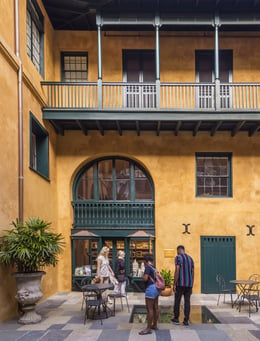
Howard’s still extant projects include courthouses, churches, and commercial buildings. Most famous are the Pontalba Buildings, a pair of apartment and retail properties that flank Jackson Square in the French Quarter. The Louisiana State Museum’s 1850 HouseOpens in new tab exhibit in the Lower Pontalba Building interprets an apartment as it might have looked when the building opened. Antique furnishings collected for the museum represent the many retailers and importers wealthy New Orleanians patronized.

Madewood Plantation
Madewood Plantation, near Napoleonville, Louisiana, built for Colonel Thomas Pugh in 1846, is an example of Henry Howard’s more traditional earlier Greek Revival designs. The house operated as a bed and breakfast for many years until its 2018 sale to Louisiana artist and historic preservation enthusiast Hunt SlonemOpens in new tab.

Although Madewood is no longer open to the public, you can still make a virtual visit through its many film set appearances, including Sofia Coppola’s 2017 film The Beguiled and the 2016 remake of Roots. Also in 2016, Beyonce Knowles-Carter used Louisiana’s Madewood as one of the settings for her epic visual album Lemonade.

Longwood Plantation
The massive mansions designed by Howard and others in the 1850s were far more ambitious than those built in previous generations. These monumental structures would prove unsustainable in the post–Civil War economy. No building better illustrates the rise and fall of plantation wealth than Longwood in Natchez, Mississippi. Unlike the many other historic homes in Natchez, Longwood was never completed. Philadelphia architect Samuel Sloan designed Longwood for Dr. Haller Nutt and his wife Julia in 1859. Nutt likely got the idea for the octagonal shape and onion dome from a fanciful “Oriental Villa” design Sloan had published previously. In its finished state the exterior would have been covered in white or gray stucco.

Sloan sent northern workmen to execute his design in Natchez. When the Civil War broke out, they dropped their tools and hurried back to Pennsylvania, leaving Longwood’s wood and brick structure bare. The massive second floor rooms and soaring dome remain suspended in time, with building tools and shipping crates still lingering in corners. Before Nutt died of an illness in 1864, he managed to have a metal roof installed and the ground floor finished. Those few rooms remained the only living space for Julia and future generations until the family sold the house in 1968. Today the Pilgrimage Garden ClubOpens in new tab operates Longwood as a museum. The unfinished upstairs offers behind-the-scenes insight into Sloan’s design and construction process. It also stands as a stark reminder of the futile pride and ambition of the building nicknamed “Nutt’s Folly.”


As with many plantations, new research has found more information about Longwood’s residents outside the mansion. In 1867, newspapers reported that crowds of formerly enslaved people marked the Fourth of July with a freedmen’s celebration in Natchez. Attendees came from miles around for speeches and a downtown parade leading to Longwood. One local newspaper observed “that there were not less than nine thousand people on the picnic grounds during the day.”

Windsor Ruins
Maintaining, let alone modernizing, giant plantation houses remained a daunting task in the early 20th century. Nottoway and other mansions changed owners several times. Many fell into disrepair.
Among those once-luxurious plantations was Windsor, outside of Port Gibson, Mississippi. Smith Coffee Daniell II had the mansion built from 1859–61. Like Howard’s grandest mansions, it had indoor plumbing for bathrooms and imposing exterior columns. Like Nutt, Daniell fell prey to illness just as construction completed in 1861. During the Civil War Windsor’s height made it an ideal observation and signal station for the Confederate Army and later Union Army General Ulysses S. Grant.

The Daniell family retained ownership of Windsor, but in 1890 it was destroyed by fire, likely from a guest’s cigar or cigarette ashes. Today its massive brick columns with their cast-iron Corinthian capitals remain as a ghostly outline of the mansion. The large cast-iron exterior staircases have been repurposed for the Oakland Memorial Chapel at nearby Alcorn State University, the oldest public historically Black land-grant institution in the United States.
The Mississippi Department of Archives and HistoryOpens in new tab maintains the Windsor Ruins site, which is open to the public. Like Longwood, the Windsor Ruins give a unique perspective on building materials and the passage of time.
Decorative Arts of the Gulf South
HNOC’s ongoing research project dedicated to the material culture of the Gulf South

Related Stories

Threads of Motherhood
The clever construction of a maternity dress offers an intimate glimpse into 19th-century motherhood.

African American–Made Furnishings from the Pre–Civil War Gulf South
The work of the Decorative Arts of the Gulf South project has revealed stories of African American material culture throughout the region.
Related Collection Highlights

“The Scourged Back”
HNOC acquired an original copy of the infamous image that took Civil War-era America by storm, quickly becoming a tool of the abolitionist cause.

Elmwood Plantation Menu
This stylish menu from a restaurant in a former plantation home belies the site’s dark history of human enslavement.

Cane River Collection
Over 1,400 legal and financial documents amount to a detailed record of one slice of 19th-century Black Creole life.
Related Virtual Exhibitions
Purchased Lives: New Orleans and the Domestic Slave Trade, 1808–1865
A groundbreaking examination of America's perpetuation of the slave trade and New Orleans’s role as a hub of slave trading.

Related Books


Related News

WVUE: On International Coffee Day, HNOC Unveils New Research About Rose Nicaud

HNOC, LHA Select “The Carceral City” to Receive 2024 Williams Prize

New Exhibition Explores Historical Links Between Slavery and Mass Incarceration
Subscribe to Our Newsletter
