



Skip to content
The Historic New Orleans Collection
An old-style currency note from the City of New Orleans, valued at one dollar. It features images of two ships, elaborate designs, and portraits of women. The note is dated January 1, 1863, with decorative borders and numerals 49 120.

Banking and the Civil War

Banking and the Civil War, or, Floating Away on a Sea of Paper Money

Beginning in March 1861, the Confederate States of America began printing its own paper banknotes. The earliest notes, known as the Montgomery Issue, after the Confederacy’s first capital in Montgomery, Alabama, were printed in New York by the National Bank Note Company and smuggled across the Union lines. Subsequent issues were printed in New Orleans; Richmond, Virginia; and Columbia, South Carolina. As the war stretched on and major industrial centers, including New Orleans, fell to Union forces, the Confederacy had difficulty maintaining access to the supplies and safe passage needed to print and distribute CSA money not only to banks, businesses, and private citizens, but also to the hundreds of thousands of officers and soldiers fighting for the Confederate cause. Furthermore, because the CSA printed money without tying the value of its notes to actual treasury resources (which were limited despite efforts to raise funds through bond issuances), the notes were subject to widespread inflation.

State treasuries were also actively engaged in financing the war and state economies. They, too, printed money without regard for gold and silver specie on hand. Louisiana mobilized its state banking system in support of the war in 1861, and Governor Thomas Overton Moore issued an order to all Louisiana banks to suspend specie payments in November of that year, leaving the state and its inhabitants to operate in an economy based entirely on paper money. Note issuances were not limited to the CSA and state. Forty of Louisiana’s forty-eight parishes printed their own paper money during the Civil War, and towns across the state—from Shreveport to Alexandria, from Natchitoches to Clinton, from Thibodaux to Baton Rouge—all sought to satisfy the demand for a circulating currency by turning to the printing press. Even private businesses, including Magazine Street saddlers Magee and George, issued notes redeemable for goods and services when national, state, and even municipal notes were too scarce to offer as change.
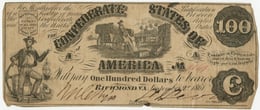
Confederate States of America $100 bill from 1861, featuring a central image of a vignette with a horse-drawn wagon and a man leaning on a bale. Decorative script, engravings, and intricate borders are visible along with the denomination 100 in corners.
An old Confederate States of America ten-dollar bill featuring allegorical figures and the denomination 10. It is dated September 2, 1861, printed in Richmond, and includes intricate designs and text.
An old Louisiana $100 bill from 1863 featuring a mans portrait, an elaborate building, and a seated woman with a shield. The text includes State of Louisiana and the date March 10th, 1863.
A vintage three-dollar banknote from Magee & George, dated January 21, 1862, New Orleans. Features ornate designs and the number 3 prominently. The note states it is redeemable at an office on Magazine Street.
Vintage Mississippi banknote for twenty dollars featuring a train, decorative engravings, and handwritten details. Dated November 1862, it includes the state name and denomination prominently displayed.
Antique currency note from the State of Alabama, valued at fifty cents. Features denomination prominently and an illustration of a tree stump. Includes a small portrait of a woman on the right and decorative text detailing its authenticity.
An 1862 five-dollar note from the Parish of Concordia. The note features intricate designs, with text stating its use for tax payments, signed by officials. A seated figure holds a staff on the left, and the number 1027 is written in red.
A vintage three-dollar banknote from the Parish of St. John the Baptist, dated 1862. It features a portrait of a man, the number 3, and an illustration of a seated woman with a bundle of wheat and a sickle.
Vintage five dollar note from The Parish of St. Tammany, Louisiana, dated January 1, 1862. Features ornate designs, a seated woman with scales, and bold red text highlighting the denomination.