







Derven Scholars
Paid internships for college students interested in museum education
Who: Undergraduate seniors and juniors studying in New Orleans (fall program) and Louisiana (summer program)
When: Summer (June–July) and fall (September–November)
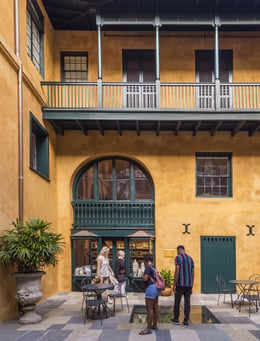
Where: Onsite at HNOC in the French Quarter
Summary
The Derven Scholars Program provides interns with experience in museum pedagogy, public history, education, and curriculum development within a history-museum setting. Interns will collaborate with museum educators to create curriculum materials, student resources, and engagement tools that support current and upcoming exhibitions. Through this work, interns will explore the museum as an extension of the classroom and develop strategies that connect historical content, collections, and exhibitions to diverse learning environments. The program emphasizes the role of museums as dynamic educational spaces that foster inquiry, interpretation, and meaningful connections between public history and classroom learning.
Expectations
The intern will:
- Develop curriculum materials and educational resources aligned with museum exhibitions and learning goals.
- Explore best practices in museum pedagogy, museum education, and informal learning.
- Create tools that bridge classroom instruction and museum-based learning experiences.
- Support visitor and learner engagement through accessible and inclusive educational content.
- Gain experience translating historical research into meaningful educational opportunities.
Daphne L. Derven
The Derven Scholars program honors the memory and legacy of Daphne L. Derven, whose vision and commitment to educational outreach transformed HNOC for the better. Her work continues to inspire staff, teachers, and students.

Available Opportunities
Frequently Asked Questions
The Derven Scholars Program is a recurring summer internship offered annually during the months of June and July.
Yes. The Derven Scholars Program is an on-site internship. Participating interns are expected to report in person to the Historic New Orleans Collection’s French Quarter campus throughout the duration of the program.
Qualified candidates are students attending Louisiana-based colleges or universities who are classified as undergraduate juniors, undergraduate seniors, or graduate students. Applicants must live in the New Orleans metropolitan area or within a reasonably commutable distance.
The next cohort of the Derven Scholars Program will run during the Summer 2027 program season for nine weeks, from May 31 through July 30, 2027. During this time, interns will commit to a 12-hour weekly schedule, working two full days on-site each week at the Historic New Orleans Collection’s French Quarter campus.
Yes. The Derven Scholars Program is a paid internship. Interns receive a $1,500 stipend upon completion of the internship, contingent on the successful submission of all required assignments and deliverables.
No. The Derven Scholars Program is a part-time internship requiring participants to commit to fewer than 20 hours of on-site engagement per week. Therefore, housing is not provided for interns appointed to this specific program. Applicants should reside in the New Orleans metropolitan area or within a reasonably commutable distance.
Applications for the next cohort are scheduled to open on February 1, 2027.
The Derven Scholars Program accepts one intern per annual cohort.
No. The Derven Scholars program welcomes applicants from a variety of academic backgrounds. While students pursuing degrees in education, humanities, social sciences, and liberal arts are especially encouraged to apply, students from other fields who demonstrate an interest in museum education, public history, or educational programming are also welcome to apply.
Education Department
Contact our education department via this form or email education@hnoc.org.

Created by Derven Scholars
Explore presentations and lesson plans developed by HNOC Derven Scholars.


New Orleans in Film & Television

Powerful Women of the New Orleans Underground

Runnin’ and Runnin’ in Louisiana: The Underground Railroad

The World of Rose Nicaud

Vieux Carré Survey Case Study
Internships
Explore paid opportunities for undergraduate and postgraduate students interested in museum studies and archival research.

Subscribe to Our Education Newsletter
