







Researching Your Property’s History
A Half Day Seminar
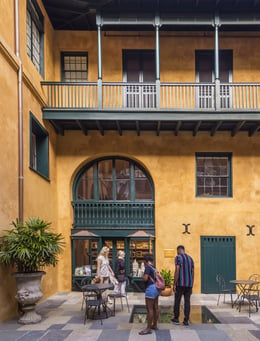
Williams Research Center, 410 Chartres Street
Free admission, registration required
Registration Dates:
HNOC Members: September 28
General public: October 5
Join the Historic New Orleans Collection for an exciting half-day seminar exploring four distinct resources available to anyone delving into New Orleans property research. HNOC staff will offer presentations on the notarial archives, historic city directories, and the Collins C. Diboll Vieux Carré Digital Survey, an extensive database that documents that every individual lot and structure within the French Quarter. Guest speaker Judy Riffel will close out the day by presenting an overview of Spanish land grants in Louisiana and their principal repositories.
This seminar is designed for everyone with a particular focus on how property records can help with personal genealogical research. No prior research skills are necessary.
Admission is free with registration required. Registration opens on September 28 for HNOC members and October 5 for the general public. Not a member? Join today.
Schedule
Optional Lunch & Tour
Attendees will have the option of purchasing an architectural walking tour led by HNOC staff ($25 per person), and/or purchasing a box lunch catered by Gracious Bakery ($20 per person) during registration.
Check in at the Williams Research Center, 410 Chartres Street
Rebecca Smith, Williams Research Center Director
Jari Honora, HNOC Family Historian
The New Orleans Notarial Archives is an exceptional repository for tracing New Orleans families. The archives preserve more than three centuries of legal records created under Louisiana's civil law tradition. Notarial acts—including wills, marriage contracts, property sales, successions, emancipations, donations, and other legal documents—can reveal generations of family relationships and bring ancestral stories to life. This session will offer practical guidance for navigating the archives and making the most of this indispensable resource.
Sarah Duggan, HNOC Decorative Arts of the Gulf South Project Manager
Historic city directories can be a rich source of information about local families, especially those who did not own the buildings where they lived and worked. These annual almanacs contain addresses, advertisements, tariff rates, and lists of government officials. Decorative Arts of the Gulf South (DAGS) Project Manager Sarah Duggan will share some highlights from her research with city directories for the upcoming exhibition Made to Last: Black Craftspeople in Early New Orleans.
Attendees are welcome to bring their own lunch, or will have the option of purchasing a $20 box lunch catered by Gracious Bakery during registration.
Rebecca Smith, Williams Research Center Director
In 1960, the Louisiana Landmarks Society (LLS) underwrote the cost of a pilot study documenting the architectural and land-use history of a single block of the Vieux Carré: square 63, bounded by Royal, Conti, Bourbon, and St. Louis Streets. The study followed the pattern established by the Historic American Buildings Survey done in the 1930s by the Works Progress Administration. Pleased with the work done on square 63, the LLS, joined by the Vieux Carré Commission (VCC), sought grant funds to expand the study to cover the entire French Quarter, eventually becoming the Vieux Carré Survey (VCS). HNOC took ownership of the project in 1977. Over the past 66 years, the survey has not only been completed to cover all 120 French Quarter squares, but it has been updated several times over with new data and photography. The biggest update began in 2000, when HNOC began digitization of the entire VCS. Because the maintenance of the VCS, one of HNOC's most heavily used assets, remains a high institutional priority, we have just completed another update to the database to make it even more user friendly. We will take an in-depth look at the newly refreshed site at this workshop.
Judy Riffel, professional genealogist and independent scholar
Louisiana genealogist Judy Riffel will present an overview of Spanish land grants, explaining how Spain used them to encourage settlement and shape the development of colonial Louisiana. She will trace the process by which settlers applied for and secured land grants, highlighting the legal requirements, surveys, petitions, and other records generated along the way. The presentation will also introduce participants to the principal repositories where these documents can be found.
Participants will have an opportunity to ask questions from our panel of experts.
Duration: Approximately 90 minutes
Admission: $25 per person (add on at checkout)
After a full afternoon of sessions, it’s time to uncover the architectural legacy of New Orleans! Your tour starts at HNOC, where you’ll gain foundational insights into the city’s building traditions through our historic structures. HNOC staff will then lead you into the vibrant French Quarter, where you will decipher architectural styles, explore hidden details, learn about ongoing preservation efforts, and peer into the past.
Attendees are encouraged to wear comfortable shoes and be prepared to stand and/or walk for 90 minutes.
Speakers

Sarah Duggan
Sarah Duggan
Sarah Duggan is the project manager of the Decorative Arts of the Gulf South (DAGS) project at the Historic New Orleans Collection, an initiative that documents and shares information about pre-1865 material life in Louisiana, Mississippi, and Alabama. She leads DAGS’s work through data management, cataloging fieldwork, archival research, and two internship programs. In 2021 she cocurated the exhibition Pieces of History: Ten Years of Decorative Arts Field Work. Duggan holds a master’s degree from the Winterthur Program in American Material Culture at the University of a Delaware, and a bachelor’s in history and religious studies from the College of William and Mary.

Jari C. Honora
Jari C. Honora
Jari C. Honora, a Certified Genealogist®, works as the family historian at the Williams Research Center. He is a native New Orleanian and graduate of St. Augustine High School and Tulane University. He also does historical and genealogical research professionally, including previous research for the TV programs Finding Your Roots, We’ll Meet Again, and the Georgetown Memory Project. He is a trustee of the Board for Certification of Genealogists and board member of the Louisiana Historical Society and Genealogical Research Society of New Orleans.

Judy Riffel
Judy Riffel
Judy Riffel is a professional genealogist who has specialized in Louisiana research for over 35 years. She has authored more than 20 books and articles on genealogy. Her research has appeared in the television programs Who Do You Think You Are? and Finding Your Roots, and she served as lead genealogist for the Georgetown Memory Project. An officer in the archival support group Le Comité des Archives de la Louisiane and editor of its quarterly journal Le Raconteur, she has worked to bring little-known and neglected historical documents to light. Her particular area of interest is Louisiana’s colonial period.

Rebecca Smith
Rebecca Smith
Rebecca Smith is the director of the Williams Research Center. In this role, she oversees the reference and cataloging departments, focusing on making HNOC's extensive holdings available both in-person in our reading room and online via our robust public catalog. Rebecca has been with HNOC for over 20 years, serving as a cataloger and as the head of reader services prior to her current role. Rebecca has professional expertise in archival reference services and archival disaster preparation and recovery. Originally from Mansfield, Pennsylvania, Rebecca has a BA in history from Bethany College (West Virginia) and an MLIS from LSU.
Williams Research Center
Explore centuries of Gulf South culture with unparalleled access to rare documents, art, and historic treasures.


Genealogy Resources
Our experts at the Williams Research Center are available to help you dive into your family history.
Related Stories
From the French Quarter to the Vatican
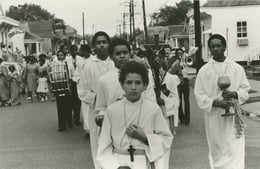
Shortly after Robert Francis Prevost was announced as the first American pope, HNOC’s Jari C. Honora uncovered a surprising New Orleans connection, revealing the pontiff’s maternal grandparents to be Creoles of color from the Seventh Ward.

Stories from 10 Years of Scavenging Attics, Porches, and Parlors
Since 2011, young scholars have spent their summers cataloging historic objects made or used in the Gulf South before 1865.

“Lost Friends” Ads Reveal the Heartbreak of Family Separation During Slavery
Messages from the past dispel the benevolent slaveholder myth.

What’s the Difference Between Cajun and Creole—Or Is There One?
The answers are tied up in race, class, language, and, of course, history.
Related News

NY Times: New Pope Has Creole Roots in New Orleans, Genealogist Says

NOLA.com: Pope Leo XIV has Roots in New Orleans’s 7th Ward

Subscribe to Our Newsletter
