







Cataloging Every Item in the Williams Residence, from Spoons to Sofas
During the renovation of 533 Royal Street, staff are working to clean and create records for all of our founders’ furnishings—some 3,000 objects in total.
By Katherine Jolliff Dunn, curatorial cataloger, and Kristin Hebert Veit, curatorial cataloger
November 18, 2025
By Katherine Jolliff Dunn, curatorial cataloger, and Kristin Hebert Veit, curatorial cataloger
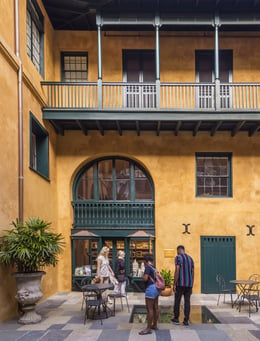
Tucked away behind a high garden wall, the townhouse at 718 Toulouse Street is mostly hidden from French Quarter foot traffic and curious eyes. But HNOC founders Kemper and Leila Williams always planned for their private home to serve a more public purpose. The couple lived there from 1946 to 1964, and in 1973 the townhouse opened as a museum, complete with the Williamses’ furnishings and personal possessions.


When the Collection’s 533 Royal Street campus, which includes the Williams Residence, closed to the public for renovations in 2023, HNOC saw an unprecedented opportunity. Here was a chance to take stock of the contents of the Residence, assess preservation needs, and get a better sense of our holdings relating to the Williamses and their day-to-day lives. The building was chock-full of the couple’s possessions; in addition to the items on display, a multitude of objects were stored behind the scenes. Even the oven was full of pots and pans! Our registration and preparation departments took on the huge task of carefully packing every item in the Residence and relocating the entire collection to off-site storage.
It was at the Collection’s storage facility that our job as catalogers began. Along with Decorative Arts Curator Lydia Blackmore and Associate Registrar Kylie Hewitt, we began creating descriptive records of each and every item in the Residence—well over 3,000 objects in total. Museum objects are generally cataloged when they come into our collection, but most of the items in the Williams Residence had never undergone such recordkeeping. We began in July 2023, starting with the Williamses’ sprawling collections of china and silver, and we're still at it. Later we will move on to cataloging glassware, textiles, and furniture. The process is predicted to take a total of five years.


Many of these objects sat in storage in the Residence for decades, so the first task is often to give them a good cleaning. This can be painstaking, dirty work that requires a variety of tools including polishing cloths, toothbrushes, and even toothpicks. Once an item is sparkling, we mark it with a unique accession number so that a given spoon, for example, can be differentiated from other, similar spoons. These marks are entirely removable and do not harm or permanently alter the objects. Then it’s time to create or update the item’s catalog record.
For most of the objects we handle, there is no existing information in our records; we're starting from scratch. We create a record in our cataloging system, Axiell Collections, that summarizes what we know about an object: its dimensions, materials, maker, date, a physical description, and any background we might have about how the Williamses acquired it.
When older cataloging information does exist, it is often incomplete or not sufficiently descriptive. For example, one old catalog record simply described a set of china as gold and white—but the Williamses owned three different sets of gold and white china, and we had no way to tell which one went with the catalog record. Our updated catalog records will include a greater level of detail, eliminating this kind of confusion for future staff and researchers.
When cataloging is complete, we photograph each object, wrap it carefully in archival tissue, and return it to storage. Then we retrieve the next box from the shelves, and the process begins again.


It’s difficult to imagine taking on a project of this magnitude without the aid of technology. Digital photography and cataloging software help us create accurate, complete records of each item with minimal lag time. And technology has been useful in researching the provenance of objects so that we can accurately describe them; with the help of online databases, Katherine has become adept at identifying silver makers’ distinguishing marks.
Watch: Williams Residence Conservation
In this behind-the-scenes video, HNOC staff polish silver from the Williams Residence to ensure the pieces remain safe and preserved during storage.
Technology also comes in handy when we encounter an item we can’t immediately identify. One pair of small objects had previously been cataloged as corncob holders, but that didn’t seem quite right based on their appearance—and we couldn’t envision Leila Williams, by all accounts an elegant and graceful hostess, eating corn off the cob! We uploaded a photo of the items to Google Lens, a visual search engine, which matched it with other photos of similar items. We discovered that our mystery objects weren’t corncob holders at all, but rather strawberry hullers.
The Williamses’ style was eclectic. Working with interior decorator Marc Antony, Leila furnished the home with objects that reflected the couple’s love of history and travel. Many objects were repurposed: a column capital became a table base, while a vase became a lamp. The result is a unique blend of the personal, the local, and the international.


The Williamses were a sociable couple, regularly hosting events and family holidays. Their extensive collections of silver, china, and glassware reflect their wealth and the high style in which they entertained. One large set of silver includes more than 167 pieces. The objects tell the story of their use in the Williamses’ everyday lives—the wear on some items suggests they were favorites that the couple used regularly. Other objects are in pristine condition, indicating that they were not as frequently used, if at all.
Kemper and Leila Williams cared deeply about preservation and worked diligently to ensure that their home and personal possessions would serve to educate the public. Our careful research and description, coupled with the physical conservation these items undergo as a part of the cataloging process, will aid museum staff in telling the story of the Williams Residence and our founders’ lives there for generations to come.
Read More
Williams Residence
Currently closed for repairs, the historic townhouse offers a window into the day-to-day life of HNOC’s founders in midcentury New Orleans.

533 Royal Street Renovation
HNOC’s flagship location will reopen in 2029 as a new attraction that tells New Orleans history through the people who lived there.

Related Stories

Preserving the Pretty
HNOC introduces a guide to preserving and displaying Black Masking Indian suits.

Identity Theft
Nearly 35 years ago, a heedless conservator altered a rare portrait of a free woman of color. Now, it has been restored and is on view again—and this time, HNOC is telling the story.
Related Books

Furnishing Louisiana: Creole and Acadian Furniture, 1735–1835
by Jack D. Holden, H. Parrott Bacot, and Cybèle T. Gontar, with Brian J. Costello and Francis J. Puig
edited by Jessica Dorman and Sarah R. Doerries

Related News

French Quarter Journal: HNOC’s Vieux Carré Digital Survey Receives A “Sporty” Redesign

Biz New Orleans: HNOC Renovates the French Quarter While Preserving History and Culture

HNOC Launches Improved Collins C. Diboll Vieux Carré Digital Survey
Subscribe to Our Newsletter
