






Black River Country
Painter Alexander John Drysdale was known for his landscapes, for which he used a technique of thinning oil paint with kerosene.
Alexander John Drysdale (1870–1934) is known for his misty, tonalist Louisiana scenes. Inspired by the state’s wetlands, Drysdale “drifted along the bayous in a boat,” according to biographer Howard A. Buechner, “a mustached figure in old clothes, puffing his pipe, and finding inspiration in Barataria, Teche, Chef Menteur, and Black River.” This demilune (half moon) painting, Black River Country, is typical of his canvases. Between 1910 and 1916 Drysdale developed the technique for which he is remembered today: thinning his oil paints with kerosene or coal oil in what he termed “a watercolor technique applied to oil.” Drysdale lined up his canvases and first painted in the sky, after which he delineated land areas with quickly rendered brushstrokes to represent swamp grasses and marsh flowers. His impressionistic landscapes frequently feature a single moss-draped oak tree, but Black River Country depicts a pair of oaks flanked by a cypress.

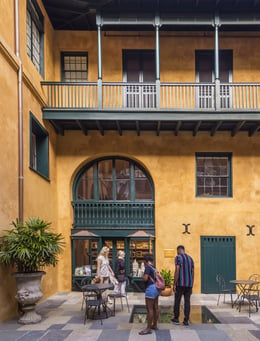
HNOC acquired Black River Country to install in a place of prominence in the Seignouret-Brulatour Building, because Drysdale has a strong connection to the painting’s new home. He was a member of the Arts and Crafts Club of New Orleans, which incorporated in 1922. Banker and philanthropist William Ratcliffe Irby, who owned the building at the time, renovated it for the club’s use as part of his commitment “to great charitable efforts and to the use of his large fortune for the benefit of his fellow citizens,” according to an obituary of the benefactor. He also purchased a number of Vieux Carré properties to save them from demolition. At the time of his death, in 1926, Irby was remodeling the upper part of the building with the intention of moving there. Among the fittings Irby installed was a $20,000 pipe organ.
Historical photographs show a landscape hanging in Irby’s organ room. Accordingly, HNOC looked to landscapes when selecting an artwork for the newly restored space, and Drysdale was chosen for his prominence among Louisiana landscape artists of Irby’s period. Black River Country belongs to a 22-painting series commissioned in 1927 for and subsequently exhibited at the D. H. Holmes Department Store on Canal Street. The installation of Drysdale’s vintage landscape in this room, made possible by the Laussat Society, is an ideal representation of Irby’s contribution to the reclamation of the historic structures of the French Quarter, particularly the Seignouret-Brulatour Building.
By Judith Bonner, senior curator
Related Stories

Who’s a Good Boy? These Pups from the Past
For as long as dogs have been domesticated, there have been dog lovers. The evidence runs throughout HNOC’s holdings.

HNOC’s Portrait Census
A census of portraits tells us who is—and isn’t—represented in HNOC’s holdings.
Related Collection Highlights


I Am the Black Woman
A rare series of 14 linocuts by Elizabeth Catlett carries her manifesto on behalf of Black American women.

Louisiana Alphabet
Lexical illustrations from the godfather of the Historic New Orleans Collection
Related Virtual Exhibitions

French Quarter Life: People and Places in the Vieux Carré
Artistic impressions of New Orleans’s most iconic neighborhood

From Cameo to Close-Up: Louisiana in Film
Explore how the picturesque scenery of Louisiana has provided the backdrop for films since the early 1900s.
Related Books


In Search of Julien Hudson: Free Artist of Color in Pre–Civil War New Orleans
edited and with an introduction by Erin M. Greenwald, with essays by William Keyse Rudolph and Patricia Brady

Subscribe to Our Newsletter
