







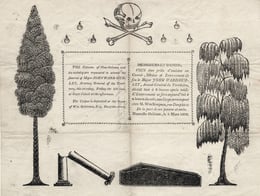
Death Notice for John Ward Gurley
One hot-headed young upstart in early 19th-century Louisiana found his way onto the dueling field, where the odds were not in his favor.
The period between the Louisiana Purchase (1803) and Louisiana statehood (1812) saw major political and social changes. The many young lawyers, legislators, educators, doctors, and engineers who moved to New Orleans from northern states to help in the transition—dubbed the “generation of 1804” by historian Eberhard Faber—were eager to find opportunity and wealth in the new American territory. Liberated from the strictures of northern society, these new arrivals indulged in the debauchery for which New Orleans has been known throughout its history. Gambling and drinking were rampant, as were fisticuffs and brawling. One of the more colorful newcomers was John Ward Gurley (1778–1808).
Gurley moved to New Orleans from Lebanon, Connecticut, in 1803. Though he hadn’t attended college, he trained for a career in law and was admitted to the bar, after which he practiced law in Boston for a short time. In 1804 he was appointed attorney general for the territory of Orleans by Governor William C. C. Claiborne, replacing Attorney General Richard Raynal Keene. Keene and Gurley had an acrimonious relationship, which they took to the dueling field, each surviving with minor injuries. Gurley then engaged in a two-year feud with prominent lawyer Edward Livingston that nearly ended in a duel. Gurley’s next disagreement was with Livingston’s cousin, Philip Livingston Jones, over Gurley’s refusal to recommend Jones to Governor Claiborne for the position of sheriff. This disagreement ended on March 3, 1808, on the dueling field where Gurley was killed. He was only 29 years old.

HNOC recently acquired a notice for Gurley’s funeral, which was printed either the same day as his death or the following day. As the funeral was the evening of March 4, just one day after his death, the notice was clearly a rush job, as evidenced by various smudges on the document. Despite that, it is a highly decorative item, adorned with a skull and crossbones, flames, a broken column, a willow tree, a cedar tree, and an open coffin: all symbols of death, rebirth, or immortality. It is also one of the earliest known examples of job printing in New Orleans—that is, printing that was provided for items such as letterhead, tickets, notices, and invoices rather than the printing of books. Unfortunately, the printer of this magnificent notice is unknown.
In a letter to Thomas Jefferson dated March 5, 1808, Claiborne said of Gurley, “The death of this excellent Citizen is by me most sincerely regreted [sic]; I found him faithful to the Government and to friendship; he possessed splendid Talents, and the best dispositions to serve his Country;—His loss to the Territory is irreparable.”
This article originally appeared in the Summer 2025 issue of The Historic New Orleans Collection Quarterly. To receive the print version of the magazine, become a member!
By Nina Bozak, curator of rare books
More from Our Holdings
Collection Highlights
Dive into the Collection’s holdings with image-rich previews of treasures from New Orleans history.

Related Stories

A Parade of Presidents
HNOC’s holdings shed light on moments when New Orleans welcomed America’s Commander-in-Chief.

Louisiana v. Voting Rights, Then and Now
With a Louisiana redistricting case on the Supreme Court’s 2025–26 docket, the Voting Rights Act is once again under scrutiny. It’s not the first time Louisiana has tested the boundaries of the franchise.
Related Collection Highlights

Robert R. Livingston’s Louisiana Purchase Letter
The coded midnight letter that foreshadowed the largest land transfer in US history
Related Books

Monumental: Oscar Dunn and His Radical Fight in Reconstruction Louisiana
by Brian K. Mitchell, Barrington S. Edwards, and Nick Weldon

Captive State: Louisiana and the Making of Mass Incarceration
by Eric Seiferth, Katherine Jolliff Dunn, and Kevin T. Harrell (curators) and Nick Weldon (editor)
Subscribe to Our Newsletter
