








The Chef Paul Prudhomme Building
Two-story brick building, originally constructed in 1834
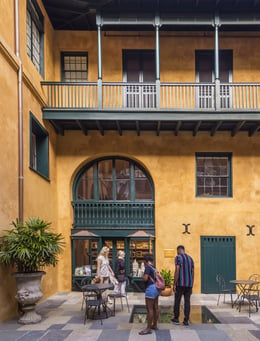
Recently acquired and renovated by HNOC to use for offices and other back-of-house spaces, the two-story commercial building combines portions of two 19th-century brick structures. Originally four stories tall, the buildings were drastically altered following hurricane damage in 1915. A renovation and reconstruction project in 1997 combined the two structures to expand the world-famous restaurant K-Paul’s Louisiana Kitchen.
Timeline
1785: Julie Brion, a free woman of color, purchases the lot and later passes the property to her daughter.
1806: Pierre Foucher purchases the property from the daughter of Julie Brion. Marie Foucher later acquires the property from her parents’ estate.
1834: Builders John Mitchell and Benjamin F. Fox construct a series of three, four-story commercial brick buildings “with granite pillars on first floor,” per a building contract, for Philippe Auguste Delachaise, husband of Marie Foucher. Two of these adjacent properties, 420 Chartres and 416–18 Chartres, are the site of the present-day structure.

1880s–1910s: The four-story buildings house a variety of commercial uses. Sanborn Fire insurance maps show a printing company, paper box manufacturing, and woodworking businesses at 416–18 Chartres. At 420 Chartres, a tire shop and storage for the J. Reiss Co. Candy and Cracker Factory are among the uses listed.
1915: The New Orleans Hurricane of 1915 causes widespread damage in the city and destroys all but the front facade of 420 Chartres, which was then a chewing gum factory. Next door, 416–18 Chartres Street suffers $1000 in damages but remains standing.
1935–36: Florence Cuccia purchases 416–18 Chartres as a two-story building. Margaret Schilling McElhiney purchases 420 Chartres, which operates as a one-story printing company.
1946–76: The Austin Inn restaurant operates from 416–18 Chartres. Photographs from 1964 show that the two-story building retains Greek Revival details from the 1834 building, including granite pillars on the first floor and lintels above the second story windows. 420 Chartres is used as a garage, remaining as a one-story remnant of the prior building.


1979: Paul Prudhomme and Kay Hinrichs open K-Paul’s Louisiana Kitchen at 416–18 Chartres to much acclaim. In the following years, Prudhomme brings Cajun cooking into the national spotlight with the popular restaurant, culinary tours, cookbooks, television shows, and a line of spice blends.
1991: An extensive renovation combines 416–18 Chartres and 420 Chartres. The facades of the historic buildings are reconstructed, and a second story is added above the one-story remnant at 420 Chartres Street. The Vieux Carré Commission honors the renovation project with a certificate of recognition.
2020: After more than 40 years in business, K-Paul’s Louisiana Kitchen closes due to the COVID-19 pandemic.
2023—2025: The Historic New Orleans Collection buys the building. Extensive renovations are made to utilize the space for the preparation department, offices, and other back-of-house spaces, while preserving the building’s historic structures and features. Staff begin relocating to the building in the fall of 2025.

December 3, 2025: At a private dedication ceremony, HNOC unveils the new name for the former K-Paul’s Louisiana Kitchen: the Chef Paul Prudhomme Building. HNOC restored the original menu box from K-Paul’s Louisiana Kitchen to house a commemorative plaque honoring the building’s rich culinary history.
About the Renovation
HNOC Names Former K-Paul’s Restaurant Building in Honor of Chef Paul Prudhomme
Further Reading
Our Buildings
HNOC’s 14 historic buildings, spread over three blocks of the French Quarter, are foundational parts of our collection. Explore illustrated timelines of their architectural histories here.

Research Tools
Vieux Carré Survey
Begun in 1960 to bolster local historic preservation efforts, the survey contains detailed property data about every building and lot in the French Quarter from the French colonial period to the present.

Related Stories

The Woman behind New Orleans’s Famous Pontalba Buildings
The Baroness de Pontalba survived gunshot wounds and left her husband in France before constructing two of New Orleans's most iconic structures.

Masonic and Odd Fellows Buildings in New Orleans
Society halls and temples have had a lasting impact on the local architectural landscape. Here’s where to find them.
Related Collection Highlights


Clarence John Laughlin Archive
Through his dreamlike black-and-white images, the surrealist Louisiana photographer explored, amplified, and commented on the mystique of the South.

Mother St. Croix Photographs of Ursuline Convent
The ebullient nun documented her cloisters, sisters, and pupils with care and skill. In doing so she became the earliest known woman to photographically record daily life in New Orleans
Related presentations
Vieux Carré Survey Case Study

Related Books


Haunter of Ruins: The Photography of Clarence John Laughlin
with essays by Jon Kukla, John H. Lawrence, Andrei Codrescu, Ellen Gilchrist, Shirley Ann Grau, Jonathan Williams, Albert Belisle Davis, and John Wood

Spanish New Orleans and the Caribbean / La Nueva Orleans y el Caribe españoles
edited by Alfred E. Lemmon
Related News

NOLA.com: This Former French Quarter Restaurant Will Now Tell New Orleans History After $6.4M Renovation

NOLA.com: Former K-Paul’s Louisiana Kitchen Gets a New Life and a New Name

Subscribe to Our Newsletter
