






Townhouse
American townhouse built ca. 1827 and fully renovated ca. 1888
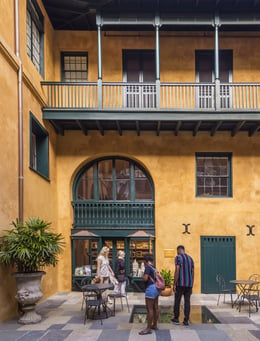
This two-story American townhouse, built ca. 1827, originally had two front archways. Renovations completed in 1888 made it a three-bay home with a side staircase and wrought-iron balcony. The building has been used as a bank, boardinghouse, brothel, gift shop, and offices.
Timeline

1827: A two-story brick building is constructed on a lot once owned by Jean François Merieult.
1829: The Consolidated Association of Planters of Louisiana (CAPL) opens on site, giving loans to stockholders who put up plantation acres and enslaved laborers as collateral.
1888: The CAPL liquidates after the Civil War. In 1888, CAPL sells the property to Antonio Augusti, a real estate investor and builder. He fully renovates the old bank building into an urban townhome suitable for a lodging house. The renovated three-bay house has a recessed entrance to a side-hall stair, nine rooms, two cisterns, gas lighting, and a new cast-iron gallery.
1890s–1910s: The renovated house is used as a boardinghouse.
1917–21: Genevieve Stewart operates a boardinghouse on the site, which is repeatedly raided by the police as a suspected brothel. In the fall of 1920, just a few months after the start of Prohibition, Miss Stewart’s is the subject of a sensationalist first-hand account of booze and prostitution published in the Times-Picayune.

1947: Leila Moore Williams purchases the property, which adjoins her new residence. The Williamses later sell the property when they move uptown.
1965–67: Preservationist Clay Shaw buys the building to restore it to use. He sells the property two days before he is indicted on charges of conspiring to assassinate President John F. Kennedy. He is later found innocent.


1980: The Kemper and Leila Williams Foundation purchases the building, rejoining the property with the historic Merieult lot and the Williamses’ other French Quarter holdings. The new offices in the townhouse become home to the first computer used at the museum.
Our Buildings
HNOC’s Architectural Treasures
Every building has stories to tell. Learn more about HNOC’s historic French Quarter properties.


Related Stories

Discovering Stained Glass in New Orleans
How a Michigan widower found inspiration in the sacred glasswork of the Crescent City.

Beyond Nottoway
The mansion at Nottoway Plantation burned to the ground, but related sites survive across the South.
Related Collection Highlights

Mother St. Croix Photographs of Ursuline Convent
The ebullient nun documented her cloisters, sisters, and pupils with care and skill. In doing so she became the earliest known woman to photographically record daily life in New Orleans


Clarence John Laughlin Archive
Through his dreamlike black-and-white images, the surrealist Louisiana photographer explored, amplified, and commented on the mystique of the South.
Related presentations
Vieux Carré Survey Case Study

Related Books


Spanish New Orleans and the Caribbean / La Nueva Orleans y el Caribe españoles
edited by Alfred E. Lemmon

Creole World: Photographs of New Orleans and the Latin Caribbean Sphere
by Richard Sexton
with essays by Jay D. Edwards and John H. Lawrence
Related News

HNOC Names Former K-Paul’s Restaurant Building in Honor of Chef Paul Prudhomme

NOLA.com: This Former French Quarter Restaurant Will Now Tell New Orleans History After $6.4M Renovation

NOLA.com Features HNOC’s Paul Prudhomme Building Among 19 Award-Winning Historic Renovation Projects
Subscribe to Our Newsletter
