







Fighting for Rights
Early Twentieth-Century Women
The national woman suffrage movement, which began in earnest in 1848 at the Seneca Falls Convention in New York, was slow to gain traction in New Orleans. The first woman suffrage organization in Louisiana, the Portia Club, was not established until almost fifty years later, in 1892. This club was soon followed by the Equal Rights Association, in 1895.
Because African American women were often excluded from white woman suffrage organizations, they founded their own groups, such as the Phillis Wheatley Club—named for the eighteenth-century enslaved African American poet and dedicated to a variety of political and social causes.
Women gained the right to vote in 1920 with the ratification of the Nineteenth Amendment. In New Orleans, groups such as the Louisiana Women’s Committee, the Independent Women’s Organization, the Woman Citizens’ Union, and the local chapter of the League of Women Voters were formed. These organizations served a variety of purposes, from encouraging voter registration and voter education to promoting certain candidates and progressive issues. In the 1930s these groups became watchdogs for public corruption and proponents of election reform.
The 1930s also saw the beginnings of the French Quarter preservation movement, and women were at the forefront. The neighborhood, which had fallen into a state of neglect, faced threats of demolition and new construction. Recognizing its historic value, preservation-minded New Orleanians began buying property and reinventing the neighborhood. Women were active in the creation of groups such as the Vieux Carré Commission; the Vieux Carré Property Owners, Residents, and Associates; and the Louisiana Landmarks Society.
Leila Moore Williams (1901–1966)

A native of New Orleans, Leila Moore Williams devoted her life to philanthropy, service to others, and the preservation of the city’s cultural heritage. She served on the boards of the Council for Social Agencies and St. Anna’s Asylum and volunteered with the Junior League. She and her husband, L. Kemper Williams, were involved in civic organizations around the city, such as the New Orleans Symphony, Christ Church Cathedral, and the Boy Scouts of America.
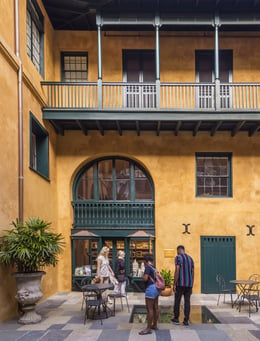
In the vanguard of French Quarter preservationists, Leila and Kemper Williams bought two properties in the neighborhood in 1938—the Merieult House on Royal Street and a late nineteenth-century residence contiguous to the Merieult House, facing Toulouse Street. After renovating both properties, the couple lived in the Toulouse Street house for the next seventeen years. During that time, they began collecting artifacts related to the history of New Orleans and Louisiana.
Recognizing the significance of their collection and French Quarter properties, the Williamses established The Historic New Orleans Collection, endowed by the Kemper and Leila Williams Foundation. In the fifty years since the death of Leila Williams, The Historic New Orleans Collection has grown into a thriving museum, research center, and publisher dedicated to preserving the history of the region and bringing it to life for the public.


Hilda Phelps Hammond (1890–1951)

Hilda Phelps Hammond’s career in politics and civil service began when Hammond served as president of the Newcomb College senior class of 1909. Newcomb College was the women’s coordinate college of Tulane University, and in her role as class president, Hammond worked with fellow notable classmates Natalie Vivian Scott and Martha Gilmore Robinson to put Newcomb on an equal standing with Tulane.
During the First World War, Hammond volunteered as the chairperson of the Louisiana Woman’s Committee of the Council of National Defense. In the 1930s, disillusioned with the corruption and power of the Huey Long political machine, Hammond helped form and served as president of the Louisiana Women’s Committee, an organization dedicated to ending Long’s control of state politics. With Hammond at the lead, the committee used radio, print, and a national letter-writing campaign, corresponding with senators and members of the national media.
Hammond’s work with the Louisiana Women’s Committee paved the way for New Orleans women to enter the political sphere. Veterans of the committee went on to form and were active in the League of Women Voters and the Independent Women’s Organization.


Martha Gilmore Robinson (1888–1981)

Known for her political activism and preservation advocacy, Martha Gilmore Robinson was a prominent civic leader in New Orleans for over fifty years. In 1909 she graduated from Newcomb College, along with notable classmates Mary Meeks Morrison and Hilda Phelps Hammond. She was a founding member of Le Petit Théâtre du Vieux Carré in 1916. She also served on the case committee for the local Child Welfare Association, which provided basic medical services to women and children in need.
Eventually she turned her attention to local politics. She served as president of the Women’s Division of the Honest Election League in 1932, and two years later, she founded the Woman Citizens’ Union, an organization dedicated to educating women on citizenship responsibilities and to promoting responsible government participation. This group later merged with the League of Women Voters, for which Robinson served as the president of the state and local chapters.
In her later years, Robinson became interested in historic preservation. She cofounded the Louisiana Landmarks Society in 1950. In the mid-1960s she served as president of the Louisiana Council for the Vieux Carré, a coalition of twenty-seven civic organizations that was formed to stop the proposed Riverfront Expressway, an elevated roadway that would have run along the riverfront in the French Quarter. In her lifetime of public service, Robinson received many honors, including the Order of the British Empire, the Times-Picayune Loving Cup, and the Louise du Pont Crowninshield Award from the National Trust for Historic Preservation.


Mary Meek Morrison (1911–1999)

A longtime resident of the French Quarter, Mary Meek Morrison was influential in both municipal politics and the twentieth-century French Quarter preservation movement. In the 1930s, Morrison joined other female volunteers in the efforts to elect Sam Jones to the governorship in 1940 and deLesseps “Chep” Morrison—the half brother of her husband, Jacob Morrison—to the mayor’s office in 1946.
Both Sam Jones and Chep Morrison were reform candidates running in opposition to the Long political machine. Women such as Mary Meek Morrison, who volunteered as a ward leader and poll watcher, were instrumental in ending voter fraud and in registering female voters during these elections.
In 1945 Morrison helped form the Independent Women’s Organization, which was dedicated to good government and increasing participation among women in politics. In the latter half of the century, Morrison turned her efforts toward the preservation of the French Quarter.
She was a founder of the Louisiana Council for the Vieux Carré and was active in the Vieux Carré Commission; in the local advocacy organization Vieux Carré Property Owners, Residents, and Associates (VCPORA); and in the Louisiana Landmarks Society. Her preservation work earned her national recognition from the National Trust for Historic Preservation.


Martha Gasquet Westfeldt (1884–1960)

Martha Gasquet Westfeldt was an artist, philanthropist, political activist, and civic leader. Her tearoom and book shop on Royal Street, the Green Shutter, was a center for arts and culture in New Orleans. It served as the temporary headquarters of the Arts and Crafts Club, of which she was a charter member. A pottery expert and collector, Westfeldt coordinated numerous exhibitions and funded pottery classes for underprivileged children. Her innovation and generosity also made possible a lending library of artworks at the New Orleans Public Library.
During the First World War, she served as a private in the New Orleans chapter of the Red Cross Ambulance and Motor Corps, transporting German prisoners of war held in Louisiana. In the 1930s, Westfeldt entered the political sphere as a leading member of the Louisiana Women’s Committee, which was organized to oppose the political corruption of the Huey Long administration.
During the Second World War, she transformed the Green Shutter into the Free French Shop, a craft and secondhand store that served as a center for fundraising and the gathering of supplies to alleviate the suffering of European civilians. An active member of the Free French and France Forever groups, Westfeldt assisted French merchant marines under the Vichy regime to defect.
Her wartime efforts on behalf of France, Belgium, and other European allies earned later recognition from France, which awarded her the Legion of Honor, and from Belgium, which awarded her the Silver Medal of the Order of the Crown.


