







Tierra Sagrada
Film Screening and Q&A
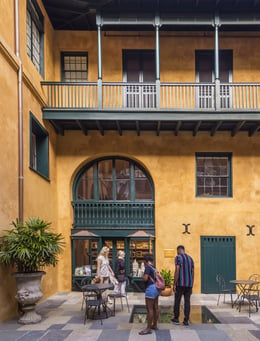
Williams Research Center, 410 Chartres Street
Free and open to the public
Amidst the hustle and bustle of French Quarter Fest, join us for a rare glimpse into the world of Cuban music and culture. HNOC is excited to present a free screening of Ned Sublette’s 2022 documentary film Tierra Sagrada (Sacred Ground). Featuring wall-to-wall music shot entirely on location, the film follows Afro-Cuban religious festivities across four intense days in January 2020, shortly before the arrival of the COVID-19 pandemic.


Tierra Sagrada takes viewers to urban house temples, lush rural groves, and public parties in and around Matanzas and Sagua La Grande—places with deep African heritage that have not been seen in most films about Cuba.
The screening is free and open to the public and will be followed by a live Q&A with filmmaker, author, and music historian Ned Sublette. Don’t miss this incredible addition to your French Quarter Fest itinerary!
Meet the Filmmaker

Ned Sublette
Ned Sublette
Ned Sublette, a former Tulane Rockefeller Humanities Fellow (2004–5) and Guggenheim Fellow, is co-author, with Constance Sublette, of The American Slave Coast (2015) and author of The Year Before the Flood (2009), The World That Made New Orleans (2008), and Cuba and Its Music (2004). In 2016 he founded Postmambo Studies, which offers music-immersion seminars at key sites in the Afro-Atlantic world. He has produced over 100 one-hour documentaries for the public radio program Afropop Worldwide, along with recordings by artists such as Los Muñequitos de Matanzas, Los Van Van, Kanda Bongo Man, Viento de Agua, and his own album Cowboy Rumba (1999). He is the songwriter of “Cowboys Are Frequently Secretly Fond of Each Other” (1981), which became a hit for Willie Nelson and Orville Peck in 2024.
Film Details
Learn more about documentary and how it was filmed through notes from filmmaker Ned Sublette.
Tierra Sagrada features wall-to-wall music with different varieties of African-descended drums, some of which have not been previously seen on film. Each scene features master drummers and charismatic singers who have devoted themselves to their extensive liturgies, functioning as spiritual technicians within their communities. The drums drive the film’s action throughout, with momentum toward the dramatic experience of spirit trance.
Oru Seco in Pueblo Nuevo, Matanzas, the opening sequence, provides background information in the form of titles, which are intercut with a rhythmically complex oru seco (a sacred batá drum cycle without voices, played facing the altar prior to the main ceremony). It takes place in the casa templo (house temple) of Ana Pérez, emeritus member of the famed group Los Muñequitos de Matanzas.
Tambor for Oggún at the Casa Templo de Berriel, Jovellanos shows a sacred drum ceremony, with intense dancing, for Oggún, the Yoruba orisha of iron and war. It takes place in the casa templo of 82-year-old Israel Berriel’s family. Berriel, who appears in this sequence and whose trance cuts it short, was well known in Cuba as the akpwon, or sacred-music vocalist, with Los Muñequitos de Matanzas. He died 10 months after filming.
Song for Iroko in Carlos Rojas
To the north of Jovellanos is the town of Carlos Rojas. Once called Cimarrones, its ceiba trees are associated with spirit and could hide self-emancipated formerly enslaved people in their hollow trunks. Ceiba trees are sacred and must not be cut down. Iroko, an orisha in the Yoruba tradition, lives in these trees, which are festooned with kerchiefs and with a female spirit figure in the form of a doll, to whom homage is given. The song may be unique to this community; no other version of it seems to exist.
Tambor for Oyá at the Casa Templo de Omo Layé, Barrio La Marina, Matanzas
Shot at Omo Layé, the female-directed cabildo (religious organization) that is one of the most venerable in Matanzas, this is the longest scene in the film, at 18 minutes. It depicts the interplay of drumming and spiritual energy like nothing else on film, anywhere.
Día de Reyes Procession in Barrio La Marina, Matanzas
This tour de force of active street photography by New Orleans’s Lily Keber follows from the previous scene. After the ceremony at Omo Layé, the drummers and singers moved out into the street for a magnificent parade evoking the 19th-century Día de Reyes festivities. In slavery days, Día de Reyes (Epiphany, Jan. 6) was historically the day that Black Cubans took to the streets in ancestral regalia. In Matanzas, the tradition restarted in the 21st century. You’ve never seen a street procession like this, featuring high-energy student dancers of a community project that teaches traditional dance at a 100% real level: Barrio La Marina’s La Rumba Soy Yo Academia de Baile, a project associated with Los Muñequitos de Matanzas.
Tambor at the Casa Templo of the Echarte Family, Coralillo
Photographed in a sacred grove in rural Cuba, as the sun goes down, this scene shows a rural family playing their variety of African-descended drum, together with what Sublette calls “a Congo style of singing Yoruba music.” A dramatic spirit possession cuts the segment off.
Palo Songs in the Barrio San Juan, Sagua La Grande
Palo, meaning stick, or wood, refers to the Congo-descended Cuban religion. It’s a different practice, with different music, from the Yoruba practice whose music opens the film. Congo music is intensely repetitive. It has a strongly marked beat, often with a thump that has been adapted and simplified in the world’s popular music today. We’ve come a long way from the complex polyrhythm with which the film began.
Palo Yaya
“I’m a rumbera / Since I was in my mother’s womb.” The final credits sequence features a song of Cuban lore composed by Matanzas songwriter Francisco Domínguez. The only non-ceremonial piece in the film, it was a throwaway end-of-night jam in Matanzas that began with the oru seco that opened the film. It features three generations of women, including Ana Pérez, Yuriem García Pérez, and 15-year old Kilma Alfonso on conga.
Events in Cuba produced by Caridad Diez for Rumbaways
Director of Photography: Lily Keber
Recorded during a Postmambo Music Seminar, January 2020.
Executive Producer: Ned Sublette for Postmambo Films
© (p) 2020, 2026
Support
This film screening is presented in partnership with Postmambo Studies.

Related Programs
Syncopated Siblings: The Music of Cuba and New Orleans

Related Stories

’Tis the Season . . . for Louisiana Holiday Music
From jazz to bounce, funk to klezmer, these songs add local flavor to the holidays.

Promoting Tipitina’s in Its Raucous Early Years
Through unusual posters and interviews with two of Tipitina’s co-founders, we take a look back at the club's early years.
Related Collection Highlights

Leigh “Little Queenie” Harris Collection
A new collection documents the career of a “little” woman who made a big impact on New Orleans music.

Vintage Tipitina’s Posters
HNOC cataloger Emily Perkins picks her favorites from the Tipitina’s posters in the Michael P. Smith Collection.

Les lys et les roses
A bound volume of eight pieces for piano and voice sheds light on the role of women in New Orleans’s 19th-century music scene.
Related Virtual Exhibitions

Shout, Sister, Shout!: The Boswell Sisters of New Orleans
Explore the musical legacy of New Orleans’s own Boswell Sisters, who where among the first stars of radio’s golden age.

New Orleans Medley: Sounds of the City
The music of New Orleans is the living product of dynamic cultural interactions played out over centuries in this diverse southern port city.
Related Books

Ernie K-Doe: The R&B Emperor of New Orleans
by Ben Sandmel
with a foreword by Peter Guralnick

French Baroque Music of New Orleans
edited by Alfred E. Lemmon
with essays in English by Jennifer Gipson, Andrew Justice, Alfred E. Lemmon, and Mark McKnight, and in French by Jean Duron
Subscribe to Our Newsletter
