





“My God, Mr. Dixon! That would be the greatest building in the history of mankind, and we’ll build that sucker.”

How the Superdome Became a Louisiana Landmark
Nathaniel Curtis Jr. designed the stadium to be a modern counterpart to the great domes of the world.
By Molly Reid Cleaver, senior editor
January 30, 2025
By Molly Reid Cleaver, senior editor
On August 3, 1975, the Louisiana Superdome opened to the public after nine years of development, delays, anticipation, and controversy. Enormous and eye-catching, it stood as the largest indoor arena in the world—see the 1975 Guinness Book of World Records—and signaled the transformation of New Orleans’s economy toward tourism and hospitality.
Nathaniel “Buster” Curtis Jr., partner in the New Orleans firm Curtis and Davis, was the Superdome’s lead architect. His papers, held at HNOC, tell the story of how it became an irreplaceable part of the New Orleans skyline.

The Idea
The Superdome was the brainchild of entrepreneur and sports promoter Dave Dixon. In the 1950s, then-Mayor Chep Morrison had created a Major League Sports Committee for the purpose of attracting a pro franchise to build tourism and economic activity. Baseball was what Morrison had in mind, but Dixon convinced him that pro football was America’s sport of the future.
When the Houston Astrodome opened in 1964, it was hailed as the “eighth wonder of the world.” Dixon and others took notice. Here was a way to introduce New Orleans as a sports destination: by building an even bigger domed stadium. Dixon took his idea to the newly elected Governor John McKeithen.
“I pitched him the idea that this would be a chance for Louisiana to pass Houston,” Dixon said, speaking to scholar Matthew B. Hinton in 2008. “He bought it immediately. He said, ‘My God, Mr. Dixon! That would be the greatest building in the history of mankind, and we’ll build that sucker.’”

Dixon was not only the Superdome’s booster-in-chief; he also led the effort to get New Orleans an NFL franchise, resulting in the November 1966 birth of the New Orleans Saints.
On November 8, 1966, the project officially began via constitutional amendment, when voters overwhelmingly approved the creation of the Louisiana Stadium and Exposition District (LSED). Dixon was appointed its executive director. The amendment allocated funding for the stadium through a 4 percent tax on hotel and motel rooms, and early estimates placed the project’s budget at $35 million. That number would multiply more than fourfold over the next nine years, resulting in public outcry, a state intervention, and a final price tag of $163 million.
But it was all worth it, boosters maintained. The LSED declared it “the most important project of the century for Louisiana.”

The City
By the time construction began in mid-1971, New Orleans was in the middle of a transformation that would reshape the city for decades to come. The dominance of the port as an economic anchor had been waning for years. Containerization, introduced in the mid-1950s, was quickly becoming the new norm, but the City That Care Forgot was slow to catch up. The Port of New Orleans debuted its first container terminal in 1973, but the new technology required far fewer workers. The age of longshoremen was out, and the city needed new jobs. The manufacturing sector was in decline, not only in New Orleans but across the country.
“City and state leaders . . . chose to pursue a service-based industry, i.e. tourism, to fill this void,” Higgins writes in “A House Divided: The Evolution of the Louisiana Superdome from a Divisive Concept into a Symbol of New Orleans and the Surrounding Areas.” “The Superdome was the prime symbol of the movement towards a service-based industry.”
During the 1940s and ’50s, preservationists had worked to enshrine New Orleans’s historic architecture and traditional jazz music, with great success. The city’s distinctive culture, ripe for harvesting and repackaging to a global audience, would soon become the engine for the new “cultural economy.”
“The Superdome was the prime symbol of the movement towards a service-based industry.”
While the architectural-preservation movement focused largely on the French Quarter, city officials of the mid-’60s were eager to bring the rest of the central downtown area into the 20th century. The city was largely without tall structures, save for the Hennen Building (built in 1895) and the Hibernia Bank Building (1921). While the Superdome wound its way toward completion, skyscrapers flowered nearby: The International Trade Mart (now known as the World Trade Center), was erected 1964–67 and was soon joined by the Plaza Tower and the Hyatt Regency. The Dome would rival them all.

The Architect
Nathaniel Curtis Jr. (1917–1997), known to friends and colleagues as Buster, was born into the world of design. His father, Nathaniel Curtis Sr. (1881–1951), cofounded the Tulane School of Architecture and later worked at the firm Goldstein, Parham, and Labouisse.
Curtis the younger graduated from Tulane in 1940, with change in the air. “Preparations for World War II were being felt,” he writes in Dear Children, a self-published memoir he produced for his family. He joined the Navy Reserve under its commissioned-officer training program, populated by “a relatively small, elite, closely knit group of well-educated and dedicated men.” After his service, he completed a master’s program in architecture at Harvard University under the GI Bill. The next year, in 1947, he started his own firm with fellow Tulane grad Arthur Q. Davis. It was a partnership that would last over 30 years.

This spread from a promotional booklet shows the many cooks in the Dome’s design-build kitchen. Curtis is seen in the bottom second-to-left image.
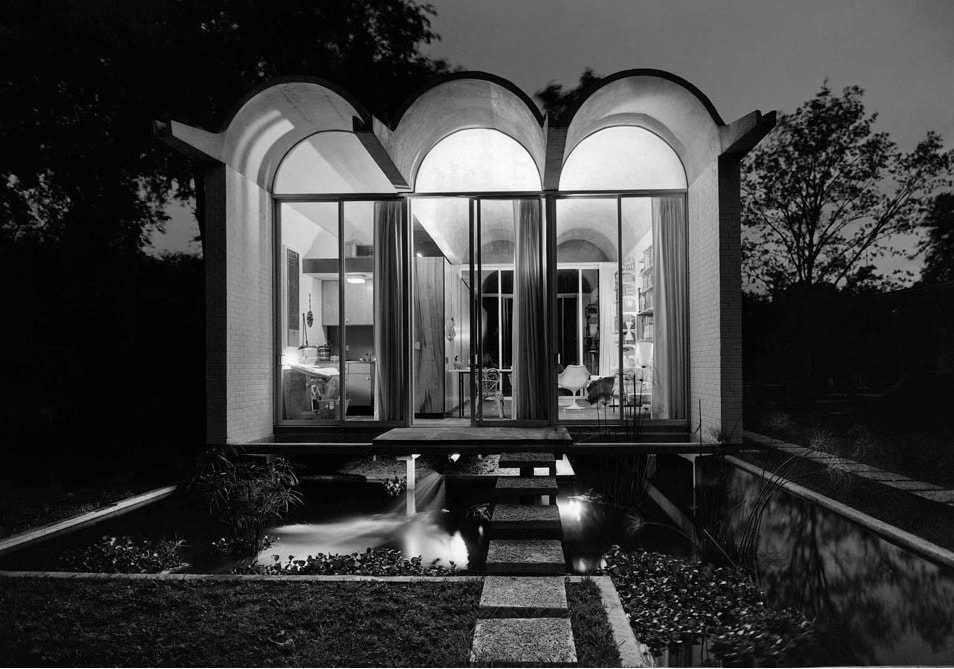
Curtis and Davis were adherents of modernism, and they quickly made their mark by adapting the clean lines and geometric shapes of the Bauhaus to suit New Orleans’s hot climate, incorporating time-tested vernacular features such as cross-ventilation, galleries, and courtyards. The firm designed roughly 400 structures in New Orleans and around the world, including the Automotive Life Insurance Building (which stands today as the Mid-City branch of New Orleans Public Library), the James V. Forrestal Building in Washington, D. C., countless residences, and the ain’t-dere-no-more Rivergate Convention Center.
Governor McKeithen named Curtis project director for the design of the new domed stadium soon after the creation of the LSED, and Curtis led a team of architects and engineers that would bring the Dome to life.
Despite the long-term success of the Superdome and the general renown Curtis earned as an architect, he and Davis maintained frosty relations after the dissolution of their partnership. Repeatedly, Curtis and his allies (including Dixon, Mayor Moon Landrieu, and others) accused Davis of taking credit for the Superdome, when in fact he had very little to do with its design except in name only (the firm, after all, was called Curtis and Davis). During much of the Superdome’s construction, Davis was the lead architect on a hospital project in West Berlin.

The Dome
The Superdome’s namesake, its curved, clear-span roof, was and remains a feat of structural engineering. Measuring 680 feet in diameter and comprising 9.7 acres of surface area, the Dome’s dome is made possible by its steel substructure. A “crown block” at the top serves as the center of a radial matrix of circular “ribs” and crossbeams. Supporting the weight of this structure is the all-important tension ring, made of 24 prefabricated steel sections that were welded together in place. Roof Structures Inc. was the principal subcontractor in its design, and for construction, Curtis and the LSED entrusted the job to the American Bridge Division of US Steel Corp.

Curtis explained the significance of the Dome’s tension ring in a 1976 publication, The Louisiana Superdome: “This ring, capable of withstanding the massive thrusts of the dome structure, is made of 1-1/2-inch-thick steel and prefabricated in 24 sections that were welded together 169 feet in the air. Because the strength of the welds is critical to the strength of the tension ring, they were performed by a specially trained and qualified welder in the semicontrolled atmosphere of a tent house, which was moved around the rim of the building from one weld to another. Each individual weld was X-rayed to ensure the perfection of the vital joints. On June 12, 1973, the entire roof, weighing 5,000 tons, was jacked down onto the tension ring in one of the most delicate and critical operations of the whole construction process.”
The attention to detail in the dome’s design and construction has paid off over the years: The winds of Hurricane Katrina only ripped off part of the roof’s cladding, and the structure held up under the weight of 8 to 10 inches of snow during the unprecedented winter storm of 2025. (A quick calculation yields a conservative estimate of 10,400 cubic yards of snow on the roof, weighing approximately 2,800 tons.)

The Opening
The LSED faced opposition early and often as costs ballooned. By 1969, contractors had yet to break ground, but the budget had reached a projected $93.5 million. When Governor McKeithen promised additional state funds to finance the shortfall from the hotel-motel tax, an outcry ensued. Three state legislators, led by John G. Schwegmann, of the Schwegmann Brothers grocery store chain, took the LSED to civil court over the matter. The case made its way to the Louisiana Supreme Court, with a narrow majority ruling in favor of the LSED in 1969.
Once construction began, though, the train left the station, and there was no stopping it, not subcontractor drama, construction delays, ever-rising costs, or allegations of financial mismanagement.
The LSED circulated newsletters showing the project’s progress and tantalizing readers with bells and whistles, from the “Giant Screen Television” rig suspended above the field to the gargantuan air conditioning system. The building had a capacity of 80,000—75,187 seats, plus standing room.


Finally, on August 3, 1975, the Superdome opened to much ballyhoo, with the Saints’ first home Dome game three days later. (They lost, to the Houston Oilers.) The LSED continued to attract controversy: The stadium’s operating expenses greatly outweighed revenue, and it lost millions of dollars in its first few years.
Moreover, the Dome was a testing ground for a newly desegregated populace. As Hinton discusses in his thesis, there were reports of “rude and inefficient” service workers. “A ‘spit guard’ was installed between the mid-level and lower-level seats in response to complaints from patrons that they were being spat on by youths in upper-level seating sections,” he writes.

Despite all this, there was the building itself, elegant and undeniable. According to a New Orleans magazine feature, the world-renowned modernist sculptor Isamu Noguchi visited the city to see the Dome for himself. He declared, “It is the greatest piece of sculpture I have ever seen. After this, we sculptors can quit.”
Ultimately, the dual juggernauts of the NFL and tourism assured the Superdome’s place in history and in the hearts of New Orleanians. Today, the Superdome and the Saints form one of the city’s biggest pieces of common ground across race and class. Super Bowl LIX will be the Dome’s eighth time hosting pro football’s biggest game, more than any other stadium.
As Curtis wrote in 1975, “The Louisiana Superdome, which had begun as an awe-inspiring dream, had become an even more awe-inspiring reality.”
Thanks to HNOC Manuscripts Cataloger Michael M. Redmann for his assistance with the research for this article.
Exhibitions
Championship Memories
February 7 to February 10, 2025
In celebration of Super Bowl LIX, HNOC is excited to host a limited-time display of Saints championship memorabilia.

Related Stories

First Draft
Before the Superdome, There Was Tulane Stadium
The venue played host to Tulane Green Wave games, the New Orleans Saints’s first few seasons, and three Super Bowls.

Related News

HNOC in the News
WVUE-TV: Fourth Annual HNOC Chess Fest Brings Family Fun to the TEP Center
October 29, 2025
Returning November 1, the free event brings together chess lovers of all ages and skill levels and celebrates game’s rich New Orleans history.

HNOC in the News
WWL-TV: Celebrating 50 Years of the New Orleans Superdome
August 5, 2025
HNOC senior editor Nick Weldon joined “Great Day Louisiana” to explain the history and engineering mastery behind one of America’s most iconic football stadiums.

HNOC in the News
WGNO: A Look Back at New Orleans Super Bowl History
February 9, 2025
WGNO’s Christopher Leach interviewed HNOC editor Nick Weldon about the Super Bowl’s New Orleans beginnings in Tulane Stadium.
Related Books


FIRST DRAFT NEWSLETTER
New Orleans Stories,
Delivered to Your Inbox
