







The Big Freezy
Sweltering New Orleans played a pivotal role in the history of man-made ice.
By Kelton Sears, editor
August 13, 2026
By Kelton Sears, editor
Dr. John Gorrie died anxious, humiliated, and debt-ridden in his Florida Panhandle home on June 29, 1855. He had just returned from one of many frustrating visits to New Orleans, where, for the better part of seven years, he desperately and unsuccessfully courted investors for his strange new invention: an “artificial” ice machine. Chilly public reception and a string of bad luck drove him to a nervous breakdown, culminating in a sudden illness that claimed his life when he was 51 years old. Shortly before his death, he wrote that his ice machine “had been found in advance of the wants of the country.”
The frigid treatment his invention received had completely thawed by May 18, 1868, when the Louisiana Ice Manufacturing Company, the world’s first industrial ice-making plant, held its grand opening ceremony on the New Orleans riverfront at Tchoupitoulas and Delachaise Streets. According to the New-Orleans Times, one of the 150 guests raised a toast to “the change it had effected upon the Mississippi, and of the astonishment the [river] must feel at being suddenly frozen up at this point.” Gorrie’s vision for an icy New Orleans proved prophetic, as the city became one of the epicenters of a new industry that reshaped not just the Gulf South but modern civilization.

During the first half of the 19th century, if you needed ice and lived in the perennially warm regions of the American South, India, China, Europe, or the Caribbean, you were at the mercy of the “Ice King,” Boston’s Frederic Tudor. The Tudor Ice Company was one of the first multinational American businesses, launched in February 1806 to public ridicule thanks to its bizarre premise. Tudor harvested free ice from New England’s lakes, put it on a schooner, and shipped it for sale wherever ice didn’t naturally occur. “No joke,” the Boston Gazette reported of his first shipment. “A vessel with a cargo of 80 tons of ice has cleared out from this port for Martinique. We hope this will not prove to be a slippery speculation.”
To start, it was extremely slippery, landing Tudor in debtor’s prison several times. Residents of Martinique had no idea what to do with his first shipment ice, didn’t want to buy it, and had nowhere to store it even if they did. His first shipment to New Orleans in 1826 went even worse. The mayor, Count Louis Philippe de Roffignac, “thought ice was dangerous to the health of people inhabiting so warm a clime and dumped the first cargo into the river,” according to the Times-Picayune. Ironically, the Roffignac, a New Orleans iced cocktail, was invented around 50 years later and named in the mayor’s honor.
Over time, the Ice King’s business solidified into a global success. By the 1840s, New Orleans and other hot metropolises around the world were erecting large, insulated “ice houses” to store and distribute Tudor ice, a product that earned the nickname “white gold.” Costing today’s equivalent of $30 a pound during the summer, when unreliable supply coincided with high demand, ice became a luxury many Southerners desired but only the rich could regularly afford.

Dr. John Gorrie of Apalachicola, Florida, was one of Tudor’s many customers, but he wasn’t using the ice to chill his drinks. In 1841, he rigged up a contraption to soothe the waves of malaria and yellow fever patients overwhelming his hospital—the first air conditioner. A bedpan with a small hole was filled with ice and hung from the ceiling. Hot air rose, then flowed back down through the hole as it was cooled, lowering the temperature of the room. Gorrie became transfixed by the medical potential of cooled air, but he couldn’t afford the ice he needed to scale up his experiments. So, he decided to try and make it himself. It took three years, but by 1844, he had a slow, hand-cranked prototype for an ice-making machine, taking advantage of the cooling effect produced by rapidly compressing and expanding air—the same trick that powers modern refrigerators.
Thrilled, he left his medical practice to pursue full-time development in 1845. He began writing extensively about the machine in newspapers, but the pushback he received was so intense, he started assuming a pen name. The Bombay Times and Journal of Commerce said his invention was a “cock-and-bull story,” and some even framed it as a religious affront, including an author at the New York Globe who wrote, “There is a crank down in Apalachicola, Florida, that thinks he can make ice by his machine as good as God Almighty.” Biographer Vivian Sherlock wrote that shortly before his death, Gorrie suspected Tudor was behind the smear campaign, recognizing the threat artificial ice posed to the import business.

Undeterred, Gorrie took a steamboat from New Orleans to Ohio in 1848 to have an improved model of his ice machine professionally built at the Cincinnati Iron Works. He had it disassembled and shipped back to New Orleans, the financial capital of the South, where he returned frequently to court investors until his death. Unfortunately, Gorrie wrote that “defects of mechanical contrivance and unskilled workmanship” made the machine’s reassembly in New Orleans rocky and its operation unreliable.
He persisted, and on May 6, 1851, US Patent No. 8080 was awarded to “John Gorrie, of New Orleans, Louisiana” for the "artificial production of ice,” the first machine of its kind in the country. That same year, Gorrie’s chief financial backer in New Orleans unexpectedly died, dealing a critical blow to his finances and morale. After continued negative press scared away other potential investors, Gorrie died with today’s equivalent of $200,000 in debt.

Despite Gorrie’s attempts, the Civil War is what finally precipitated New Orleans’s historic first in ice. When war broke out in 1861, Northern ice imports were cut off a week later by the Anaconda Plan, the Union blockade of Confederate ports—accelerating efforts towards an independent Southern ice industry. In 1859, Ferdinand Carré of France patented a more advanced, ammonia-based ice making machine, and by 1863, a firm founded by two fellow Frenchmen from New Orleans, Mathieu Jules Bujac and Camille Girardey, had a pair of small Carré machines run through the Union blockade.
Bujac and Girardey furnished one of them to a Confederate military hospital in Augusta, Georgia, where the ice was used to treat fever, echoing Gorrie’s original intentions. The other was kept in New Orleans, where Bujac and Girardey began experimenting with industrial production at the corner of Orange and Tchoupitoulas Streets, eventually importing three larger machines as well. “It is a mistake to call this artificial ice. It is real ice made by artificial means,” the Times-Picayune wrote of a summer visit to their test facility in July 1864. “This was ice made with the thermometer at 93 in the shade.”

Due to limitations in Carré’s design, the duo found at-scale production difficult. When the war ended in 1865, engineer and former Confederate Daniel Holden purchased Bujac and Girardey’s machine in Augusta, had it shipped to San Antonio, and developed two critical improvements. A steam coil replaced a boiler, heating up the ammonia more efficiently, and distilled water was used for the first time, making the final product not only drinkable, but clear—a first for artificial ice. Suddenly, muddy Mississippi River water could be transformed into sparkling, sanitary ice blocks.
Holden wrote that Bujac declared it “the most complete ice machine ever erected.” Bujac and Girardey had six 10-ton Carré machines built in Gretna under Holden’s supervision, and in 1868, the units made their historic debut powering the new Louisiana Ice Manufacturing Company, the world’s first industrial ice-making plant.


Desperately in need of new industry after the war, the Reconstruction-era South rejoiced. Cities across the region replicated the New Orleans model in the decades that followed. After dominating for most of the century, Northern ice imports were gradually made obsolete by manufacturing. An 1872 Times-Picayune article described New Orleans’s massive appetite for ice, with the city purchasing roughly 45 to 50 tons a day during the winter and 160 to 175 tons the rest of the year. Ice cream saloons alone accounted for up to 3,500 pounds a day, with hotels, soda fountains, restaurants, and bars right behind them.
But the largest patrons of New Orleans ice companies, the article noted, were “the wagons, which take from one to five tons per day each for resale to retail customers.” Hauling massive ice blocks in their horse-drawn wagons (and, later, trucks), icemen were a regular sight in the streets of New Orleans. Children often followed them through the city begging for ice chips, stealing small chunks from the wagon while icemen weren’t looking. Thanks to the muddy footprints and puddles icemen left after chipping blocks to fit in customers’ iceboxes, housewives typically timed their mopping with deliveries.


In a city famous for graft, the ice companies made a mess as well. Angry customers and icemen rallied against the new Citizens’ Ice Company in 1902, a spuriously named entity derisively called the “Ice Trust” by opponents. “Grip of the Ice Trust, Fastening About Throats of the People,” blared a New Orleans States headline. Combining one-third of the city’s manufacturers under their centrally managed delivery service, Citizens pitched better prices by cutting out the middlemen. Customers claimed they were actually manipulating supply, fixing prices, and trying to drive independent manufacturers and icemen out of business. Though they were never successfully prosecuted, in 1950, an association of 13 ice manufacturers operating as the New Orleans Ice Delivery Corporation received a federal antitrust indictment for practices closely mirroring Citizens’ alleged misdeeds.

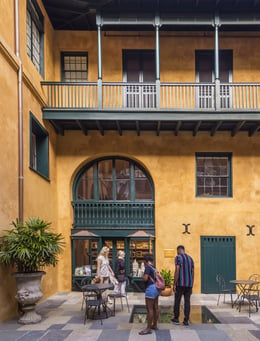
Possibly in reaction to those kinds of practices, ice manufacturing models in New Orleans greatly diversified by 1910, including icemen-owned plants, co-ops run by ice-dependent interests like butchers, and small adjunct operations at breweries. By 1937, New Orleans was home to 49 ice manufacturing plants, employing between 1,500 and 2,000 people. One of which, Pelican Ice, lays claim as the world’s oldest continuously operated ice company, still running today in Kenner. Another, Cosmopolitan Ice Co., occupied a French Quarter building at 537 Chartres Street now owned by the Historic New Orleans Collection.
Man-made ice transformed the region, enabling the Gulf seafood industry’s expansion beyond the coast, shaping New Orleans’s iconic cocktail culture, and linking new Northern markets to fresh Ponchatoula strawberries and other refrigerated produce. That legacy gave rise to another historic New Orleans invention as well: Ernest Hansen’s 1934 Sno-Bliz, the first electric block ice-shaving machine, used to create the original sno-ball.
More on HNOC’s Icehouse

More On Technology & Innovation

How the Gulf Coast Boosted the First Men to the Moon
America’s journey to the moon passed through Louisiana and Mississippi.

Daniel F. Galouye’s Fantastic Sci-Fi Future
Long before Black Mirror and Severance, science fiction magazines were a potent way to channel modern anxieties into entertainment media. One New Orleans writer became a leading world builder of weirdness.
Related Collection Highlights

Space Shuttle Model
A model rocket serves as a memento of New Orleans’s role in US space exploration.

Dr. Tichenor’s Bottle Label
Still sold today, the sharp New Orleans tonic has its roots in the Civil War.

Braughn Family Photomontage
A dramatic composite photograph depicts a prominent New Orleans family in high style.
Related Books


Charting Louisiana: Five Hundred Years of Maps
edited by Alfred E. Lemmon, John T. Magill, and Jason Wiese; consulting editor, John R. Hébert
New Orleans Stories,
Delivered to Your Inbox
