







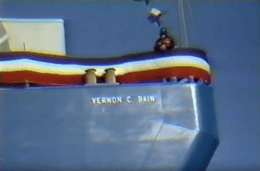
Vernon C. Bain Christening Ceremony Video
When New York City’s war on drugs sent incarceration rates soaring, officials commissioned a floating jail built and christened downriver from New Orleans.
The use of maritime jails and prisons dates to at least the mid-18th century, when the British converted unseaworthy hulks into internment spaces for prisoners of war. In the United States, such vessels primarily functioned in peacetime as a low-cost alternative for relieving overcrowded civilian jails and prisons, most significantly in New York City during the crack epidemic of the 1980s. To deal with soaring incarceration rates, the city converted two Staten Island ferries and two British navy barracks barges into floating carceral facilities, providing the New York City Department of Correction over 1,000 additional beds. Then-Mayor Edward Koch saw the decision as a workaround to avoid building more jails and prisons in heavily populated neighborhoods.

Despite declining incarceration rates by the decade’s end, the city subsequently ordered another, even larger vessel, announcing in March 1989 that it had awarded the $125 million contract for its construction to Louisiana’s Avondale Industries shipyard. This video documents the christening of the Vernon C. Bain, held at the Avondale shipyard on January 8, 1992. The donation of the video was facilitated by visual artist Sean Vegezzi. The recording opens with a shot of the event’s program overlaid with woodwinds and brass playing “America the Beautiful,” followed by “Dixie.” After introductions by Avondale Corporate Vice President René P. Meric, remarks from New York City Department of Correction Assistant Commissioner John Shanahan precede an intense moment where the hulking facility is lowered into the Mississippi River to be towed the 1,800 nautical miles to its new home.
When the five-story, 47,326-ton barge arrived in New York Harbor later that month, it was $35 million over budget and 18 months overdue. Named for a late Rikers Island warden, the Vernon C. Bain was moored in the East River off Hunts Point in the South Bronx. The ship’s facilities included a chapel, library, dining hall, and clinic as well as a caged outdoor recreational area on its top deck. At 625 feet long and 125 feet wide, it contained dormitories for 700 people and 100 cells. Dubbed the “Louisiana Purchase” by one local, the massive blue-and-white prison barge was quickly considered an unsightly financial boondoggle.
The ship closed briefly in 1995 before reopening as a juvenile detention center, then finally as a standard intake and processing facility for adults. A sobering landmark of New York City’s role in the era of mass incarceration, the Vernon C. Bain remained the United States’s last prison ship when it closed permanently in November 2023.
By Kevin T. Harrell, collections cataloger
More From Our Holdings
Collection Highlights
Dive into the Collection’s holdings with image-rich previews of treasures from New Orleans history.

Related Stories

Poets Respond to “Captive State” in Verse
Nine Louisiana poets visited the landmark exhibition on the history of incarceration and created original work based on their experiences.

Death on Display
Louisiana’s travelling electric chair, and the shift from public to private executions
Related Collection Highlights

The Mysterious Axman’s Jazz
At the turn of the 20th century, a music-loving serial killer proclaimed that only jazz lovers would be safe from his reign of terror.
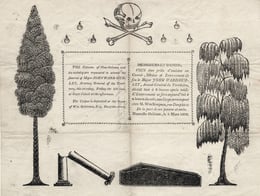
Death Notice for John Ward Gurley
One hot-headed young upstart in early 19th-century Louisiana found his way onto the dueling field, where the odds were not in his favor.
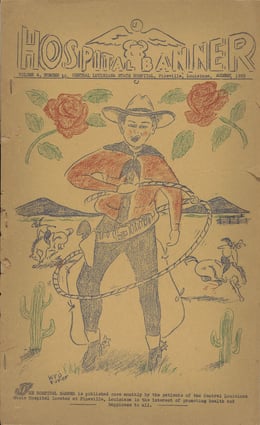
Hospital Banner Newsletters
An unusual periodical, written and produced by residents of the state mental hospital in the mid-20th century
Related Exhibitions
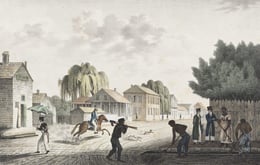
Captive State: Louisiana and the Making of Mass Incarceration
Learn how the institutions of slavery and mass incarceration are historically linked, and how these connections have made Louisiana the world leader in incarceration today.
Related News
Innocence Project New Orleans to Honor HNOC with John Thompson Award for Courage & Justice
In NOLA.com Guest Column, HNOC Historian Discusses “Captive State” As Public History Project

HNOC Announces Extension of Exhibition Examining Incarceration in Louisiana
Subscribe to Our Newsletter
