







Death on Display
Louisiana’s travelling electric chair, and the shift from public to private executions
By Jacqui Shine, guest contributor
December 3, 2025
By Jacqui Shine, guest contributor
Louisiana’s electric chair now sits on display at the Louisiana Prison Museum and Cultural Center at Angola Correctional Facility, where it appears much as reporter Mac Crary described it in 1950:
Square, and built of heavy pieces of oak, with the great straps lying along the arms, and about the legs like the tentacles of an octopus. The cup-shaped cap hung over the back. It stood there on its heavy insulating mat of rubber, waiting. . . . To the left stood the electrical control panel, and it too seemed to be waiting, almost holding its breath in anticipation.

“Gruesome Gertie,” as the chair is nicknamed, hasn’t been used in an execution since 1991, and hasn’t moved since the 1950s, but it once traveled throughout the state. In fact, public display has played a key role in the chair’s history—and in the history of capital punishment in Louisiana.
CAPITAL PUNISHMENT IN EARLY LOUISIANA
In the British colonial era in North America and in the early years of the United States, executions by hanging were public events, held in town squares during daylight hours and attended by people of diverse social standing. They were, historian Louis Masur has written, spectacles both civil and religious, the condemned dead emblems of the state’s power, of the sinner’s fate, and of the futility of crime.
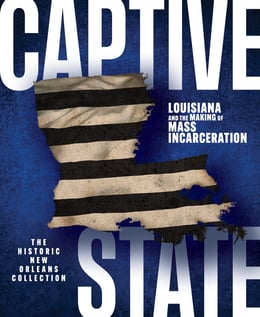
They could also be raucous and disorderly. As explored in HNOC’s new book Captive State: Louisiana and the Making of Mass Incarceration, the same was true in colonial Louisiana. In the colony’s French and Spanish eras, capital punishment upheld and reinforced political and racial hierarchy, and executions were public and brutal by design.
From 1769 until 1805 (the year Louisiana’s public legal system was aligned with English common law), Louisiana followed a condensed collection of Spanish laws known as the Code O’Reilly. Named for Alejandro O’Reilly (a.k.a. “Bloody O’Reilly”), the Spanish governor who established it, the code contained a rubric for capital punishment: death by burning, decapitation, hanging, or dragging by animals. After 1805, the Acts of Louisiana mandated hanging as the sole method of execution for capital crimes.

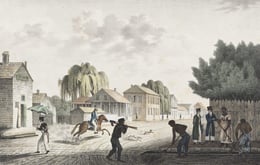
The 1862 hanging of William Bruce Mumford was ordered by Union Army Major General Benjamin Butler. Butler’s decision to execute Mumford publicly at the New Orleans Mint, “according to the Spanish custom,” was a nod to customs established under Governor O’Reilly.
 Captive State: Louisiana and the Making of Mass Incarceration
A NEW ERA IN CAPITAL PUNISHMENT
Botched hangings were common nationwide, and, beginning in the late 19th century, reform advocates began searching for alternatives. These activists were not only concerned with ensuring humane treatment of the condemned. They also wanted to protect audiences from the grisly realities of hangings gone wrong, including accidental decapitation.
Partly because of public curiosity around the introduction of electricity in the 1880s, electrocution struck many people as a more “scientific” mode of state execution. It seemed a more humane and rational way to punish a person convicted of a capital offense such as murder and less likely to go awry. In 1890, just before the State of New York put William Kemmler to death in the nation’s first-ever execution by electric chair, one journalistOpens in new tab hailed “a new era in capital punishment,” in which “the condemned may pass away without affording a spectacle at once unscientific and revolting.” Invented by dentist Alfred P. Southwick, the device resembled a dentist’s chair, its appearance offering an added veneer of medical authority.

Electrocution did not, however, prove humane. (Nor has any other method of state execution, for that matter.) Kemmler’s execution was botched:Opens in new tab He survived the first round of charge, and, during the second, his body briefly caught fire, part of a scene so horrible that the New York Times headlined its story “Far Worse Than Hanging.” Three years later, William G. Taylor also survived the first round of electrocution in New York’s chair. The charge had been strong enough to blow the generator, which had to be repaired before he could be shocked again.
These disastrous early incidents did little to harm the method’s popularity. In 1891, New York physicians who witnessed four deaths by electrocution on one day told newspaper reporters that the deaths “in every instance [were] absolutely painless and instantaneous” and that the execution scenes “reminded [one] of a little family party as they sat in the room together.” Botched electrocutions were often framed in the media as individual and unfortunate accidents, not challenges to the state’s punishment prerogative.

A PARTICULARLY SOUTHERN WAY TO PUNISH
The adoption of electrocution across the United States was a key factor in moving executions out of public view. When New York, the first state to officially designate electrocution its chosen method of execution, did so in 1888, it was at the advice of a legislative committee that noted that “the place for its infliction may be strictly private.” The resulting law turned the privacy option into a mandate, requiring that execution be performed “within the walls of the State prison,” with access limited to a handful of sheriffs and deputies—and, eventually, journalists. When Southern states began adopting the electric chair in the early 1900s, they typically also centralized executions because of the chair’s technical requirements.
While the adoption of electrocution was couched in humanitarian terms in much of the country, historian Michael Ayers Trotti argues that Southern discourse differed. Southern lawmakers’ chief problem with public executions, Trotti writes, was not their prurience but that they exceeded white control: Black spectators could and did transform public executions into the sanctifying rituals and disruptive expressions of power that characterized church services. When Ruben Cately and Hyppolite Brown were executed in New Iberia, Louisiana, in 1900, they were allowed to speak at length: asking forgiveness, giving it, commending themselves to God, all while engaged with their audience. Cately’s father called to him from the crowd, and Black spectators applauded when they finished speaking. Privatizing executions was a way of extending Jim Crow, eliminating “African American authority from the South’s public life,” Trotti writes.
Southern commentators complained that such crowds took the terror out of state execution. Hangings, their gruesome potential notwithstanding, were not rough enough. Where Northern progressives had embraced the rational science of the electric chair, Southern commentators stressed its mystification: Conducted privately by electrocution, state execution regained its “appalling mystery,” its “solemn, awe-inspiring terror.” For Southerners, execution by electrocution was, as one Atlanta Constitution reporter put it in an 1893 article, “a secret, silent monster” by a method that would “best yield terror.”
It was for these reasons, Trotti suggests, that electrocution “became a particularly Southern way to punish.”


LOUISIANA GOES ELECTRIC
It took some time for Louisiana lawmakers to embrace the change from hanging to electrocution; the idea was brought before the state legislature several times over the years.
In May 1934, after news reports of two brutally “bungled” hangings in Jefferson Parish, two Louisiana legislators introduced bills to end hangings, adopt electrocution, and move all executions to a central location. The proposition received broad support—but only after some debate over where to locate the chair. Louisiana House representatives “frankly said they did not want to put it in the middle of their districts,” and during committee debate, the Shreveport Times reported, “a portable chair was proposed, to be moved from one parish seat to another as needed.”
The legislators settled instead on a permanent location at a prison farm in Iberville Parish. Governor Oscar Allen ultimately vetoed the bill—with “considerable regret” —though it’s not clear why he rejected it. The centralization would have taken execution out of the hands of parish sheriffs, so it is possible that local opposition to the loss of control played a role in the veto.
The solution imagined by the Louisiana legislation in 1934 became reality in March 1940, when Mississippi passed a law adopting electrocution and decreeing that executions would be conducted with a portable electric chair that could be transported to any part of the state. A few months later, in June, Louisiana followed suit.
But it wasn’t clear to lawmakers in either state where they would get traveling electric chairs. States sourced their non-portable electric chairs in different ways: Some hired local electrical engineering firms to construct them, while others left the task to their own prison inmates. The nation’s involvement in World War II made it difficult to find manufacturers who weren’t already loaded down with wartime defense contracts.
In Louisiana, the unusual need produced an unusual object: a free-standing electric chair that connected to a gas-engine generator built into the back of a pickup truck.
TAKING THE SHOW ON THE ROAD
Built by a New Orleans firm at a cost of $5,000 (over $100,000 today), Louisiana’s portable electric chair was to be carried into a parish courthouse, where its cables would be run out a window and connected to the generator. It would be operated by a state executioner and an Angola “electrician,” usually a “trusty,” a title given to incarcerated individuals who had been granted increased responsibilities. One 1942 story reported that the local sheriff would retain “the privilege if he so desires of throwing the switch.”
By the time Louisiana got its mobile chair, state executions were held privately, but part of the appeal of the traveling electric chair might have been the possibility that they would again become public events—specifically, local public events.
Louisiana had remained committed to the practice of county-level executions long after other states abandoned it, experimenting only briefly with centralization, from 1911 to 1918. Legislators voted to move executions back to the parishes because they believed local presence was essential for the procedure to have a deterrent effect—and because on-site executions upset the men incarcerated there, adding to their punishment.
In Louisiana (and elsewhere in the US), the public communal witness of state killing served not merely as a deterrent to crime but as a way to reinforce white supremacy. While public execution had never been limited to Black Louisianians—“Bloody” O’Reilly got his nicknameOpens in new tab in part for publicly executing French colonists who rebelled against Spanish rule—the state-sanctioned killing of Black people was more common and much more brutal. Take, for example, the public trials and executions of enslaved rebels after the 1811 German Coast Rebellion. Three convicted participants were publicly hanged in Jackson Square. Their heads, along with the heads and mutilated bodies of other rebels who’d been summarily executed or died during the uprising, were displayed on pikes along the levee as warning to others.
Local public execution enforced the racial order and implicitly sanctioned the extrajudicial killings designed to do the same. Festive lynching scenes closely resembled public state executions.

Artist Elizabeth Catlett depicted lynching in one of the 14 linocut prints she created for the series I Am the Black Woman. The series celebrates the strength and accomplishments of her people, as well as their trials.
LYNCHINGS BY ANOTHER NAME
Louisiana’s first execution by electrocution, which took place in the town of Springville in Livingston Parish in 1941, had much the feeling of a lynching—or, perhaps, a lynching averted. An Associated Press story reported that the condemned individual, a Black man named Eugene Johnson convicted of murder, had to be “kept in jails away from the parish for months because of popular feeling” and was only brought to the parish seat on the morning of the execution.
This “popular feeling” was only one factor in fanning local curiosity. There hadn’t been an execution in Livingston Parish since 1896, newspapers reported, and the parish wasn’t even electrified yet. Springville’s population was only about 30, but a reportedly convivial and chatty crowd of more than 400 people gathered outside the jail that morning. Though the law limited witnesses to about a dozen, 40 crowded into and around the jail cell where Johnson was executed.
Within two years, Louisiana law enforcement began to complain that these on-the-go executions were, in fact, too much like lynchings. The novelty of the chair was part of the problem: The sight of the generator truck on a courthouse lawn, the thick cables that snaked up through windows into the building, the whine and roar of the generator humming, and then roaring at the time of death—everything about the device attracted attention. In rural parishes, as one Mississippi paperOpens in new tab later put it, “executions now result in more or less ‘Roman holidays’ in the county-seat cities where they are held. The signal for the festivities has been the arrival of the truck carrying the portable chair,” which invariably brought curious crowds and, in some cases, inspired approved witnesses to sell their seats to the highest bidders.
Shortly after an especially public pair of executions in Caddo Parish, the state’s Police Jury Association and Sheriffs’ Association both called on legislators to move all executions to the state penitentiary, citing the “sordid morbidity of people over these executions.” Dozens of people had begged local officials to witness the executions, held just days apart, flooding the courthouse and nearly pushing witnesses out of the execution chamber. Many parents brought their children with them to see the electric chair. These were, the Caddo Parish clerk said, “no more than ‘semi-public legal lynchings.’”

THE STATE EXECUTIONER
The portable electrocution device itself posed practical difficulties. Without a home base for executions, the state relied on traveling or local labor to put the chair to use. The state’s official executioner arrived in town the day before a scheduled punishment, usually joined by at least one correctional officer from Angola, where the device was stored. An electrician installed the chair, usually in a jail cell or courthouse, and connected it to the generator built into the pickup truck that delivered it. The local sheriff was tasked with escorting the condemned, and a local coroner attended to witness and declare death.
It was an imperfect system, with much room for misstep. In the infamous case of Willie Francis, sentenced to death for murder at age 16, the official executioner, Grady Jarret, was replaced by Angola prison guard Ephie Foster. There was no electrician. Inexperienced and inebriated, Foster botched the execution. Francis was badly burned but did not die. A second attempt the following year was successful. He was pronounced dead in the electric chair on May 9, 1947. A similarly inept execution was performed in 1950 in St. Martin Parish: Clarence Joseph Jr. was electrocuted three times before he died.
BACK TO ANGOLA
By 1956, the appetite for public spectacle had faded. The Louisiana legislature passed a bill to hold all electrocutions at Angola and to ensure that “every execution shall be made in a room entirely cut off from view of all except those permitted by law.” The chair was installed next to the notorious Red Hat building—notorious for being the most restrictive housing unit at Angola, and for the inhumane treatment endured by the men who lived there—with the generator stationed outside and cables run in through a window. The state executed another 30 men by electrocution there before adopting lethal injection in 1993.
The State of Louisiana still puts people to death, carrying out its first execution in 15 years on March 18, 2025. That day it introduced yet another new form of capital punishment, using nitrogen hypoxia to execute Jessie Dean Hoffman Jr. By law, the punishment was carried out privately.
Related Stories

Poets Respond to “Captive State” in Verse
Nine Louisiana poets visited the landmark exhibition on the history of incarceration and created original work based on their experiences.
Inside Angola’s Prison Newspaper, the ‘Angolite’
John Corley, associate editor at Louisiana State Penitentiary, discusses the history and operations of the award-winning periodical.
Related Collection Highlights

“Vernon C. Bain” Christening Ceremony Video
When New York City’s war on drugs sent incarceration rates soaring, officials commissioned a floating jail built and christened downriver from New Orleans.

The Mysterious Axman’s Jazz
At the turn of the 20th century, a music-loving serial killer proclaimed that only jazz lovers would be safe from his reign of terror.
Death Notice for John Ward Gurley
One hot-headed young upstart in early 19th-century Louisiana found his way onto the dueling field, where the odds were not in his favor.
Related Exhibitions
Captive State: Louisiana and the Making of Mass Incarceration
Learn how the institutions of slavery and mass incarceration are historically linked, and how these connections have made Louisiana the world leader in incarceration today.
Related News

WWL-TV: Inside a New Exhibit on Mass Incarceration

Forbes: HNOC Explores Human Tragedy of Mass Incarceration in Louisiana

“Captive State” Named Museum Exhibition of the Year by Louisiana Endowment for the Humanities
Subscribe to Our Newsletter
