






Luster’s photographs not only helped incarcerated people connect with their families; her method also gave subjects a chance to collaborate creatively, providing a measure of control and self-expression in a setting that rendered them largely powerless and invisible to the outside world.

Processing Hope and Loss in the Prison Portraits of “One Big Self”
Deborah Luster’s portrait series, taken inside prisons across Louisiana, confronts viewers with the human lives at stake in the incarceration capital of the world.
By Catie Sampson, cataloger
January 23, 2025
By Catie Sampson, cataloger
Standing before a newly constructed plywood coffin, an aged man squints at the camera with a crucifix held loosely at his side.
A woman’s outstretched arm shows the tattooed portrait of a sister lost to gun violence.
Near the edge of a cotton field, a young Black man shoulders a voluminous cloth sack, his fist closed around a handful of bolls.
The faces gaze back at viewers from metal plates, rendered in an exaggerated warm tonality that feels at odds with the reality of the subjects depicted. All are incarcerated in prisons across Louisiana and represented in Deborah Luster’s long-term project One Big Self: Prisoners of Louisiana.

Related Exhibition
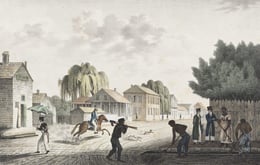 Captive State: Louisiana and the Making of Mass Incarceration
July 19, 2024 to February 16, 2025
In 1998 Deborah Luster, with a group of other photographers, was invited to create documentary work in the northeastern parishes of Louisiana to accompany an application for an Empowerment Zone grant, given by a federal program designed to stimulate the economies of historically impoverished rural and urban regions. During her first visit to the area, Luster met the warden of the minimum-security East Carroll Parish Prison Farm in Transylvania, Louisiana, and was given permission to photograph some of the people incarcerated there. As she developed these early images in her darkroom, Luster felt drawn to reveal more of the faces hidden among the overwhelming population of incarcerated persons within the Louisiana prison system.
The project resonated with Luster on a deeper level. A decade earlier, Luster’s mother was murdered in her home by a hired gunman. Although justice was served and a man ultimately convicted of the crime, it was through photography that Luster found a way to navigate her grief and process the loss of her mother.
Over the next four years, Luster continued to visit East Carroll Parish Prison Farm, eventually gaining access to take portraits at the Louisiana Correctional Institute for Women and the maximum-security Louisiana State Penitentiary, known as Angola. Luster would enter these spaces with little more than her camera and a black velvet backdrop. Sometimes she would be accompanied by her longtime collaborator, poet C. D. Wright, who would observe while Luster made her photographs. Luster worked quickly but thoughtfully, making portraits of as many subjects as possible to illustrate the enormity Louisiana’s incarcerated population. As the project continued, she would bring wallet-size copies of portraits she’d made on previous visits to share with the sitters. These little photographs would be traded around, sent to children and other loved ones—some of them incarcerated themselves.


Over time, Luster began experimenting with different ways of presenting the images, shifting from prints to enlarging negatives onto sheets of photosensitized blackened aluminum to facilitate handling by viewers. “When you hold a photograph, it changes everything,” Luster says. The resulting images evoke the qualities of 19th-century tintype photographs, the first form of mass portraiture available to everyday Americans.
In addition to providing a novel form of material culture, tintypes circulated as keepsakes during the upheaval of the second half of the 19th century, when the Civil War and the Industrial Revolution drastically altered the fabric of the nation. As New York gallerist and curator Steven Kasher writes in his book America and the Tintype, “Tintypes acted as salves for the disruptions of the era. Social conditions were pulling families apart: war, migration, railways, distant schooling, distant jobs, long days at the factory. Pictures could ameliorate separations.” Luster, too, felt the power of these photographs to connect across divides—both for the families of the incarcerated and in engaging with society at large.
In a 2015 interviewOpens in new tab with the San Francisco Museum of Modern Art, Luster recalled a conversation she had with a woman at the Louisiana Correctional Institute for Women in St. Gabriel who hadn’t seen her children in 15 years. She expressed hope that sending her portrait home might encourage them to visit, and within a few months she had reconnected with four of her children. Reflecting on the story, Luster said, “I just imagine that there are other functions that these photographs fill. . . .That really is what this project is all about.”


Luster’s photographs not only helped incarcerated people connect with their families; her method also gave subjects a chance to collaborate creatively, providing a measure of control and self-expression in a setting that rendered them largely powerless and invisible to the outside world. This was a complicated aspect of the project, as there exists an inarguable power dynamic between photographer and subject. This imbalance was underscored by the nature of Luster’s access to these spaces and the confinement of her sitters—a white artist working in a system that disproportionately affects people of color.
Drawing upon the conventions of early tintypes, Luster’s photographs offer the formal qualities of studio portraiture while inviting sitters to reveal (or obscure) aspects of their identities beyond their incarcerated status. Luster invited each sitter to select props, clothing and costumery, and accessories meaningful to them. On the verso of the metal plates are inscribed details volunteered by each individual—nicknames, work roles, length of sentences, and at times their number of children.
“We are all creatures of chance and choice,” Luster writes in the introduction to the One Big Self catalog, published by Twin Palms in 2003. “I chose to photograph each person as they presented their very own selves before my camera on the chance that I might be fortunate enough to contact, as poet Jack Gilbert writes, ‘their hearts in their marvelous cases.’ I took my chances. I wanted this to be as collaborative an enterprise as possible.”
Luster returned to the same three prisons over the next few years, bringing around 25,000 wallet-sized prints to the subjects represented in One Big Self. The project culminated in 250 4x5-inch photographic plates, and Luster reproduced the series in three cabinet editions, each housed in a steel cabinet—a poetic nod to the containment of prison architecture, and an invitation for the viewer break the barrier between the outside and the human lives depicted within. HNOC acquired one of the sets in 2023 to include in the exhibition Captive State: The Making of Mass Incarceration in LouisianaOpens in new tab.
Much thought went into the presentation of the images as part of Captive State—how to preserve the photographs as physical objects while enabling the interactivity the artist intended. The exhibition team, working with the photography department, organized the reproduction of Luster’s original plates on an aluminum substrate. Preparators placed the reproductions in the drawers of Luster’s original steel cabinet, allowing viewers to file through hundreds of portraits and interact one-on-one with the photographs and the people depicted.


The originals hang on the gallery wall next to the cabinet. Clustered in a large grid, the visual impact of their totality reinforces the magnitude of the incarcerated population in the state of Louisiana, centering the often-obscured faces of those impacted by our prison system.
“These photographs belong to the eyes of the free world viewer—citizen, voter, gallery goer, broker of social policy,” Luster writes in the catalog intro. “They are intended to serve as a reminder of the thin blue line traced by societal and telluric forces that contribute so often to our personal fortunes. They belong equally to the eyes of the photographed in their own universe of family and friends, intended as evidence of life, presented here, as André Breton has written, not only as faces to be examined but also ‘as oracles to be questioned.’”


Related Books
Books
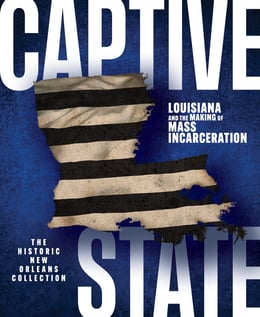
Captive State: Louisiana and the Making of Mass Incarceration
by Eric Seiferth, Katherine Jolliff Dunn, and Kevin T. Harrell (curators) and Nick Weldon (editor)
Related Exhibitions
Exhibitions
Captive State: Louisiana and the Making of Mass Incarceration
July 19, 2024 to February 16, 2025
Learn how the institutions of slavery and mass incarceration are historically linked, and how these connections have made Louisiana the world leader in incarceration today.
Related Stories
First Draft
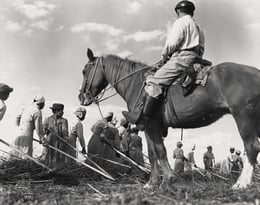
A Long Arc of Injustice
Once the hub of the domestic slave trade, Louisiana now leads the world in incarceration, with Black people disproportionately affected. HNOC’s exhibition Captive State traces the roots of this inequity all the way back to the founding of the state.
First Draft
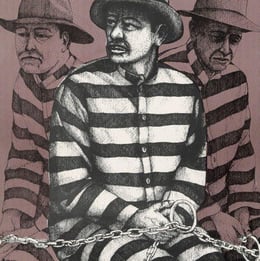
Inside Angola’s Prison Newspaper, the ‘Angolite’
John Corley, associate editor at Louisiana State Penitentiary, discusses the history and operations of the award-winning periodical.
Related Collection Highlights
“Vernon C. Bain” Christening Ceremony Video
When New York City’s war on drugs sent incarceration rates soaring, officials commissioned a floating jail built and christened downriver from New Orleans.
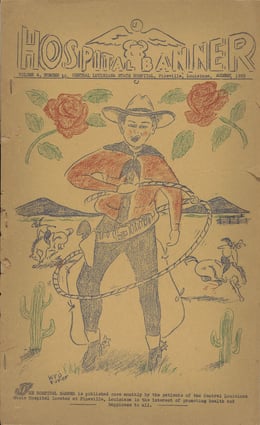
Hospital Banner Newsletters
An unusual periodical, written and produced by residents of the state mental hospital in the mid-20th century
Related News
Announcement
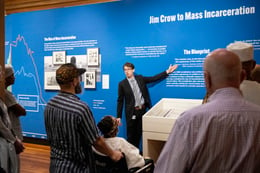
“Captive State” Book: Upcoming Local and Regional Literary Events
September 17, 2025
Explore opportunities to learn more about HNOC’s latest publication at upcoming community events.

Announcement
HNOC Book “Captive State” Receives Southeastern Museum Conference Publication Award
August 12, 2026
The 2025 publication was awarded Second Place (Silver) by the SEMC Publications Competitions jury.
HNOC in the News
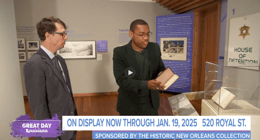
WWL-TV: Inside a New Exhibit on Mass Incarceration
October 25, 2024
WWL-TV's Great Day Louisiana visited HNOC's new exhibition about the history of mass incarceration in Louisiana.
FIRST DRAFT NEWSLETTER
New Orleans Stories,
Delivered to Your Inbox
