







A Long Arc of Injustice
Once the hub of the domestic slave trade, Louisiana now leads the world in incarceration, with Black people disproportionately affected. HNOC’s exhibition Captive State traces the roots of this inequity all the way back to the founding of the state.
By Nick Weldon, editor
July 18, 2024
By Nick Weldon, editor
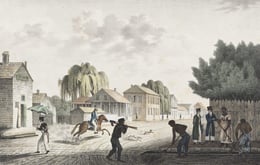 Captive State: Louisiana and the Making of Mass Incarceration
When Curtis Davis arrived as a prisoner at the Louisiana State Penitentiary in 1992, he was sent directly to the fields. He picked cotton and fruit on a plantation property that has operated continuously with forced labor for nearly 200 years. Until his release in 2016, Davis never made more than 20 cents an hour for any of his labor. He spoke about his experience in a video interview, produced by the Promise of Justice Initiative, that is featured in the new exhibition Captive State: Louisiana and the Making of Mass Incarceration.
“Slavery has never been abolished in these United States of America,” Davis says. “It has been codified into law through the 13th Amendment and the Louisiana Constitution.”
Davis articulated the central thesis of Captive State: that the institutions of slavery and mass incarceration are historically linked. The 13th Amendment enshrined this connection in the US Constitution in 1865, by abolishing slavery “except as punishment for crime whereof the party shall have been duly convicted.” Once the hub of the domestic slave trade, Louisiana now leads the world in incarceration, with Black people disproportionately affected. Captive State traces the roots of this inequity all the way back to the founding of the state.
“Since Louisiana’s colonial era, those in power have used the law to control, punish, and exploit others,” said Eric Seiferth, the exhibition’s curator. “Captive State documents how slavery and incarceration were mutually reinforcing in ways that have had long-term impacts on people in this state, particularly Black Louisianians.”

Two landmark legal documents anchor its narrative. The first is the Code noir (above), a set of laws issued by the French crown in 1724 that regulated the status, treatment, and behavior of enslaved and free Black people. The other document is the original Louisiana Constitution of 1898. Thomas J. Semmes, a leader at the 1898 constitutional convention, made clear that “our mission was, in the first place, to establish the supremacy of the white race in this State.” Among other things, this constitution codified forced convict labor into state law.
Davis’s story is one of many featured in Captive State that convey the human consequences of these laws throughout the state’s history. Visitors hear about Peggy, an enslaved woman found guilty of killing another enslaved woman, and see the 13.5-pound iron ball and chain that she wore for three years as punishment. There’s the story of Cezar, an enslaved man in New Orleans who confessed to crimes after being tortured and was sentenced to a brutal public execution. They also view a letter written by Rufus Kinsman, a free Black sailor who described the “hell” of being jailed, whipped, and forced to work on a chain gang after being falsely arrested as a fugitive slave.

Colonial governments carried out torture and executions in the public square to make examples of the condemned, but during the 1800s, the primary sites of incarceration moved further from the city center and public view into a network of segregated facilities. Louisiana began leasing out its prisoners for their labor in 1844. After the abolition of slavery in 1865, this system of convict leasing became the state’s primary method for extracting cheap labor from a largely Black population. A map on display illustrates the brutal era of the convict lease, during which thousands of state prisoners died in custody.
The 1898 state constitution marked a turning point for incarceration in Louisiana. In addition to codifying forced convict labor, it ended convict leasing, returning custody of prisoners to the state. Three years after its passage, the state purchased the plantations owned by the last convict lessee and turned them into the new Louisiana State Penitentiary, which became known as Angola, after one of the plantations. Critically, the constitution also reduced the requirements for felony convictions in trials, requiring only 9 of 12 jurors, rather than a unanimous verdict, to send a defendant to places like Angola. The split-jury law led to more guilty pleas and verdicts, supplying a steady stream of prisoners to the state.
“Louisiana’s 1898 constitution made racist Jim Crow practices the legal foundation of the state and had a direct impact on the rise of mass incarceration decades later,” Seiferth says.
In the gallery, a large data graphic depicting incarceration rates over the last century shows the overwhelming extent to which Louisiana has come to lead the US in locking up its citizens. The trendline locally and nationally is punctuated by exponential growth in the latter half of the 20th century. With split-jury verdicts long entrenched as state law, legislators in the 1970s and subsequent decades began adding a litany of new “tough-on-crime” penalties that sent more Louisianians to prison for longer terms with fewer opportunities for parole than ever before.

Photographs on display convey the notorious reputation Angola continued to carry into the 20th century. A time-lapse animation shows the build-up of the Orleans Parish jail complex at Tulane Avenue and Broad Street. Three-dimensional objects, including a bed, commode, and jail intake materials, bring the realities of the contemporary jail experience to the fore.
Throughout, human stories underscore the interpretation. Davis’s testimonial video is one of 10 that display in the gallery. Visitors can view 250 photographic portraits of people incarcerated at Louisiana prisons, taken by artist Deborah Luster for her piece One Big Self: Prisoners of Louisiana. The second-floor gallery is dedicated to Lori Waselchuk’s Grace Before Dying photographic series, which documents the hospice program at the Louisiana State Penitentiary. Hospice program volunteers Steven Garner and Gary Tyler were the lead artists behind two quilts that welcome visitors at the second- and third-floor gallery entrances.

The exhibition concludes with the story of the 2018 amendment approved by Louisiana voters that finally abolished the nonunanimous jury provisions of the 1898 constitution. Visitors then exit through a gallery designed for engagement and reflection. A 90-minute tour titled “Piecing It Together: A Captive State Tour and Conversation” finishes in this space and offers visitors an opportunity to engage more deeply in the subject matter. At its core, Captive State encourages visitors to contemplate our shared responsibilities in this system—and our shared humanity.
“I just pray that people can realize that there are everyday people behind these walls who love, who get sad, who hurt, who are happy, who have dreams,” says Daryl Waters, the subject of a featured testimonial. “You can lock us up, but you can’t stop us from being human beings.”
Related Books
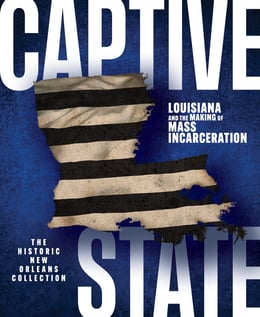
Captive State: Louisiana and the Making of Mass Incarceration
by Eric Seiferth, Katherine Jolliff Dunn, and Kevin T. Harrell (curators) and Nick Weldon (editor)
Related Exhibitions
Captive State: Louisiana and the Making of Mass Incarceration
Learn how the institutions of slavery and mass incarceration are historically linked, and how these connections have made Louisiana the world leader in incarceration today.
Related Stories

Poets Respond to “Captive State” in Verse
Nine Louisiana poets visited the landmark exhibition on the history of incarceration and created original work based on their experiences.

Death on Display
Louisiana’s travelling electric chair, and the shift from public to private executions
Related Collection Highlights

“Vernon C. Bain” Christening Ceremony Video
When New York City’s war on drugs sent incarceration rates soaring, officials commissioned a floating jail built and christened downriver from New Orleans.
Hospital Banner Newsletters
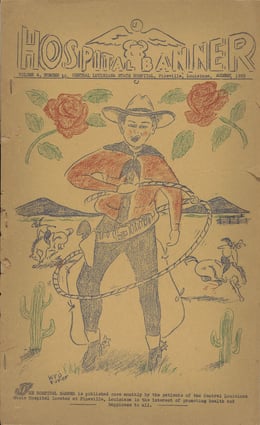
An unusual periodical, written and produced by residents of the state mental hospital in the mid-20th century
Related News

“Captive State” Named Museum Exhibition of the Year by Louisiana Endowment for the Humanities

WGNO: Video Explores HNOC’s New “Captive State” Book
HNOC Announces Extension of Exhibition Examining Incarceration in Louisiana
Subscribe to Our Newsletter
